
On this page
- Three different things get sold as winter driving lessons
- What your beginner course already covered, and what it skipped
- What each one costs
- The cheapest winter lesson might be one you already paid for
- What you actually practise on an ice pad
- When to book, and why the window is shorter than it looks
- Which one to book, by where you are right now
- What a winter course won't get you
- Questions parents and new drivers ask
Three different things get sold as winter driving lessons
Search for winter driving lessons and three completely different products come back wearing one name. One is an hour in a car with an instructor, on real roads, in real slush. One is a video course you finish at the kitchen table in an evening. One is half a day on a frozen pad where somebody tells you to lose control on purpose. They cost different money, they teach different things, and one of them might already be paid for.
A regular lesson, booked when the roads are bad
This is the plain version, and for most new drivers it's the right one. You book an in-car hour with a licensed instructor, for a morning when the roads are bad, on purpose. SafePass Driving School in Ontario publishes the clearest rate we found: 45-minute sessions at $50 each, HST waived, or folded into your BDE in-car hours at no extra cost.
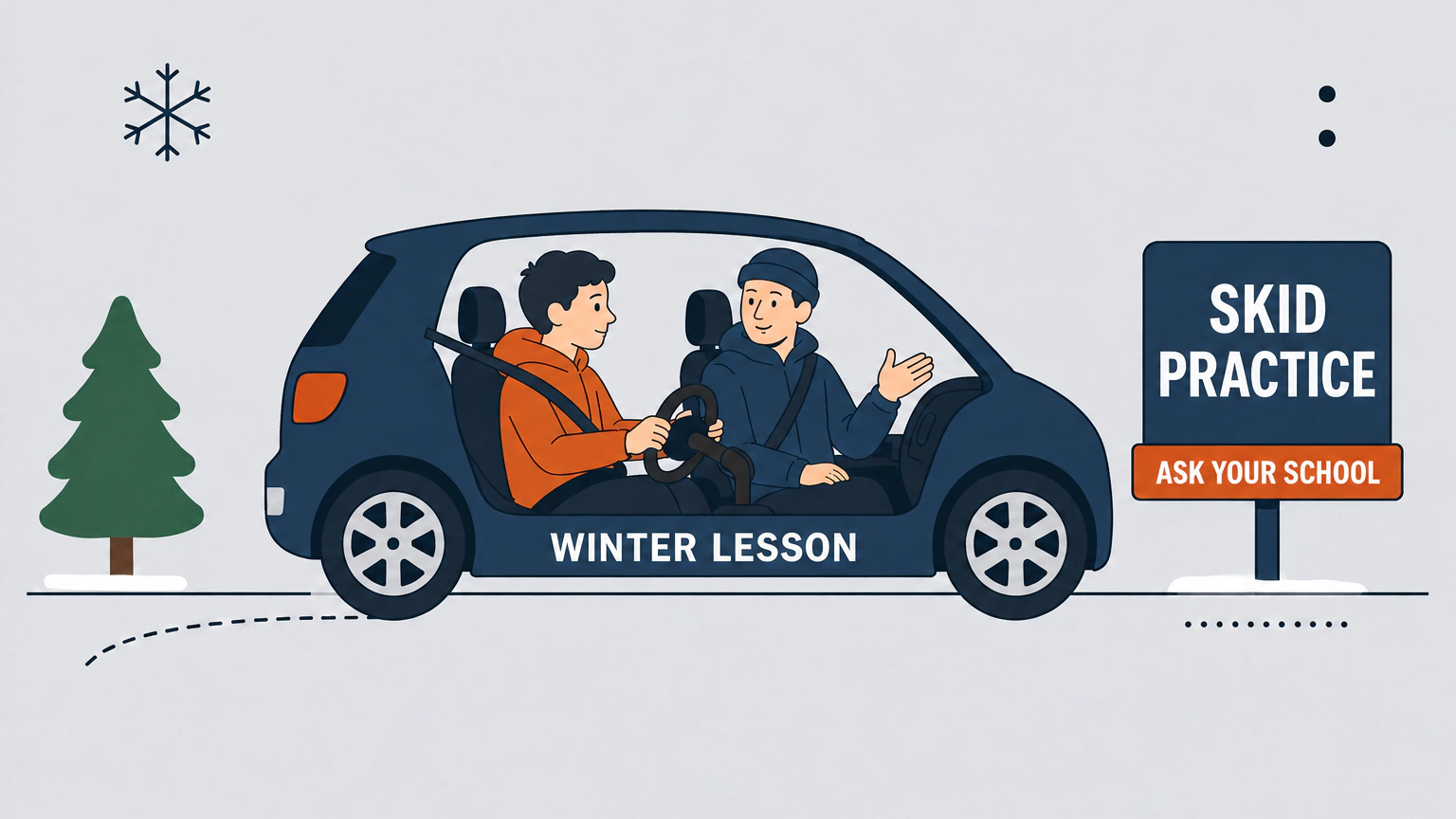
What you're buying is your own commute. The hill on your street, the intersection you dread, the lot behind the school that never gets plowed, with somebody beside you who has driven it a thousand times. What you can't buy is a skid. No instructor will let you spin a car on a public road, and none should. If you're starting from scratch, start with driving schools in Calgary and driving schools in Edmonton.
An online course you take at the kitchen table
No car, no instructor, no snow. You watch, you answer questions, and that's the course. TrainAndDevelop.ca sells one for $59.99 with an average completion time of an hour and a certificate at the end. The Saskatchewan Safety Council charges $75 for the online half alone, and that one runs two to three hours.
The content is real, and it's the cheap half of the good stuff: eye-lead time, black ice, what happens when a wheel locks, how speed changes your stopping distance. A screen teaches all of that perfectly well. What a screen can't teach is what your hands should do when the back of the car steps out. That's a reflex, and reflexes come from doing.
Half a day on a closed ice pad
This is the one people picture when they hear winter driving school, and it's the rarest. You drive on a closed pad or a frozen track, usually in your own car, on a handful of fixed dates a season. The Saskatchewan Safety Council runs its practical on a purpose-built outdoor skid pad in the Saskatoon and Regina areas, two and a half to three hours of it. Mécaglisse, north of Montréal, charges $399 plus tax for a full day in your own car, with the theory sent out beforehand in French.
Read the audience line before you book one. Tecnic sells its slippery-surface course to fleets, and City Driver's Ottawa winter package says plainly that it "is designed for experienced drivers who require a refresher or additional training". Neither is describing a seventeen-year-old six months out of a beginner course.
What your beginner course already covered, and what it skipped
Ontario publishes the curriculum standard every government approved school builds its course against, and we read all 110 pages. The word winter appears zero times. So does adverse. That count is Ontario's document only, so it says nothing about a course taken in Halifax or Kelowna.
Skids are in there. A whole learning outcome is headed "Detection and recovery from skidding and sliding", with a required topic of skid control and slide control principles. Then come the three things a student has to be able to do.
What Ontario actually asks a beginner to be able to do about skids: "Explain the principles of skid control and slide control." "Describe situations under which brake lock-up might occur and how to recover from skidding and sliding." "Describe the likely emotions of losing control beyond the point of no return."
Explain. Describe. Describe.
The standard knows how to ask for more. It uses the verb demonstrate eighteen times elsewhere, seventeen of them inside a competency measure, including one just two outcomes earlier: "Consistently demonstrate caution in driving behaviour to compensate for different conditions." On skids, the ministry chose explain and describe. So when a parent asks whether the course taught their kid to handle a skid, the honest answer is that it taught them to explain one.
Winter is in that document under other words. It lists the surfaces you drive on as dry, oily, damp or wet, and icy or snowy. Required topics include seasonal changes and road surfaces, and tire types and conditions. The skid material is even split by drivetrain: front wheel drive and rear wheel drive, each with conventional brakes and again with ABS. It's a serious syllabus. It's a classroom one.
What each one costs
| What it is | Published example | How long it takes | Do you drive on snow or ice | Who it suits |
|---|---|---|---|---|
| A winter lesson with your own driving school | About $50 for 45 minutes | 45 to 60 minutes per session | Yes, on public roads | New drivers facing a first winter |
| In car hours you already bought inside a beginner course | No extra charge | Counts inside your 10 required hours, plus any flexible hours your school puts in the car | Yes, if you book them in January | Anyone still inside an Ontario government approved course |
| An online winter driving course | About $60 to $75 | About 1 to 3 hours | No | Drivers who want the theory cheaply |
| Online course plus an on ice practical session | $315 for the blended program | One evening online plus a half day on ice | Yes, on a closed skid pad | Drivers with a season or two behind them |
Not everyone publishes a price. City Driver's Ottawa package carries none. Centennial College's skid course says "This program requires a set number of applicants to run. Cost will depend on numbers", which is fair for a college and useless for a parent reading at eleven at night.
For scale, our own cost profiles for government approved driving schools near you put a typical driving school bill at $442, with most landing between $369 and $527, across 612 profiles. Those are our figures for the category, not a market survey, and they shift with where you live. Against that, a $50 lesson is a rounding error and the $315 blended program is most of a second course.
The cheapest winter lesson might be one you already paid for
If you or your teenager is still inside a government approved beginner course, stop shopping for a minute. There's a decent chance you've already bought winter lessons and nobody has mentioned it. Two rules in Ontario's program do the work, and both sit on the province's own page. Schools just don't tend to raise them in September, when nobody is thinking about February.
Ten flexible hours, and what you can spend them on
An approved course in Ontario runs 40 hours: 20 in a classroom, 10 in a car, and 10 more the province calls flexible instruction time. The province puts it this way: a course "must offer 10 hours of flexible instruction time, in addition to the 20 hours of classroom instruction and 10 hours of in-vehicle lessons". Those flexible hours can go to classroom work, digital instruction, simulator time, homelinks, or more in-vehicle instruction.
That last one is the door, but the course provider decides how to use those flexible hours. Ask whether the school puts any of them into in-car instruction and whether you can book that time for January. Same course, same fee, snow on the road.
The one year clock on your in car hours
The catch is the calendar. Ontario gives you one year from the start of your classroom instruction to finish the in-vehicle part, and you can't take more than two hours of it in a day.
Work it forward. Classroom in July means the clock runs to next July, so January sits comfortably inside it, and booking those hours for winter costs you nothing. Classroom last November is a different story. You're down to weeks, and two hours a day is your ceiling on catching up. If that's your situation, phone the school this week rather than after the first storm, when every learner in the city has had the same thought at the same time.
What you actually practise on an ice pad
The sellers are vague, so take the one program that publishes its content in full. The Saskatchewan Safety Council's online half covers eye-lead time and the safety zone, target fixation, effective braking, winter driving habits, black ice, collision avoidance and control recovery. Finish it, because that half is the prerequisite for the pad, where the list turns physical: straight-line emergency braking, braking before and after steering, how speed changes stopping distance, steering around objects, and vehicle drifting.
CAA-Quebec's driving schools run a shorter version, four hours split into two of theory and two on a closed track with students taking turns. Mécaglisse gives you a full day and expects you in your own car.
Your own car is the part worth noticing. A pad session in it teaches you how your car behaves at the limit, on your tires, with your brakes. That knowledge follows you home. The same afternoon in a fleet sedan mostly teaches you about the fleet sedan.
When to book, and why the window is shorter than it looks
Three deadlines, and none of them moves for you.
Take British Columbia's first. Winter tires or chains are required on most routes in the province from October 1 to April 30. On a set of highways away from the mountain passes and the high-snowfall areas, the requirement ends March 31 instead. A legal winter tire there needs at least 3.5 mm of tread and either the M+S marking or the three-peak mountain snowflake. Sort the car out first, then the lesson, and driving schools across British Columbia is where to start on the second half.
The second deadline is the one-year clock on your in-car hours, which decides it for anyone still inside a course.
The third is the shape of the season. Closed-course programs sell a small number of fixed dates, and one Quebec operator has run its winter school on three January dates in a single season. Phone before you build a plan around any particular course. CAA-Quebec's winter driving page still carries a notice saying the course "will not be offered for the 2024-2025 season due to staff shortages", which shows how easily one of these vanishes for a year.
Which one to book, by where you are right now
Still inside a beginner course. Ask your school to put any available in-car hours into January. Do that before you spend on anything else.
Course finished, first winter coming. One or two in-car lessons on your own streets, at roughly $50 a session. Skip the ice pad this year. You need the roads you actually drive more than you need a controlled spin.
Driving a few years, never lost traction. Now the pad earns its money. The blended programs are built for drivers who already have a season or two.
Buying for a teenager. Start with the in-car hours, and check whether they're already paid for. The ice day is a good present for a nineteen-year-old with a year of driving behind them. It's the wrong first purchase for a new G1.
Whichever way you go, six questions sort a good booking from a bad one:
- Ask whether the lesson runs on public roads or on a closed pad, because they teach different things.
- Ask how many minutes you actually spend behind the wheel, not how long the booking is.
- Ask whether the session can be paid for out of flexible hours you already bought.
- Ask whose car you drive, and if it's yours, what tires it needs.
- Ask what happens if the weather cancels the date, and whether you get another one.
- Ask when the last date of the season is.
What a winter course won't get you
Not an insurance discount, for a start. Ontario is blunt about the beginner course: an insurer may offer something afterwards, but "this is not part of Ontario's BDE Program, and completing a course does not guarantee a discount". For a standalone winter course, ask your insurer whether it recognizes the training before you pay. If that's the question you really came with, what a government approved course actually buys you goes through it properly.
Not a pass on the road test either. What the examiner checks before a road test covers the car you bring.
And not immunity. A half day on ice teaches you what losing grip feels like, which is worth real money and is the entire point of going. It doesn't make you safe in a storm. The drivers who worry us are the ones who finish the course and drive home feeling bulletproof.
Questions parents and new drivers ask
How much do winter driving lessons cost in Canada?
From nothing to about $400, depending which product you buy. A single in-car winter lesson runs about $50 for 45 minutes at one Ontario school. An online course is $60 to $75. The Saskatchewan Safety Council's blended online-plus-ice program is $315, and a full day at a Quebec closed-course school is $399 plus tax. Inside a beginner course, the in-car hours are already bought.
Can winter driving lessons count toward my BDE hours?
In Ontario they can, if the school books them that way. An approved course carries 10 hours of flexible instruction time on top of the 20 classroom and 10 in-vehicle hours, and in-vehicle instruction is one of the permitted uses of that time. Ask your school to schedule some of it as winter in-car time. SafePass, for one, folds winter lessons into BDE in-car hours at no extra cost.
Do I need winter tires for the lesson?
In the school's car, the tires are the school's job, though it's still worth asking when you book. In your own car, ask first. British Columbia requires winter tires or chains on most routes from October 1 to April 30, and a legal winter tire there needs at least 3.5 mm of tread plus the M+S or mountain snowflake marking. Closed-course schools using your car will tell you what they expect.
When should I book a winter driving lesson?
October, for anything with fixed dates. One Quebec school listed only three January dates, and its reservation page warns that places are limited. In-car lessons with a local school are easier to get, though the first real snow brings a rush, so book that January slot in November. Inside a beginner course, your one-year deadline decides it for you.
Can you do driving lessons in the snow?
Yes, and it's one of the most useful lessons you'll book. SafePass, for example, advertises in-car winter lessons on snow and ice. Those lessons cover braking, following distance and vehicle control in winter conditions. Deliberate loss of traction belongs on a closed pad.
Does a winter driving course lower my insurance?
Not by itself. Ontario says an insurer may give a discount after a beginner driver education program, then adds that "this is not part of Ontario's BDE Program, and completing a course does not guarantee a discount". A standalone winter course doesn't guarantee a discount. If a discount is the goal, ask your insurer what it recognizes before you pay for anything.