

On this page
Nobody at the test centre hands you a car
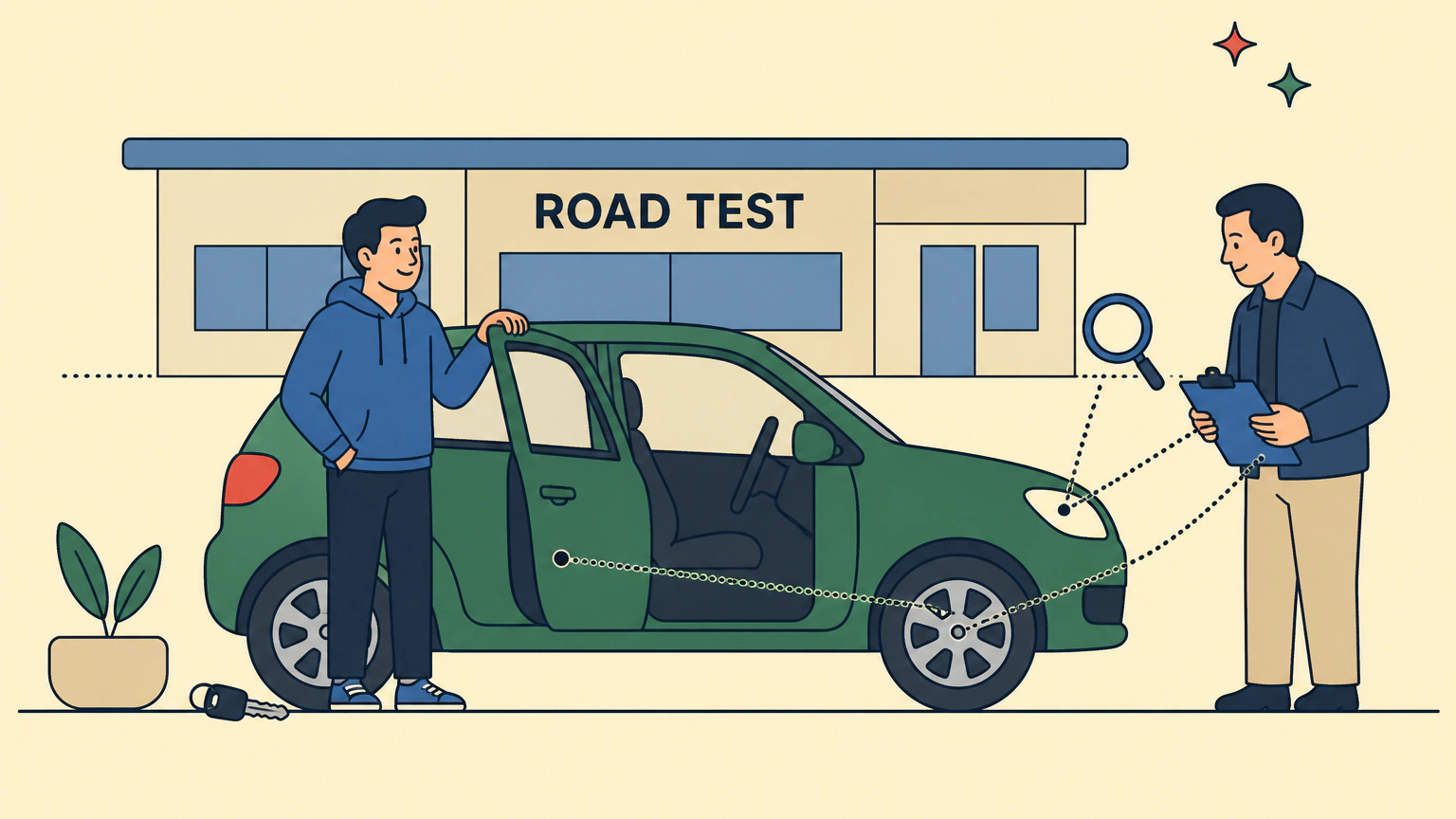
Soon you'll hand a set of keys to a stranger with a clipboard, and you're not yet sure whose car they'll open. Maybe a parent needs the car at ten. Maybe you've just landed in Canada and don't own one. Maybe you do own one, and you're quietly worried about that crack in the windshield.
None of the three provinces will lend you a vehicle at the counter, and none makes an exception because you asked nicely. So the first job is picking a route. The second is pricing it.
What Ontario, B.C. and Alberta ask you to bring
Three provinces, three vocabularies, one demand.
Ontario's Driver's Handbook keeps its list short. For the G1 exit test, which is what most people mean by the G2 road test, you bring a "vehicle in good working order", money for the fees if any are owing, your glasses if you need them to drive, and yourself, at least 30 minutes early.
ICBC wants "a safe, reliable and insured vehicle with a Canadian licence plate", plus one primary and one secondary piece of identification. You'll be asked for the plate number at the counter.
Alberta hands the detail to whoever booked you. The province says to make sure the vehicle meets all legal and safety requirements, and adds that your registry agent has a road test information sheet covering what the vehicle needs, which documents to bring, fees and the no-show policy. Ask for it the day you book.
Your three options, and who each one suits
Your own car is free and familiar, and on a test morning those are the two things worth the most. It's also the option with a checklist attached.
A borrowed car works when the owner understands what they're lending. In Ontario, bring the vehicle permit and proof of insurance. Nobody can plan a shopping trip during your appointment.
A school car costs money and removes several test-day unknowns. The vehicle is offered for road tests, and the instructor knows the test-centre routine. It can suit newcomers and one-car households. It's a reasonable place to end up.
Using your own car, or one you borrow
The check that decides whether your test happens comes before you drive. It covers items such as lights, tires, seatbelts and the dashboard. If something fails, the appointment can be over before it starts.
Do this walk yourself, in daylight, the day before. A quick check now beats having to book another slot.
The walk-around that decides it
ICBC publishes the most useful version of this list in the country: the ten reasons a vehicle most often gets turned away. DriveTest's own list is longer and blunter, and the two overlap almost completely.
Work through it in the order you meet the car. Lights at the corners, glass and wipers at the front, tires on the way past. Then open the door, sit in, and start the engine.
That last step is the one people skip, and it's the expensive one. A dash light that stays on once the engine is running can end the appointment, because a warning that affects safe operation is one of the ten. ICBC gives an airbag warning as its example. If a safety warning is glowing at you now, get it looked at this week rather than next.
The eight things an examiner checks before you drive
- Headlights, brake lights and signal lights all work, with no badly cracked or missing lenses
- No warning light that affects safe operation is showing on the dash once the engine is running
- Every seatbelt latches, retracts and releases, with no fraying on the webbing
- Tires are in good condition, properly inflated, and not a space saver spare
- The horn works
- The windshield and windows are not cracked or illegally tinted, and the wipers and washer work when weather requires them
- Doors and windows open and close, including from the inside
- Enough fuel or charge for the whole route, and a clean, uncluttered passenger seat for the examiner
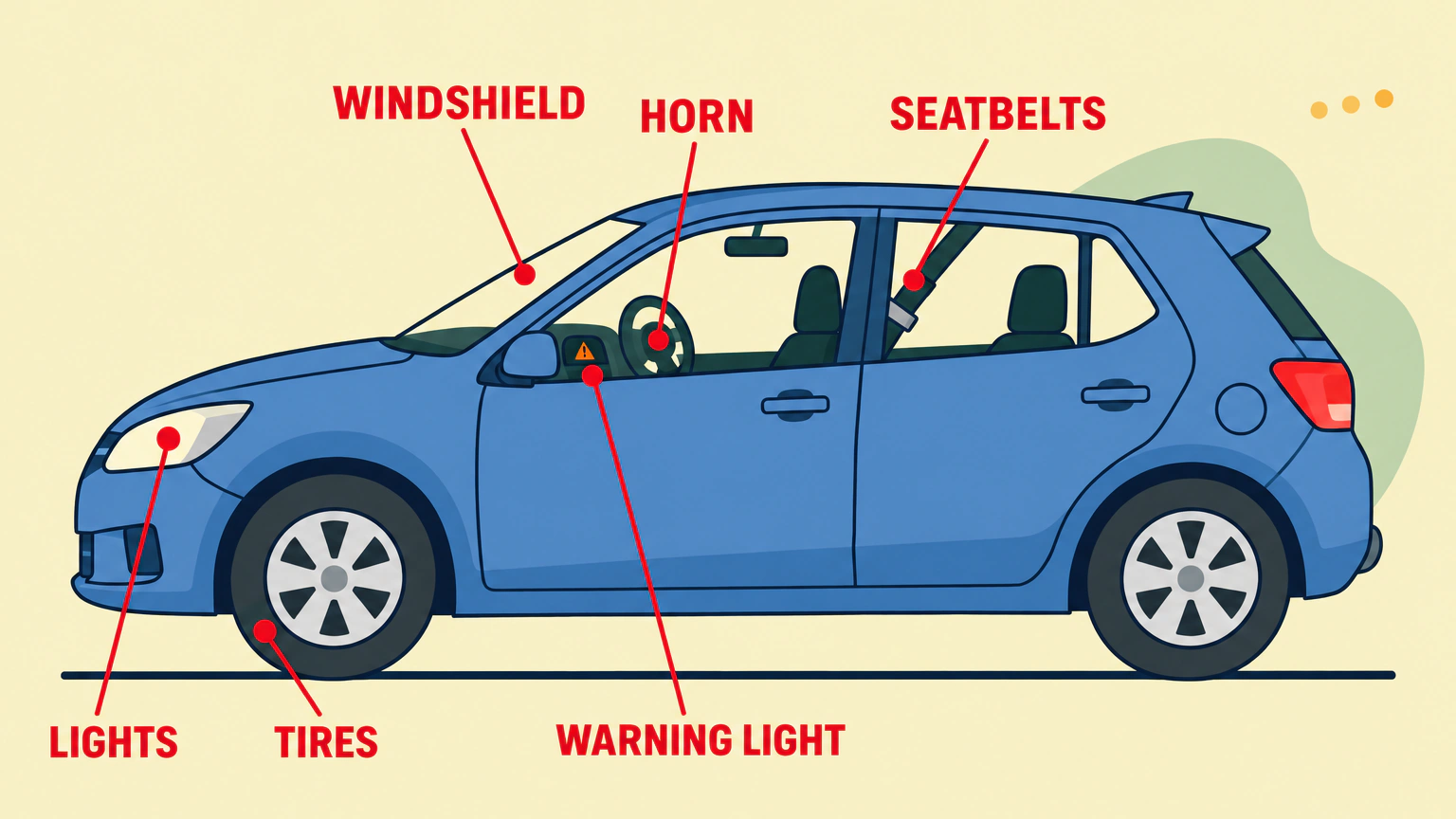
Number four surprises people. A flat tire or a temporary tire on any wheel is on DriveTest's list of reasons a test gets cancelled, so the little space saver spare you fitted last month won't do.
The papers that have to travel with a borrowed car
In Ontario, borrowing a car is a paperwork problem more than a keys problem. The owner has to hand over proof of insurance and the vehicle permit, both current, both in the car when you arrive.
In B.C. that plate number comes up at the counter before an examiner ever sees the vehicle. Text it to yourself the night before.
Back in Ontario, DriveTest names permit and plate trouble outright among the things that end a test: an expired ten-day permit, an in-transit permit, an altered plate, a plate that's missing or not properly secured. Any one of those stops the appointment the same way a dead brake light does. Bring the paper copies too. Paper settles a counter question in two seconds. An argument doesn't.
Four rules that catch people out on test day
These have nothing to do with how the car runs, and they end tests anyway.
Only two people ride. Ontario's handbook is flat about it: driving instructors, friends, relatives and translators may not come along. ICBC says the same and adds children and infants. Pets are out in both provinces. ICBC makes an exception for guide and service dogs. In Ontario, a passenger or a pet in the vehicle is grounds to cancel the test outright.
Turn the cameras off. ICBC bans audio and video recording during the test, wants GPS and navigation switched off, and warns that using them "can lead to the cancellation of your test". Ontario gets to the same place from the other direction: a dashcam or phone camera that hasn't been disabled sits on DriveTest's cancellation list, unless you can confirm out loud that it isn't recording the passenger compartment. The province also bars driving aids during the test, lane monitoring, cruise control and back-up cameras among them.
A car share needs a letter. If you're driving a co-op or car share vehicle in B.C. and you're not the named member, ICBC wants an original authorization letter on the company's letterhead, signed and dated. A fresh one for every attempt.
Check the recalls. ICBC lists an outstanding serious safety recall as a reason it may cancel your test, and points you at the federal Motor Vehicle Safety Recalls Database. That check starts with the make, model and year. The database says to ask the manufacturer or dealer whether your exact vehicle is included.
A rental car can work, but ask first
The obvious idea is to rent a car for the test. It can work, but the branch's rules decide.
Avis's Burlington terms list an Ontario G2 as an accepted licence, while Enterprise asks Canadian renters for a valid photo licence and rejects learner's permits. Both companies set other conditions around age, payment and the named driver. Neither page promises that every branch will allow road-test use, so call before you pay.
Ask the branch two things first:
- Will you rent to a driver holding a G2, an N, or a Class 5 GDL licence?
- Will my name be on the rental agreement as the driver?
If either answer is no, that car is no use to you at the test centre. B.C. also accepts a car-share vehicle when a non-member brings the company's original signed authorization letter.
Which is roughly why the school car exists as a product. A driving school already keeps cars for lessons and road tests and knows the test-centre routine.
What seven Ontario driving schools charge for a test-day car
Here's the number you came for: $120 to $160 at the seven Ontario schools whose prices we read. Four include an hour of practice beforehand.
The prices are unusually easy to compare. Several schools put the test-day car price right on the page. People buy this under a deadline, and a posted price makes the first comparison easier.
Car only, car plus a warm-up, or a full package
| School and city | What the price covers | Published price |
|---|---|---|
| Capital Driving School (Ontario; the page names no city) | Use of the school car for the G2 test, no practice hours | $120 |
| Ontario Driving School, London | Use of the school car for a road test; non-students must take a two hour lesson first | $130 |
| Roadcraft Driving School, Ottawa (Walkley centre) | Refresher lesson plus the car, instructor meets you 90 minutes before | $135 |
| Ottawa Driving School, Ottawa | One hour of practice plus the car, you meet at the test centre | $144 |
| Our Driving School, Sault Ste. Marie and Wawa | Use of the school car for the G2 test, 1.5 hours, drive to the centre and home included | $149 |
| Ottawa Safe Drivers, Ottawa | One hour lesson plus the car for the G2 test | $150 |
| Safe2pass, Ottawa | One hour of practice plus the car for the G2 test | $160 |
These are seven schools' own published prices in Ontario. G test versions run higher at nearly every school, and prices move.
The shape of that price column is worth a second. Capital's $120 row is car only. Ontario Driving School posts $130 for the vehicle, but non-students must first take a separate two-hour lesson. The $135, $144, $150 and $160 rows include an hour before the test. Our Driving School's $149 row covers transport and vehicle use.
Only Capital publishes both a car-only price and a one-hour package. There, the hour lifts the price by $40. We'd pay it. An hour in the exact car you're about to be examined in, on the roads around the exact centre, is worth every dollar of it.
Four of the seven are Ottawa schools. The Ottawa driving schools in our directory give you more local options to compare. The Toronto school we checked sells lesson packages that include the road test but posts no standalone car price. Expect to phone Toronto driving schools.
The add-ons that move the price
The headline price is rarely the whole price.
Pickup and drop-off can cost extra. Ottawa Driving School adds $30 inside Ottawa and $45 for Kanata and Stittsville, on top of a $144 package. Distance can cost more: Ontario Driving School's in-town combination package is $220, and the same thing inside a 100 km range is $350.
The G test costs more than the G2 at five of the seven schools, by $10 to $50. It's a longer test with highway driving in it, so that's fair enough. It just isn't what the G2 price in the heading told you.
Then HST. Three of the seven say plainly that their price is before tax. The rest don't say either way, which is its own kind of answer.
If you're weighing all this against the full course, what a driving course actually buys you covers the insurance side of that decision.
Red flag: A car-only price may leave out a warm-up or pickup. Check the exact package before you book. An unfamiliar car minutes before the test can turn a cheap option into an expensive lost appointment.
The question the ministry's own handbook tells you to ask
Ontario's Driver's Handbook carries a checklist for choosing a driving school, and one line on it is worth more than everything around it. Look, it says, for "clear school-contract statements regarding the cost of every aspect of the course, including use of vehicle for road test and any subsequent road test."
Read that last clause again. Any subsequent road test. The ministry is telling you to settle the price of the car on the day you fail, in writing, before you pay for the day you hope you won't. Nobody enjoys raising that while booking. Raise it anyway.
Six questions before you pay a school
- Does the price include practice time before the test, or only the car?
- Where do we meet, and how long before my appointment?
- Is pickup and drop-off included, or charged separately?
- Is HST included in the price you just quoted me?
- What does the car cost again if I fail and rebook?
- Is the car held for my exact appointment time, and what happens if the instructor runs late?
A school that won't answer those on the phone has told you something. No business can pay us for a listing or a ranking, and what else we stand behind is set out in our guarantee.
What it costs when the car is the problem
The fee is the small loss here. The appointment is the big one. Ontario's test fees are modest, and a replacement appointment can take time, so these money rules matter mostly for what they do to your calendar.
| Province | Who runs your road test | What a refused or missed appointment costs you |
|---|---|---|
| Ontario | DriveTest centres, operated by Serco Canada under contract to the Ministry of Transportation | An "out of order" costs 50 per cent of the prepaid road test fee and you rebook at your own expense |
| British Columbia | ICBC driver licensing offices | ICBC may cancel the test if the vehicle is unsafe or does not meet legal requirements; rebooking inside 48 hours carries a $25 cancellation fee |
| Alberta | Licensed driver examiners working for registry agents | Each registry agent sets and publishes its own road test fee, so the cost of a lost appointment depends on the agent you booked |
Ontario: an out of order, and half your fee
Ontario has a name for a test that can't go ahead, and the handbook prints it plainly. If your vehicle "does not meet ministry standards for the purpose of a road test", or there's a non-vehicle reason the examiner decides the test can't be completed, the examiner declares the road test out-of-order.
Then the money. You lose 50% of the road test fee. The other half stays as a credit on your driving record, and you pay the missing half again to book the next test.
DriveTest's schedule, unchanged since July 2019, puts the G2 road test at $53.75 and the G road test at $91.25, taxes included. Your first G2 test is usually already paid for, folded inside the $159.75 G1 licence package along with the knowledge test and a five-year licence.
So an out of order on a G2 costs you about $27 and a morning. If you're worried yours might be declared one, the handbook says to phone the DriveTest Centre beforehand and talk it through.
Cancel late, and the money goes with it
Ontario draws its line at 48 hours. Cancel or reschedule inside that window, or just don't turn up, and the prepaid fee is gone. The handbook makes an exception only for extenuating circumstances, a death in the immediate family among them, and even then the money stays as a credit rather than coming back. DriveTest lists what it will accept with proof: hazardous weather, a death in the family, illness, jury duty, incarceration, and an unscheduled call to work backed by a note on company letterhead.
B.C. is simpler. ICBC asks for the same 48 hours' notice and charges $25 when you cancel or rebook inside that window.
Alberta is the odd one out, and it's the one province where this becomes a shopping question. Driver examiners working for registry agents run the passenger road tests there, and the province says those agents set their own fees and have to publish them online. So what a missed appointment costs depends on who booked you. Phone two agents before you commit to one, and ask each what a no-show costs.
The hour before your test
Arrive at least 30 minutes early in Ontario. The handbook asks for it in writing, and the vehicle check happens before you drive.
If a school is driving you, plan on meeting earlier still. The Ottawa schools that publish a meeting time say 90 minutes, which sounds excessive right up until you watch someone parallel park an unfamiliar car with four minutes of practice.
Sort out one thing almost nobody thinks about: who drives home if you don't pass. A G1 holder can't drive away alone, because Ontario requires an accompanying driver in the front passenger seat. Turn up alone in a borrowed car and you have a problem in the parking lot.
One note for B.C. readers. From 19 October 2026, ICBC replaces the second road test with a Driving Record Assessment for drivers who qualify, and any second road test booked for that date or later will be cancelled. If yours is in November, check before you pay anyone for a car.
And if the school car is your answer, the next step is a shortlist. Start with the driving schools near you, phone two, and ask the six questions.
Frequently asked questions
Do you need your own car for a road test in Ontario, B.C. or Alberta?
You need a car, though not necessarily your own. Ontario, British Columbia and Alberta all expect you to bring a suitable vehicle. If you borrow in Ontario, bring the vehicle permit and proof of insurance. A driving school can also provide a car for the appointment.
Can you use a driving school's car for the test?
Yes, and it's a normal product rather than a favour. Four of the seven Ontario schools we checked bundle an hour of practice with the car. Their published prices run from $120 to $160. The instructor knows the test-centre routine, which removes some test-day guesswork.
What do seven Ontario driving schools charge for a test-day car?
Published prices run from $120 to $160 at the seven Ontario schools we checked. Capital's $120 option is car only. Four schools bundle an hour of practice, while Our Driving School's $149 option covers transport and vehicle use. Five schools charge $10 to $50 more for a G test than for their G2 option.
Can you rent a car from a rental company for a road test?
Sometimes. Avis's Burlington terms list an Ontario G2 as an accepted licence, while Enterprise requires a valid photo licence and rejects learner's permits. Before you book, ask whether your licence class qualifies, whether road-test use is allowed and whether your name will appear on the agreement.
What happens if the examiner refuses your car?
In Ontario the examiner declares the test out-of-order. You lose half the prepaid road test fee, the other half stays as a credit on your driving record, and you pay the missing half again to rebook. In B.C., ICBC may simply cancel the test. The fee stings less than the wait, which in a busy centre can run to weeks.
Does the instructor ride along during the road test?
No. Only you and the examiner are in the car. Ontario's handbook rules out driving instructors, friends, relatives and translators, and ICBC adds children and infants. Ask the school where your instructor will wait and where you should return the car.