

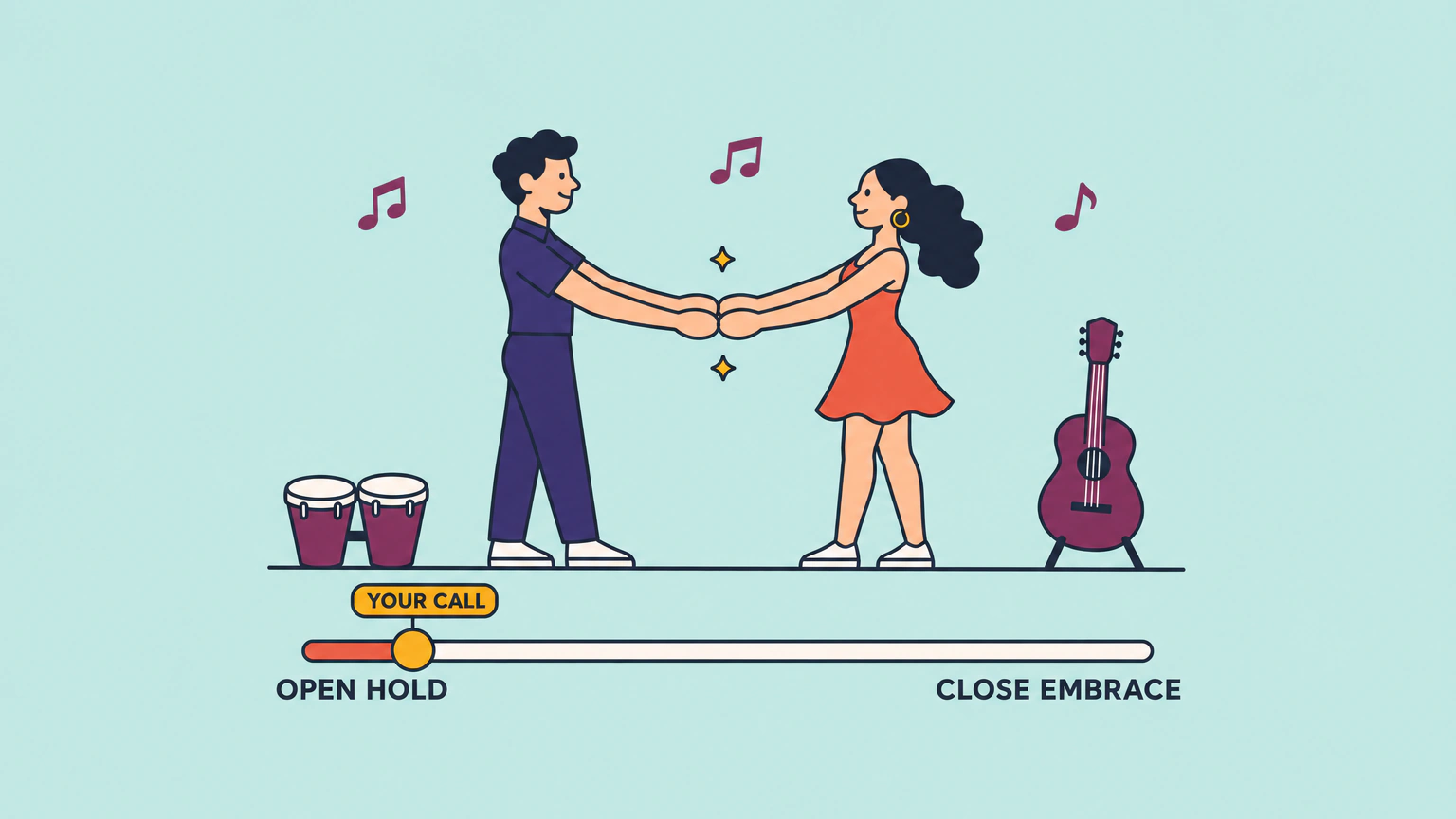
Bachata is a Dominican partner dance built on three steps and a tap. Your first class will most likely start in an open hold, not chest to chest. Of the 12 beginner programs we read in seven Canadian cities, only one is labelled sensual at beginner level. Courses run $55 to $199 as listed. You can ask for more space at any point.
We built that picture from the schools' own pages: what each one says it teaches, what it charges and whether partners rotate.
On this page
- What bachata is, in a minute
- The three styles you'll see on a class schedule
- How close a beginner class really gets
- What beginner classes teach and charge in seven cities
- Your right to say no, in class and at a social
- What happens in your first class
- Questions to ask before you pay
- Common questions about learning bachata
What bachata is, in a minute
Bachata comes from the Dominican Republic, and UNESCO added its music and dance to its intangible heritage list in 2019. UNESCO describes the dance as "a couple's dance characterized by a sensual hip movement and simple eight-step structure." The word itself "originally referred to a lively gathering or party." The band is small: one or two guitars, bongos, maracas and a guiro (a scraped percussion instrument), with a bass underneath.
The count is easy to say out loud. San Tropez in Montreal writes it as "1 • 2 • 3 • TAP 5 • 6 • 7 • TAP" and adds that "The taps on 4 and 8 do not carry weight." So you step three times, tap on the fourth beat without putting your weight on that foot, and then go the other way. Toronto Dance Salsa dates bachata's arrival in North America to the 1990s, and the dance has split into styles since.
The three styles you'll see on a class schedule
Schedules use these three words as if you already know them. Here's what each one looks like on the floor.
| Style | What you'll notice | How close it gets | Where you'll meet it |
|---|---|---|---|
| Dominican | Playful footwork and rhythm changes that follow the guitar | Anything from an open hand hold to a very tight embrace, depending on the song and the partner | The original style. ShumdeSalsa and Latin Energy start beginners here |
| Modern, or moderna | A side-to-side basic with turns and combinations you can use on a social floor | Closer handholds and less footwork than Dominican | Grew up in Western dance schools. Toronto Dance Salsa and Baza start beginners here |
| Sensual | Body waves, isolations and slow shapes | The closest of the three, known for "close intimate contact" | Created in Cádiz, Spain, by Korke Escalona and Judith Cordero. An upper-level course at Baza and Dance ConneXion |
You'll see other labels beside these. Studio X in Ottawa and edc STUDIO in Edmonton add "Urban", Baza in Vancouver teaches "Fusion" at higher levels, and Toronto Dance Salsa lists "Western traditional" too.
So where should you start? Salsavida's advice is that "learning what is common in your local scene helps you join in." Toronto Dance Salsa says most Toronto clubs dance modern. It also teaches modern, so read that as one school's view. We'd start with whichever class runs near you on a night you'll keep, because all three share the same basic count. Still weighing bachata against everything else? Here are the other dance styles on Canadian timetables.
How close a beginner class really gets
That worry breaks into three questions: which style the class teaches, which hold it uses and who you'll be dancing with.
Sensual usually comes later
Where a school says when sensual starts, it's usually after the basics. Baza starts beginners on "the essentials of Bachata Moderna" and keeps "Bachata Sensual Foundations" at Level 3. You need the school's approval for that level, and registration goes to a waitlist. Dance ConneXion in Toronto asks for "Level 3 or equivalent" before its "Sensual Technique" course, which it describes as "safe and comfortable sensual Bachata technique." San Tropez says sensual adds body movement and connection "after the foundations are secure."
Pure Havana in Ottawa is the exception. Its Sunday afternoon class is listed as "Sensual Bachata" at beginner level. Salsa in the Heart, edc STUDIO and Studio X name the styles early in their beginner courses, without saying how close those classes go.
Toronto Dance Salsa teaches modern, and it's frank about sensual: "many people don't feel comfortable with it. But, again, it's just a personal space consideration." Our advice: if closeness is the worry, read the class name twice, then ask.
Open hold first, then a roomy closed hold
Think of three distances. An open hold joins you by the hands, with space between you. A closed hold puts the leader's arm around your ribcage. Chest to chest is the one in the videos. With someone new, Toronto Dance Salsa's guide says to start in an open hand hold and "stick to a spacious closed embrace (rather than just going for that chest to chest connection)." It also has the best line on the subject: "The closed embrace should be like a hug, not a waffle iron!!!!"
Salsavida is plainer: "You can dance in an open hold, and close contact is never required." Movers and Shakers, a US school, tells women that the man shouldn't decide how close a dance starts. If he opens too close, you can "create space and move back to a semi-closed, or even open position."
Rotating partners, and how to sit it out
Most people turn up alone. Baza says "About 90% of dancers in our partner dance classes register individually." Of our 12 programs, five say partners rotate, Studio X makes it optional ("participants can switch, but it is not required") and six don't say.
Couples get a choice at the schools that mention them. Toronto Dance Salsa's FAQ describes couples who don't rotate on one side of the room while individuals "rotate every few minutes" on the other. Steps Dance Studio in Toronto lets you keep your own partner too. Baza lets couples stay together, though it recommends rotating because it "speeds up the learning process".
edc STUDIO in Edmonton is the clearest about opting out: "if you do not feel comfortable rotating partners please communicate this to your instructor". That goes for couples as well, including the half of a couple who'd rather not swap. Say so before class starts, and the teacher can plan the rotation around you.
What beginner classes teach and charge in seven cities
Here's what each school says on its own page about its beginner class.
| Studio and city | What the beginner class teaches | Format | Listed price | Do partners rotate? |
|---|---|---|---|---|
| Toronto Dance Salsa, Toronto | "modern bachata basics with a touch of traditional flavour" | 1 hour, 9 weeks | $199, tax not stated | Yes |
| Dance ConneXion, Toronto | Timing, basic steps and turns. The school specializes in modern and sensual | 1 hour, 8 weeks | $180 + HST, or $27 + HST drop-in | Yes |
| ShumdeSalsa, Toronto | Traditional bachata, with footwork and free movement | Membership or trial class | $30 trial class | Not stated. You're matched with a partner |
| Salsa in the Heart, Toronto | An introduction to "the sensual, modern and Dominican styles" | Not on the page we read | Not on the page we read | Not stated |
| Latin Energy, Mississauga | "the basics of Dominican Bachata" | 5 weeks | $109.95 + tax, on sale at $87.96 + tax | Not stated |
| Studio X, Ottawa | Basics shared by the styles, then the difference between "Dominican, Sensual and Urban" | 8 weeks | $115 + HST | Optional |
| Pure Havana, Ottawa | "Sensual Bachata" at beginner level | 1 hour, 5 Sundays | $100, tax not stated | Not stated |
| Vibe Salsa, Ottawa | Style not named. Open to beginners and experienced dancers | 1 hour, 6 weeks, social included | $55, or $18 a class | Not stated |
| San Tropez, Montreal | Foundations first, then Dominican, moderna and sensual | Bachata 1 on several days a week | $39 for 14 days, new students | Yes |
| Baza Dance Studios, Vancouver | "the essentials of Bachata Moderna" | 1 hour for 8 weeks, or 90 minutes for 5 | $190, tax not stated | Yes. Couples may stay together |
| edc STUDIO, Edmonton | An introduction to "Sensual, Dominican, and Urban" | Not on the page we read | Not on the page we read | Yes. Tell the teacher if you'd rather not |
| Salsa Explosion, Winnipeg | "Intro to Bachata", style not named | Drop-in, Saturdays at 1 p.m. | $18 a class | Not stated |
Prices are as each school lists them for fall 2026, on its own page. Some sell the same class in more than one format.
The seven programs sold as a course run $55 to $199 as listed. Five of those seven work out to $20 to $24 a class: Pure Havana at $20.00, Latin Energy at $21.99 before its sale, Toronto Dance Salsa at $22.11, Dance ConneXion at $22.50 and Baza at $23.75 on its eight-week course. That sits inside the C$20 to C$25 we use as a planning range for one adult group class when you search for dance classes near you. Studio X ($14.38) and Vibe Salsa ($9.17) come in below it. Our planning range for a six-class beginner course is C$100 to C$160.
A private lesson is the other route in. Our range is C$75 to C$115 for an hour with one learner, and for private partner dance lessons we put a couple at the same C$75 to C$115 for 45 to 60 minutes.
Check the tax line before you compare. Three of the seven course prices add tax on top, and the other four don't say. For the fuller cost picture, including how long a first course takes, see our guide to salsa for beginners.
Your right to say no, in class and at a social
You can say no to a dance, a move or a distance, at any point, and you don't owe anyone a reason. Studio X says its community "has a reputation for being warm and welcoming", and it wants to keep it that way.
What a good studio puts in writing
We found a published code of conduct at three schools: Studio X in Ottawa, Steps in Toronto and Baza in Vancouver. Studio X's is the fullest. It says partners should "comply immediately with any request not to perform a specific move or not to dance too close." It asks dancers to get "additional consent before performing any non-traditional moves (e.g. lifts, dips)." And it gives you the line worth remembering: "You have the freedom to say 'no' at any time and for any reason."
Steps asks students to "Respect the boundaries of others, particularly in partnerwork and group activities." Baza's code names harassment and "unsafe social dance practices or execution" among the incidents you can report. Before you pay anywhere, ask for the school's version. If there isn't one, ask who you'd talk to if something felt wrong.
What to do when someone dances too close
You have three moves, in order, and you can skip straight to the last one.
- Make space with your body. Movers and Shakers suggests trying that "up to three times" before you say anything.
- Say it out loud. As Studio X puts it, "words are the best way to let them know you're not comfortable with something."
- Stop. Studio X's code is plain: "Participants always have the right to stop a dance for any reason at any time."
Then tell the teacher or the organizer. Studio X lists "unwanted physical contact", "sexual harassment" and "sexual assault" among the behaviour it won't tolerate. It also says it will ask for your consent before calling the police, unless someone faces an imminent risk of harm.
If you're the one leading, Toronto Dance Salsa has a rule worth borrowing: "Save the big dips, bodywaves and super sexy moves for people you know!"
Socials work the same way. Studio X says you can decline an invitation to dance "for any reason". Toronto Dance Salsa's advice is to take a class before your first social, because there's no lesson during the evening. Some nights fold one in, though: Vibe Salsa's Tuesday bachata lessons include the social that follows.
What happens in your first class
Nobody expects you to walk in with rhythm. San Tropez says its beginner classes "explicitly teach you how to hear the beat", and it lays out a first class in five stages: find the beat, learn your basic, add movement, connect with a partner, then dance through an actual song.
Studio X asks whether you'll lead (guide the moves) or follow. Roles don't always fill evenly, and one of Toronto Dance Salsa's fall salsa classes showed a "Waitlist for Leaders, room for Followers and couples". If a course has already started, Dance ConneXion recommends that complete beginners join "no later than the third week."
One last tip, which Toronto Dance Salsa calls "the part nobody tells you." Its guide to dressing for a first salsa class ranks deodorant and fresh breath above any clothing choice, because "your partner is right there."
Questions to ask before you pay
Take these to any school before you hand over a course fee.
- Which style does Level 1 teach, and what hold does the class use?
- Do partners rotate, and can I stay out of the rotation?
- At what level does sensual start, and can I skip it?
- Do you have a written code of conduct, and who do I tell if something goes wrong?
- Is tax included in the price you've quoted me?
- Do you need more leads or follows right now, and could that put me on a waitlist?
- What happens to my money if I miss a class or stop coming?
Some course pages rule out make-up classes and refunds, so ask first. In Ontario, ontario.ca says prepaid dance classes can count as personal development services. The Consumer Protection Act covers a for-profit studio's contract when you have to pay in advance and it totals more than $50. For the rest of it, here's what Ontario's rules give you.
Once you have the answers, compare them against other dance classes near you.
Common questions about learning bachata
Is bachata a sensual dance?
It can be, and that's the version most people picture. UNESCO describes "a sensual hip movement", but Salsavida says "close contact is never required." Dominican bachata leans on footwork and musical play. Sensual bachata is one branch, and Baza and Dance ConneXion both keep it for upper levels. Whatever the style, the hold you dance in stays your choice.
Is bachata hard to learn?
The first step isn't. San Tropez says bachata has "a clear repeating rhythm and a compact basic step", and Salsavida says you can try the basic on your first day. Getting comfortable with different partners is slower, and Salsavida adds that it "takes repeated practice, and there is no fixed deadline." Level 1 runs five to nine weeks at the schools that print a length.
Can you learn bachata alone?
You can learn the steps alone, but not the partner work. Salsavida says you can practise counting, weight changes, basics and footwork by yourself, and "You will need practice with another person to develop leading and following." You don't need to bring that person, though. Eight of the 12 programs we read say outright that you can come without a partner.
Is bachata easier than salsa?
It can be, at first. Salsavida says some beginners find bachata's "repeating step-and-tap pattern easier to pick up than a salsa basic." Both dances take practice, though, and bachata gets harder once footwork, turns and body movement arrive. If you're choosing between them, our guide to salsa for beginners covers what a first course costs and how long it takes.
What do you wear to a bachata class?
Whatever you can move in. Toronto Dance Salsa says most students wear "jeans or casual pants and a top", and it warns against heavy boots and "very sticky rubber soles." Baza says "any clean shoes that you are comfortable in are fine." Studio X and Steps don't allow outdoor shoes, so bring a clean pair to change into, and leave dance shoes for later.
Was bachata really banned?
Not by any law we could find. Bachata grew up in the Dominican countryside under Rafael Trujillo, whose dictatorship Wikipedia says was marked by heavy censorship. The first recognized recording came in 1962, after his regime ended in 1961. Even then Wikipedia describes "unofficial censorship", and for years few stations besides Radio Guarachita would play it. In 2019, UNESCO added the music and dance to its heritage list.
So pick a beginner class on a night you'll keep, ask which hold it starts in and whether you can sit out the rotation, and go.