

On this page
- The short answer, split in two
- The eight months are the part that is actually in the rules
- What a government-approved BDE course must include
- What the insurance discount really is, and who decides it
- What the course costs, and how to read a quoted price
- Before you pay: three checks that take ten minutes
- Outside Ontario, the answer changes shape
- So should you take the course?
- Frequently asked questions
- Where these numbers come from
The short answer, split in two
One benefit is written into how Ontario licences work. The other is a private company's decision about your file. Only one is a promise.
What the certificate guarantees
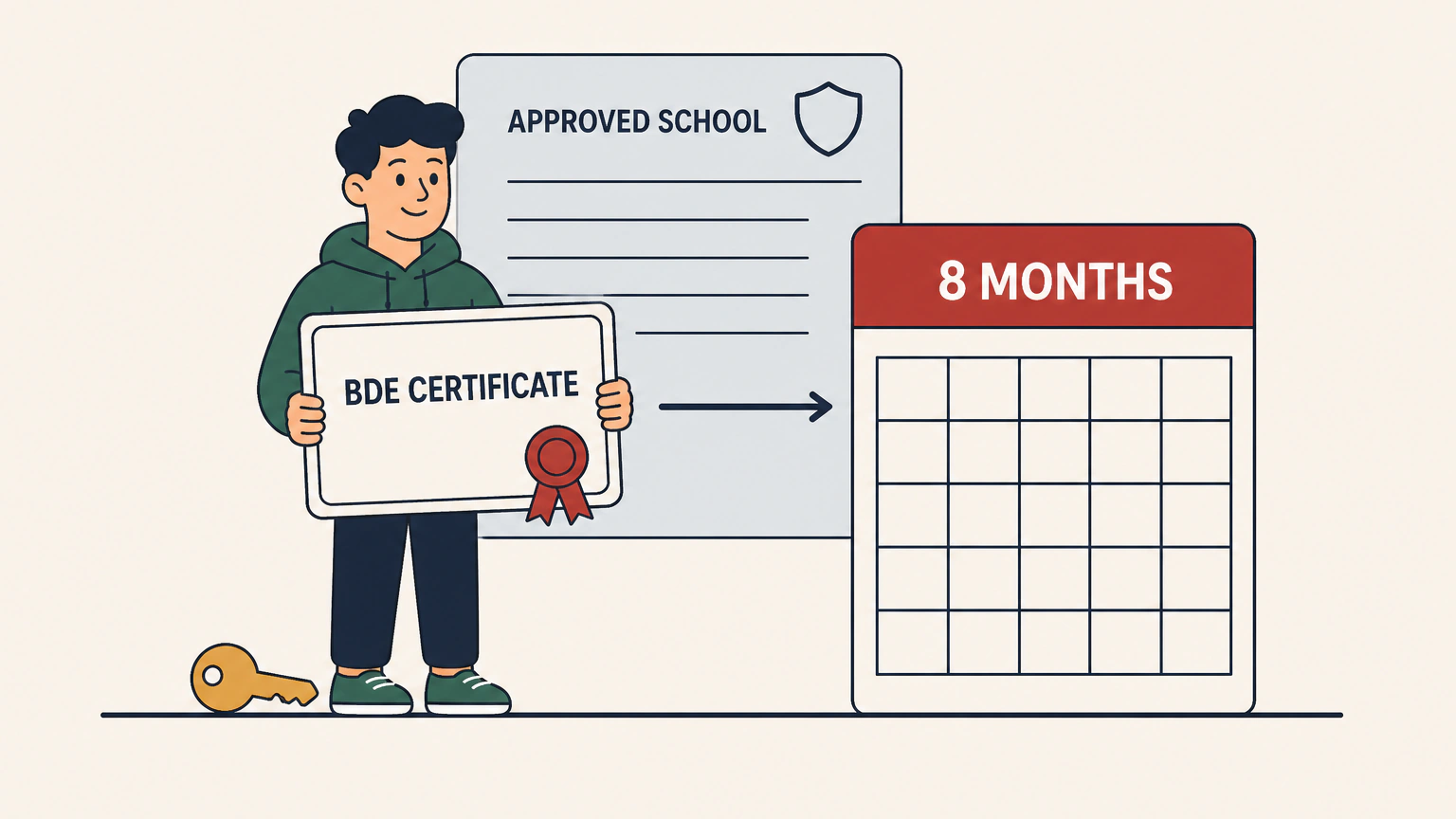
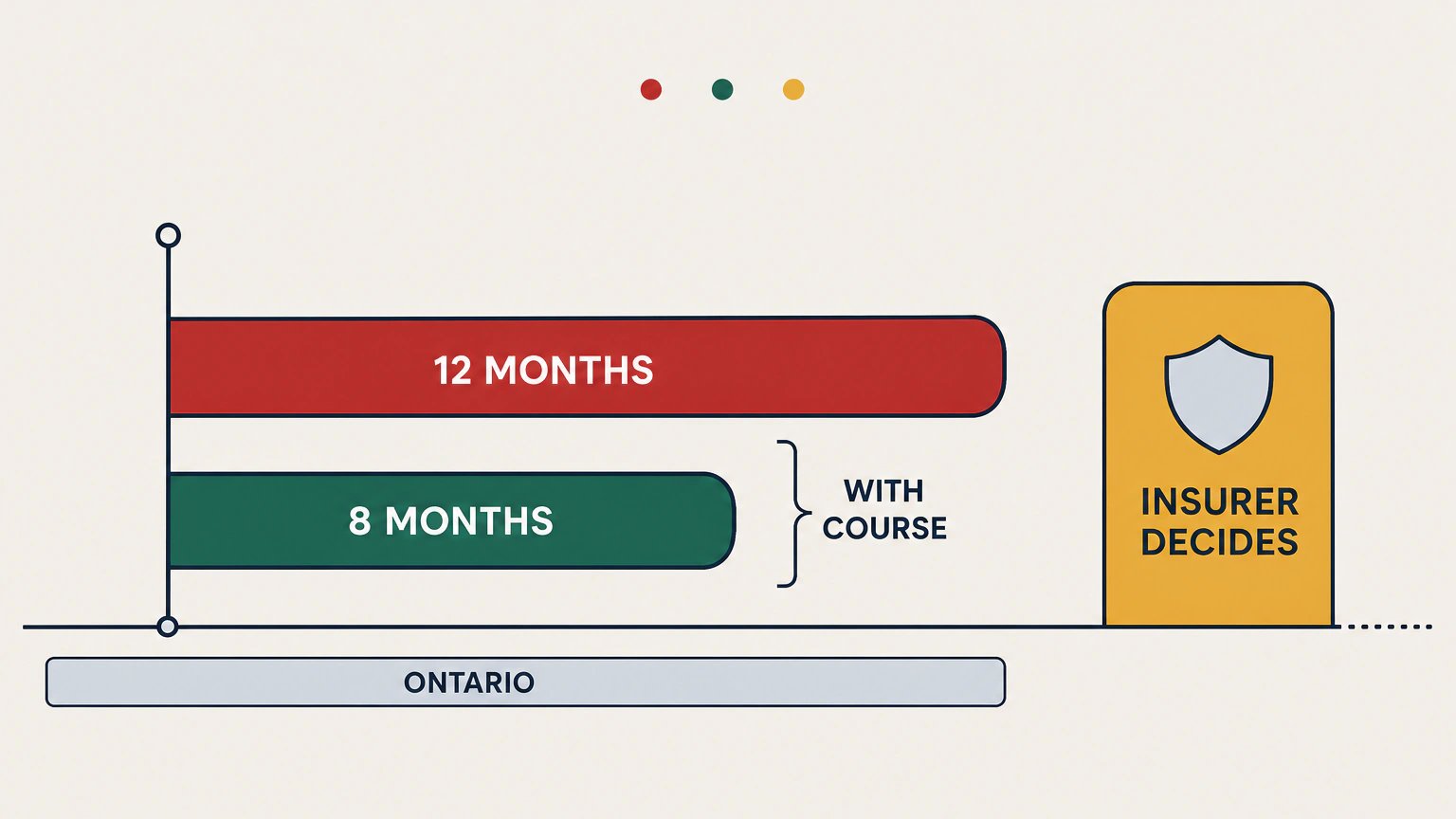
Finish a government-approved course and you can take that first road test after eight months instead of twelve. Pass it, and you've spent four fewer months on a G1 and moved into the G2 stage four months earlier.
What the certificate only makes possible
The discount is something an insurer may apply to your file, not a benefit the program hands you. Ask your insurer or broker what they do before you enrol, not after the fee is gone.
The eight months are the part that is actually in the rules
Months are the piece of this you can count.
Twelve months becomes eight
Ontario's page for new drivers states both halves plainly. "In most cases, you practice with your G1 licence for 12 months." And: "If you finish a government-approved driver education course, you can take your first road test after just eight months." The credit lands at the G1 stage and nowhere else. G2 still runs its own 12 months, course or no course.
What the course has to contain to earn it
Only a government-approved BDE course earns that credit. A cheap package of in-car lessons is a different product, however good the instructor. The ministry's standard is 40 hours, and a school either meets it or doesn't.
What the credit is worth in money, honestly
Nobody puts a dollar figure on those four months, and we went looking. Pass at eight months and four months of G1 restrictions fall away: zero blood alcohol, no 400-series highways unless a certified Ontario driving instructor is in the car, nothing between midnight and 5 a.m., a fully licensed driver of four years' experience beside you. And the G2 stage arrives four months earlier. If that decides it, start with driving schools across Ontario.
What a government-approved BDE course must include
Ontario sets the floor on its government-approved driving schools page. Hold any quote against it before you pay.
| Component | Minimum required | What to ask the school |
|---|---|---|
| Classroom instruction | 20 hours, in person or digital | Is it live or self-paced? |
| In-vehicle instruction | 10 hours with a licensed instructor | How many students are in the car? |
| Flexible instruction time | 10 hours | Which format: classroom, digital, in-vehicle, simulator or homelinks? |
| Total | 40 hours | Is the full 40 hours in writing on the invoice? |
| Sequencing | Classroom before in-vehicle; in-vehicle finished within one year of the classroom start; no more than two hours in-vehicle per day | Does the schedule you were sold fit these rules? |
The classroom, in-vehicle and flexible hours
The 40 hours split three ways: 20 classroom, 10 in-vehicle, and 10 flexible hours (classroom, digital, in-vehicle, simulator or homelinks). Classroom comes first. In-vehicle training must finish within a year of the classroom start, and no more than two hours of it can happen in a day. Add five hours of classroom on the same day and the in-vehicle limit drops to one hour.
Class sizes are capped, and that is a quality signal you can ask about
Ontario caps in-person classes at 40 students and virtual classes at 20, and in the car it's two students per instructor. Those are ceilings, not targets. A school that cheerfully answers "four in the car" is describing something an approved course doesn't allow.
What the insurance discount really is, and who decides it
Three facts settle this, and none of them appears on the pages quoting you a percentage.
What Ontario actually says
The ministry's driving-schools page carries a paragraph the sales pitches skip: "Your insurance provider may provide a discount after you have completed a BDE Program. Contact your insurance provider for more details. Note that this is not part of Ontario's BDE Program, and completing a course does not guarantee a discount." The discount belongs to somebody else, and the province is the one telling you so.
Why the number changes from page to page
The regulator, the Financial Services Regulatory Authority of Ontario (FSRA), lists "whether or not you have taken driver training" as one item inside your driving record, beside accidents, licence length, tickets and convictions. One item. Its page on what determines your rate never uses the word "discount". Insurers file their own rates, and FSRA's job is "to ensure that insurance companies' proposed rates are fair and not excessive," not to keep a discount table you can look up. That's why the 5 to 15 per cent figures on driving-school blogs trace back to no primary source we could reach. CBC reported in March 2024 that new drivers "may receive insurance discounts of up to 30 per cent" once licensed, which is CBC's reporting, not an offer.
The one question to ask before you enrol
Send your insurer or broker one email with two questions in it. Do you apply a driver-training discount? How long does it last? The answer costs nothing and it arrives before the fee does. If what comes back is vague, price the discount at zero.
Pro tip: Get the answer before the money is spent, and ask the question everybody forgets: how long does it last? No public source we could reach gives a duration, so whatever you're told is that insurer's own rule. Get it in writing, with an end date.
What the course costs, and how to read a quoted price
Two price signals exist here, and they're counting different things.
What Ontario BDE courses run
CBC reported in March 2024 that a BDE certificate "typically costs between $650 and $1,500." Our own directory data sits lower. Across 612 submitted cost profiles for driver training, the average reads $442, the typical range is $369 to $527, and the field the panel labels average per-hour rates reads $75. Read those with one eye open: the profiles mix driver-education quotes of every shape, including lesson packages that aren't 40-hour BDE programs, and the panel adapts to wherever the reader sits. Treat it as a directional benchmark for driver-education services, not an Ontario BDE-course price and not a quote, then compare government-approved driving schools near you.
What a fair quote should itemize
A quote worth accepting names four things: the in-car hours, how the classroom portion is delivered, whether the school books your road test, and whether renting the car on test day costs extra. Anything left off is a cost you meet later.
Before you pay: three checks that take ten minutes
All of it happens before the money moves.
- Find the school on Ontario's government-approved driving schools page.
- Check the same page's revoked-schools list for the school's name.
- Confirm the quote covers all 40 hours, not just the in-car portion.
- Ask how many students share the car during in-vehicle lessons.
- Ask your insurer or broker, in writing, whether they apply a driver-training discount and for how long.
- Ask when the school submits your completion to the Ministry.
- After the course, order your driver's licence history ($12) if you need proof the certificate landed.
Check the school is on the government list
Ontario publishes every approved school on one page, and the same list as an open dataset refreshed weekly. The English file dated 5 August 2026 holds 1,474 approved-location rows across 218 distinct values in its City column. Search your town and match the exact address you were quoted, since a school can run several locations.
Check the school is not on the revoked list
The same ontario.ca page carries a revoked-schools list running from 2007 to the present. Those schools no longer provide courses meeting government standards. If the name or address on your quote turns up there, stop.
Understand what a certificate you did not earn costs you
CBC phoned 20 driving instructors advertising in the Greater Toronto Area for a Marketplace investigation published in March 2024. Fourteen offered to register a student as having completed a full BDE course they never attended, for $150 to nearly $400. Fourteen out of twenty. Ontario's Auditor General, Shelley Spence, told CBC: "We have drivers out on the road that are not trained and not certified properly."
Red flag: if a school offers you the certificate without the hours. The offer itself is the warning. Ontario says the consequences for altering, purchasing or selling a BDE certificate can include driver's licence suspension, prosecution under the Highway Traffic Act, and removal of the certification from your driver record along with any benefits obtained using it, which takes the eight-month credit and any discount with it. And whoever skipped the hours still drives the car. Walk away, then report it to [email protected].
Outside Ontario, the answer changes shape
Five provinces, each checked against its own government, sort into three models.
| Province | Is the course required? | Does it change your licensing timeline? | Who decides any insurance discount? |
|---|---|---|---|
| Ontario | No | Yes: G1 exit test at eight months, not twelve | Your insurer; the province states the discount is not part of the BDE program |
| British Columbia | No | ICBC states approved training could take six months off graduated licensing | ICBC provides mandatory basic insurance, and its driver-training page names no discount |
| Alberta | No | None stated | Your insurer; the province states the completion form may be used to get a discount |
| Saskatchewan | Yes, for any class above Class 7 | Not applicable, it is a precondition | SGI provides compulsory basic insurance |
| Quebec | Yes; only SAAQ-recognized schools offer it | Not applicable, it is a precondition | SAAQ administers public bodily-injury coverage, and private insurers cover other damage |
Manitoba, the Atlantic provinces and the territories are missing on purpose. We couldn't verify their rules against a primary source, and a guessed line about licensing law is worse than an admitted gap. Ask your own licensing authority.
Where the course is mandatory
In Quebec, only driving schools recognized by the SAAQ offer the programs that are mandatory for obtaining a driver's licence. Saskatchewan is nearly as blunt. A Class 7 holder isn't eligible for a higher class without the high school driver education program, or at least six hours in-class and six in-car with an SGI-certified instructor, so driving schools in Saskatchewan are not optional. In both, the discount question is beside the point. You can't skip the course.
Where the course buys time
British Columbia works like Ontario with a larger credit. ICBC states that approved driver training "could take 6 months off your time in graduated licensing," and its driver-training page names no discount at all. Ask driving schools in British Columbia about the timeline.
Where your insurer is the government
In British Columbia and Saskatchewan, mandatory basic auto insurance comes from ICBC and SGI, and optional coverage may still be available from other insurers. Manitoba Public Insurance's site refused every automated request, so nothing here describes Manitoba. Ask MPI directly.
Alberta and the private-market provinces
Alberta asks a Class 7 learner or a Class 5 GDL driver for 15 hours of classroom and 10 hours of in-vehicle instruction. The resulting Notice of Driver Education Course Completion form "may be used to get a discount on your vehicle insurance," the province says. May. Same careful verb as Ontario's, from a second government. Alberta also entitles you to a written policy of rates, hours and refunds on request, so ask driving schools in Alberta for one.
So should you take the course?
Decide on what's certain. Price the rest at zero.
Take it for the eight months and the teaching
If an earlier road-test opportunity plus 40 structured hours in a government-approved course are worth the fee, enrol. If the whole case for spending $650 to $1,500 rests on a discount nobody will confirm in writing, it's a hope with an invoice attached.
How to make sure the certificate lands
The school certifies you online when you finish, and your student driver record is updated through the Ministry of Transportation. Ask the school when it files. If an insurer says it can't see the course, a $12 driver's licence history ends the argument.
Frequently asked questions
Does driving school lower your insurance in Ontario?
Sometimes, and nothing guarantees it. Ontario says as much: the discount "is not part of Ontario's BDE Program, and completing a course does not guarantee a discount." Your insurer may apply a driver-training discount as part of your driving record, at a size it sets itself. Ask yours in writing before you enrol.
How much does driving school reduce insurance in Ontario?
There's no published figure you can check. Insurers file their own rates, and no Ontario source lists driver-training discounts company by company, which is why the percentages on blogs never agree. CBC reported in March 2024 that new drivers may receive discounts of up to 30 per cent. That's CBC's reporting, not a promise.
How do I know if a driving school is government-approved?
Check the approved-schools list at ontario.ca, or the same list published as an open dataset, refreshed weekly and holding 1,474 approved locations in the 5 August 2026 file. Then run the name and address you were given against the revoked-schools list on the same page. Both checks take minutes.
How long does the insurance discount last?
It varies by insurer, and no public source we could reach gives a single duration. This is the insurer's own rating decision, so the only answer worth anything is the one your insurer or broker puts in writing. Ask for the end date, not just the percentage.
Does driving school lower insurance in B.C. or Alberta?
Differently in each. British Columbia's basic insurer is public, and ICBC frames approved training as six months off graduated licensing rather than as money off a premium. Alberta states that the Notice of Driver Education Course Completion form may be used to get a discount, which parks the decision with your insurer.
Is driving school worth it in Ontario if I only care about the money?
The eight-month credit is the only guaranteed return, and no source attaches a dollar value to it. If a school won't put all 40 hours on the invoice and your insurer won't confirm a discount in writing, the purely financial case is unproven.
How do I prove I completed BDE if my insurer cannot see it?
The school certifies you online when you finish, and your student driver record is updated through the Ministry of Transportation. If that hasn't reached your insurer, order your driver's licence history for a $12 fee. It documents the completion and ends the back and forth.
Where these numbers come from
Everything here comes from primary sources, not other people's summaries: Ontario's "Government-approved driving schools" and "Get a G driver's licence: new drivers" pages, FSRA's auto-insurance pages, the Ontario Data Catalogue's approved-schools dataset, CBC's Marketplace report, and the ICBC, SGI, Alberta and SAAQ pages named above. The dataset refreshes weekly, so search the current file rather than trusting any count, ours included. Our editorial standards are in our guarantee.
One honest limit before you go. This is general information about licensing rules and insurance pricing, not insurance or legal advice. Rules and rates are set province by province and insurer by insurer, so confirm anything expensive with your licensing authority and your own insurer.