

On this page
- The short answer: what Canadian swim levels are called now
- The full Swim for Life ladder, module by module
- Converting a retired Red Cross report card
- When your city runs its own ladder: the Toronto case
- What the Lifesaving Society branch in your province delivers
- After Swimmer 6: the leadership ladder
- What swim lessons cost in Canada, and how to register in the right level
- Frequently asked questions
The short answer: what Canadian swim levels are called now
You're at the registration page, the session fills tonight, and the only level name you know is the one printed on a report card from a program that no longer exists. Here's the short version. Swim lessons in Canada now run mostly on the Lifesaving Society's Swim for Life ladder: Parent & Tot, Preschool 1 to 5, Swimmer 1 to 6, then the Canadian Swim Patrol awards Rookie, Ranger and Star. Those "Swim Kids 1 to 10" levels belong to the Canadian Red Cross program, which was wound down nationally in 2022, with training continuing in First Nations communities under the Red Cross Indigenous Peoples Framework. A conversion chart will get you within a level of the right class. The pool your child actually swims at makes the final call.
You'll meet three vocabularies while you register: the Lifesaving Society's national one, your city's or your Y's local version of it, and the retired Red Cross names that still turn up on paperwork. They're all describing the same swimming.
The Swim for Life ladder, in one line
Five modules, and that's the whole ladder. Parent & Tot takes children up to 3 years. Preschool covers 3 to 5. Swimmer runs from 5 and older, Adult Swimmer is for people over 16, and Fitness Swimmer is open at any age. From there the route carries on into the basic lifesaving awards, Rookie, Ranger and Star Patrol, and then into leadership training. The Society sums up the whole climb in two lines: "Never too young to learn. Never too old to start."
Why your pool's level names may not match
The confusion has one simple cause. The Society doesn't teach a single lesson. It licenses the program to affiliate facilities, so you always register through the pool, the Y, the camp or the club, never through the Society itself. Each affiliate then paints its own names on top. One prints "Swimmer 3". The next prints an animal. A third folds two levels into one class. That's how two pools twenty minutes apart end up advertising different words for the same set of skills, and why the names on your registration page can shift from one session to the next.
The full Swim for Life ladder, module by module
Here's what each module covers, and what your child should be able to do by the end of it. One thing before the ladder, because it matters more than any level name on it: finishing a level builds real skill, and it is not drowning-proofing. Your supervision rules are exactly the same the day after the certificate comes home as the day before it, and they stay the same all the way up.
Parent & Tot (about 4 months to 3 years)
You're in the water for all of it. That's the module, really: parented, play-based, water-positive, with an adult holding the child through every class. British Columbia and Manitoba both split it into three bands, 4 to 12 months, 12 to 24 months and 2 to 3 years, and BC gives those bands names, Jellyfish, Goldfish and SeaHorse. Read your branch's published band closely, because they genuinely differ. Ontario says "up to 3 years of age". BC says "4 months to 36 months". Saskatchewan describes "children ages 1-3" on the same page where its module list says up to 3 years.
Preschool 1 to 5 (3 to 5 years)
Five levels carry a child from getting a face wet to a short front and back crawl, a forward roll entry in a lifejacket, and ten seconds of treading water. You're usually on the deck now instead of in the pool, which is its own small adjustment. BC prints the five levels as Octopus, Crab, Orca, Sea Lion and Narwhal. Alberta's municipal charts print bare numbers. Your child will care far more about being a Narwhal than about the number on the form, and honestly, fair enough.
Swimmer 1 to 6 (5 or 6 years and up)
This is the school-age ladder, and it runs on strokes and distance. Swimmer 1 starts with floats, glides and kicking. Swimmer 4 completes the Canadian Swim to Survive standard. Swimmer 6 finishes with stride entries, compact jumps, eggbeater and scissor kicks, and lengths of front crawl, back crawl and breaststroke that look comfortable rather than survived. Where the branches part company is the entry age, and it's a real disagreement rather than a rounding difference. Ontario and Manitoba publish "children 5 years and older". Saskatchewan publishes "children 6 years and older". BC recommends 5 to 12.
Canadian Swim Patrol: Rookie, Ranger and Star
After Swimmer 6 come three Patrol awards, usually from about 8 years old, and they stack timed swims, fitness workouts and first aid on top of the stroke work. Some branches keep them as separately named awards. Others fold them into the numbering, which is why BC lists "Swimmer Levels 1-9" and Edmonton's chart prints "Swimmer 7 - Rookie Patrol". Quebec does the same in French, where Nageur 7, 8 and 9 are the Jeune sauveteur awards. Both ways of writing it are correct. Your child is standing in the same place either way.
Teen, Adult and Fitness Swimmer
Adult Swimmer is published for people over 16 and runs in three levels, from complete beginners to adults who just want their strokes cleaned up. BC calls the same thing Teen & Adult 1 to 3. Fitness Swimmer is open at any age and covers pace clocks, workout design, interval training and distance. And if you never learned to swim yourself, that's your entry point, booked exactly the way you'd book a child's.
Converting a retired Red Cross report card
The date on the change is 12 January 2022. That was the day the Canadian Red Cross announced it was winding down its swim and lifeguard programming, and encouraged its water safety training partners to move to Lifesaving Society Canada programs "through the course of this year". Training continues in First Nations communities under the Red Cross Indigenous Peoples Framework. The program began in 1946 and reached more than 40 million Canadians, which is why Swim Kids is still the vocabulary most families reach for. Something that big doesn't leave the language the year it leaves the pool deck.
The conversion table
Two dated charts do the work here: the City of Edmonton's Swim Lesson Conversion Chart, last updated in October 2023, and the Fredericton YMCA's chart from 2022. We used those two precisely because they carry dates. The YMCA column is one association's naming, not a national standard.
| Age group | Lifesaving Society (current) | Canadian Red Cross (retired) | YMCA (typical) | Chart agreement |
|---|---|---|---|---|
| 4 to 12 months | Parent & Tot 1 | Starfish | Splashers | Consistent |
| 13 to 24 months | Parent & Tot 2 | Duck in Edmonton; Duck and Sea Turtle in Fredericton | Bubblers | Varies |
| 2 to 3 years | Parent & Tot 3 | Sea Turtle | Not printed for this age by Fredericton | Fredericton has no 2-to-3 row |
| 3 to 5 years | Preschool 1 | None printed by Edmonton; Sea Otter or Salamander in Fredericton | Bobbers or Floaters | Varies |
| 3 to 5 years | Preschool 2 | Sea Otter at 3 or Salamander at 4 to 5 in Edmonton; Sunfish in Fredericton | Gliders | Varies |
| 3 to 5 years | Preschool 3 | Sunfish (Salamander on the 3-year-old track) | Divers | Varies by age |
| 3 to 5 years | Preschool 4 | Sunfish or Crocodile | Divers or Surfers | Varies |
| 3 to 5 years | Preschool 5 | Crocodile or Whale | Surfers or Jumpers | Varies |
| 5 or 6 years and up | Swimmer 1 | Swim Kids 1 | Otter or Seal | Consistent |
| 5 or 6 years and up | Swimmer 2 | Swim Kids 2 | Dolphin | Consistent |
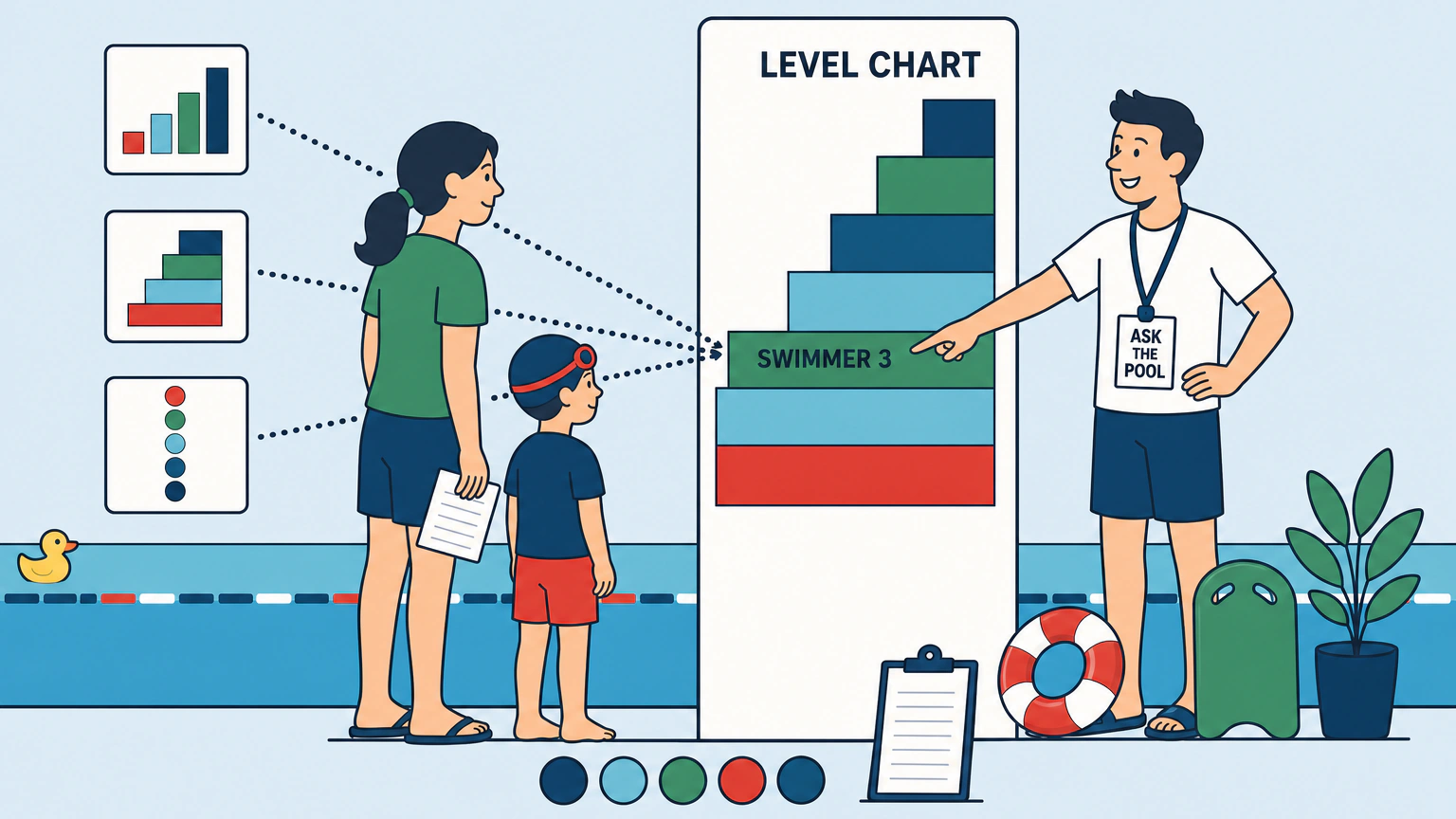
| 5 or 6 years and up | Swimmer 3 | Swim Kids 3 to 4 | Swimmer | Consistent |
| 5 or 6 years and up | Swimmer 4 | Swim Kids 5 | Star 1 | Consistent |
| 5 or 6 years and up | Swimmer 5 | Swim Kids 6, or 6 to 7 | Star 2 | Varies |
| 5 or 6 years and up | Swimmer 6 | Swim Kids 7, or 7 to 8 | Star 3 | Varies |
| 8 years and up | Rookie Patrol (Swimmer 7) | Swim Kids 8, or 8 to 9 | Star 4 | Varies |
| 8 years and up | Ranger Patrol (Swimmer 8) | Swim Kids 9, or 9 to 10 | Star 5 | Varies |
| 8 years and up | Star Patrol (Swimmer 9) | Swim Kids 10 | Star 6 or Star 7 | Consistent |
Red flag: three things should slow you down before you pay.
- A pool that won't tell you which program it delivers. Ask for the name that gets printed on the report card. That's the only label that travels to another city.
- A conversion chart with no date on it. Look at whether it still lists Red Cross levels as current. If it does, it may predate the transition, so confirm its mappings with the facility before you lean on them.
- A facility that says a lapsed Bronze Star is worthless. The Society's published prerequisite for Bronze Medallion says a Bronze Star certification "need not be current". Ask them to point at their source.
Where the published charts disagree, and what to do about it
In the school-age Swimmer block, the two dated charts agree through Swimmer 4. Above that they drift, and the drift is a full level wide. Edmonton maps Swimmer 5 to Swim Kids 6. Fredericton maps the same level to Swim Kids 6 to 7. Edmonton maps Rookie Patrol to Swim Kids 8, Fredericton to Swim Kids 8 to 9. The Preschool block drifts for a different reason. Edmonton runs separate 3-year-old and 4-to-5-year-old tracks, so one level can have different Red Cross equivalents depending on your child's birthday and the chart in front of you. So here's the working rule: use the chart as a starting point at every level, and book the assessment whenever the rows diverge or you are unsure. Edmonton's own chart tells you the same thing: "Please register for a 15 minute Swim Assessment to determine an appropriate level to register in if unsure." That's our advice too. When the two charts disagree about your child, book the fifteen minutes and stop guessing.
When your city runs its own ladder: the Toronto case
Some large municipalities don't use Swim for Life names at all. They run their own ladders and print their own report cards. Toronto is a clear example.
Guardian Swim, Preschool Swim and Ultra Swim
The City of Toronto runs three learn-to-swim ladders of its own. Guardian Swim 1 to 3 covers six months to five years, with one caregiver in the water per swimmer. Preschool Swim 1 to 4 (Penguin, Stingray, Otter, Dolphin) covers three to five years without a caregiver, and 15-minute one-to-one Tiny Tots classes run alongside it for 18 months to three years. Ultra Swim 1 to 9 carries five to 16 years, with Ultra Youth Swim for nine to 16 and Adult Swim for 17 and over. Neither dated conversion chart carries any of those names. So a Toronto report card may not translate directly in Regina, and a Swim Kids card may not translate directly in Toronto. Just moved? Start with swim lessons in Toronto and expect to be assessed.
How to place a child when no chart applies
Use the skills, not the level number. Toronto's instruction for its progressive programs is that "children should be registered into the appropriate level based on skill, not age", and it invites new swimmers to turn up at a pool during leisure swim and be assessed there. The programs we compared share many of the same underlying items, so a supervisor who has never heard your child's old level name can still place them from a skills list. Toronto screens every swimmer on day one anyway, then sends home a report card naming the level to register in next.
Pro tip: photograph the skills list on the old report card, not just the level name. Floats, glides, treading time and metres of front crawl mean the same thing in every program. The level name is only a label sitting on top of them.
What the Lifesaving Society branch in your province delivers
The Society is organized as provincial and territorial branches, and they publish different age bands and naming styles for the same national program. That's the most common reason a family that moves across a provincial line finds the ladder has quietly changed shape under them.
Province-by-province comparison
| Province | Branch | Program name used | Published age band for Swimmer | Level naming style |
|---|---|---|---|---|
| Ontario | Lifesaving Society Ontario | Swim for Life | Children 5 years and older | Numbered; Rookie, Ranger and Star Patrol named separately |
| British Columbia | Lifesaving Society BC & Yukon | Swim for Life | Recommended 5 to 12 years | Animal names for Parent & Tot and Preschool; Swimmer levels 1 to 9, Patrol included |
| Alberta | Lifesaving Society Alberta & NWT | Swim for Life, plus SwimAbilities | Not published on the branch program page | Numbered; Edmonton's city chart numbers Patrol as Swimmer 7 to 9 |
| Saskatchewan | Lifesaving Society Saskatchewan | Swim for Life | Children 6 years and older | Numbered; Canadian Swim Patrol kept separate |
| Manitoba | Lifesaving Society Manitoba | Swim for Life | Children 5 years and older | Numbered; Patrol kept separate |
| Quebec | Société de sauvetage | Nager pour la vie | Nageur 1 to 6, children 5 years and older | French numbering; Nageur 7 to 9 are the Jeune sauveteur awards |
Ontario and British Columbia differ most in naming, so if those two are the ones you're comparing, start with Ontario lesson providers or British Columbia lesson providers and read the level names each one prints.
The provinces we could not verify, and how to check yours
Nova Scotia's branch confirms that Swim for Life and Canadian Swim Patrol are taught in the province, but it publishes no per-level age band, so we left it out rather than print a guess. We didn't get to the territories or the rest of Atlantic Canada this time either, and we'd rather say so than fill a row with something plausible. Checking your own province takes one phone call anyway. Saskatchewan's branch describes the normal route plainly: lessons run at municipal aquatic facilities, regional and provincial parks, summer camps and private organizations, and "registration is done directly through the facility". Ask the facility, not the Society.
After Swimmer 6: the leadership ladder
This is where lessons begin to lead toward a first job. Finishing Star Patrol puts a swimmer on the published path to Bronze Medallion, Bronze Cross and National Lifeguard. Bronze Star can be taken first. Age and local employment requirements still apply on top of all of it. It's the same decoding problem as what a Canadian training certificate actually gets you on the road.
Bronze Star, Bronze Medallion, Bronze Cross
| Award | Published prerequisite | Course length | Fitness standard | Certification expiry |
|---|---|---|---|---|
| Bronze Star | No age requirement; swimming ability required; Swimmer 6 and/or Swim Patrol recommended | 10 hours | 400 metre fitness challenge, untimed | Not stated on the branch page |
| Bronze Medallion | 13 years of age OR Bronze Star certification (need not be current) | 18 hours plus 2 or more for the exam | 400 metre swim timed within 12 minutes | Two years |
| Bronze Cross | Bronze Medallion certification (need not be current) | 20 hours plus 2 or more for the exam | 400 metre swim timed within 11 minutes | Two years |
| National Lifeguard (pool) | Minimum 15 years of age; Bronze Cross (need not be current); Standard First Aid/CPR-C or Aquatic Emergency Care/CPR-C | Minimum 40 hours | Timed object recovery, 50 m sprint, 50 m rescue drill, 400 m endurance | Two years |
Those figures are published by the Lifesaving Society Saskatchewan branch. Other branches can add requirements on top, so read your own branch's page before you book anything.
Two prerequisite conflicts to check locally
This is where a parent gets told two different things by two official sources. The Fredericton YMCA conversion chart states that Bronze Star is for "Ages 10-12yrs" and that Bronze Medallion needs a Bronze Star certification that "need to be current". Saskatchewan's Lifesaving Society branch publishes different prerequisites: Bronze Star has no age requirement, only swimming ability, and Bronze Medallion asks for 13 years of age or a Bronze Star certification that "need not be current". Lifesaving Society Canada's national FAQ, however, lists Bronze Star as ages 10 to 12, showing that published guidance conflicts. We can't settle that for you. What you can do is check your branch's page first, then ask the facility to point at its source.
What swim lessons cost in Canada, and how to register in the right level
A first-party price benchmark
Our swim lesson page publishes cost figures drawn from submitted profiles. Across those cost profiles the average sits at $136 CAD, with a typical range of $106 to $204, a low of $80 and a high of $375. Those are our own panel figures rather than a national statistic, and the panel shifts with the visitor's location as new profiles arrive. Use it to sanity-check a quote from swim schools near you, then confirm the number on the facility's own registration page. How we assess the providers we list is set out in who we are and in our Best of awards methodology.
Questions to ask before you register
- "What program does this pool run, Swim for Life, your own levels, or something else?" The answer tells you whether a Red Cross conversion means anything at this particular desk.
- "My child finished [level name] at another pool. What do you place that as here?" Give them the level name and the skills in the same breath, and ask them to note the placement on the file.
- "Do you offer a free or low-cost swim assessment before registration closes?"
- "How many children are in the class, and what is the instructor-to-swimmer ratio at this level?" Ratios are published and they vary by level. Toronto caps Preschool Swim at 4 swimmers per instructor, and Ultra Swim 6 to 9 at 10.
- "If the level turns out to be wrong in week one, can we move without paying again?" Get the transfer rule before you pay. If the answer is vague, read your rights on a prepaid lesson contract before you hand over a card.
Frequently asked questions
What swim level is my child if their report card says Swim Kids 4?
Register for Swimmer 3. Both dated charts put Swim Kids 3 and Swim Kids 4 in the same place: Edmonton's chart pairs Swimmer 3 with "Swim Kids 3/4", and the Fredericton YMCA chart with "Swim Kids 3-4". Then ask the pool to confirm the placement in week one, because the pool is the one that decides it.
How many swim levels are there in Canada?
There's no single national number, because it depends on the program your pool delivers. Swim for Life publishes 3 Parent & Tot levels, 5 Preschool, 6 Swimmer and 3 Canadian Swim Patrol awards, which some branches number as Swimmer 7, 8 and 9. Toronto runs its own 9-level Ultra Swim ladder on top of that.
Are Red Cross swim levels still used in Canada?
Not as a general national program. The Canadian Red Cross announced on 12 January 2022 that it was winding down its swim and lifeguard programming and encouraged training partners to move to Lifesaving Society programs during that year, while training continued in First Nations communities under its Indigenous Peoples Framework. The names still turn up on old report cards and on conversion charts.
What age is each Lifesaving Society swim level for?
The published bands run Parent & Tot up to 3 years, Preschool 3 to 5 years, Swimmer 5 years and older, Adult Swimmer over 16, and Fitness Swimmer at any age. Canadian Swim Patrol generally starts around 8. Saskatchewan is the outlier, publishing Swimmer as 6 years and older, so check your own branch before assuming your child is old enough.
What is the difference between Swimmer 6 and Rookie Patrol?
Swimmer 6 is the last learn-to-swim level, and it finishes with stride entries, compact jumps and lifesaving kicks. Rookie Patrol is the first Canadian Swim Patrol award, and it stacks timed swims, fitness workouts and first aid on top of the stroke work. Confusingly, British Columbia and Edmonton both label Rookie Patrol as Swimmer 7.
Does the YMCA use the same swim levels as my city pool?
Not necessarily. Several YMCA associations run their own named ladder and publish a conversion guide to the Lifesaving Society levels, such as the Fredericton YMCA's Splashers, Bobbers, Otter, Dolphin and Star 1 to 7. Ask which program your branch delivers, and ask what name it prints on the certificate you'll be carrying to the next city.
Can my child move up a level partway through a session?
Sometimes. Toronto screens every swimmer on the first day to confirm the level matches their ability, and instructors keep evaluating through the session. Whether the move actually happens depends on space in the other class and on the facility's transfer rule. Ask about both before you pay rather than after.