

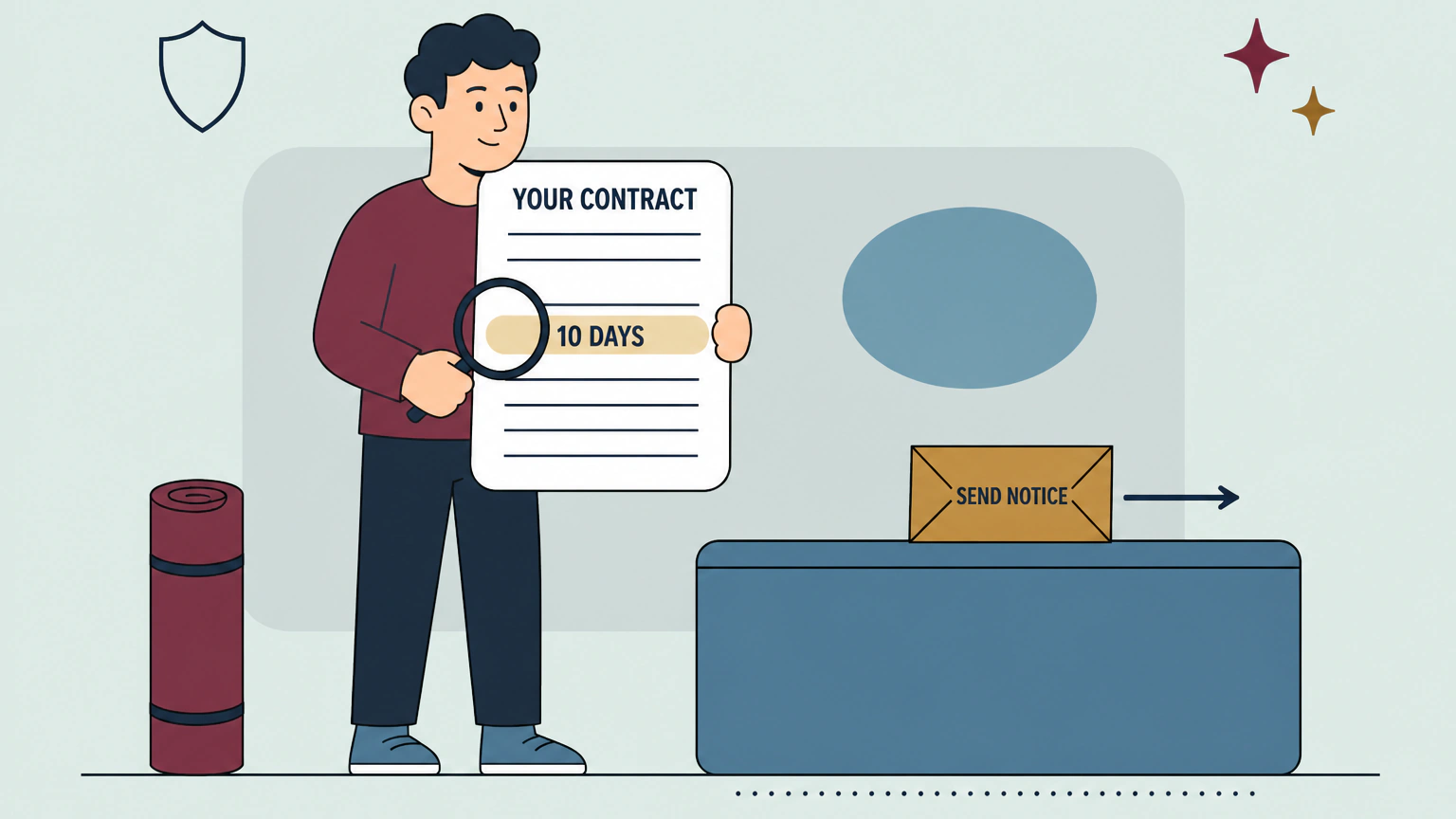
That answer is Ontario's, and only Ontario's. Cross into Quebec, British Columbia or Alberta and it changes completely.
On this page
- The short answer, and the clock most people get wrong
- First, is your contract even covered?
- The four money rules a studio has to follow
- How to cancel so that it sticks
- Past the 10 days? Four doors that may still be open
- When the money keeps coming out anyway
- Outside Ontario: three provinces, three very different answers
- Before you sign: five questions at the desk
- Frequently asked questions
- How current this is
The short answer, and the clock most people get wrong
Your 10 days start later than you think
Section 35 (1) lets you cancel "without any reason ... at any time within 10 days after the later of receiving the written copy of the agreement and the day all the services are available." Two dates, and the later one wins. Sign on 1 September for a studio whose new floor opens on 15 September, and your 10 days run from the 15th.
You do not have to give a reason, or strictly, put it in writing
Section 92 (3) says that unless the regulations require otherwise, notice "may be oral or in writing and may be given by any means," and the rights statement studios must print asks only for "any means that allows you to prove the date on which you gave notice." Send it in writing anyway. The date is the one fact you may have to prove.
Cancellation bites the moment you send it
"The cancellation takes effect when the consumer gives notice" (s. 94 (2)), and written notice not personally delivered is "deemed to be given when sent" (s. 92 (4)). It doesn't wait for the business to process or approve it. Copy that first line somewhere you can find it again. It answers every charge that lands after your notice went out.
First, is your contract even covered?
The Ontario definition is a closed list
These rules apply to "personal development services," which s. 20 (1) defines as services provided for:
- health, fitness, diet or matters of a similar nature
- modelling and talent, including photo shoots relating to modelling and talent, or matters of a similar nature
- martial arts, sports, dance or similar activities
- other matters as may be prescribed
Clause (b) then pulls in "facilities provided for or instruction on" those services, plus goods supplied incidentally. The building and the lessons come with the activity.
What that means for the classes people actually buy
Read that list against the words on your own contract.
| What you signed up for | Named in the Ontario definition? | Where it sits in s. 20 (1) |
|---|---|---|
| Gym or fitness club membership | Yes | "health, fitness, diet or matters of a similar nature", (a)(i) |
| Yoga, Pilates or aerial studio | Yes | Same branch, (a)(i) |
| Martial arts, karate, boxing or kickboxing | Yes | "martial arts", (a)(iii) |
| Self-defence course | Yes | "martial arts ... or similar activities", (a)(iii) |
| Dance, ballet, hip hop or ballroom | Yes | "dance", (a)(iii) |
| Swim lessons and other sports instruction | Not named; coverage is interpretive | "sports ... or similar activities", (a)(iii); the Ontario government's own page lists "sports clubs" |
| Modelling or talent programs | Yes | (a)(ii), including photo shoots |
| Piano, guitar, vocal, mathematics or ESL lessons | Not named | The list does not include music or academic instruction; other parts of the Act may still apply |
Piano, guitar, vocal, mathematics and ESL contracts are absent from that definition, and absence is not a ruling. It does not mean those contracts are unprotected. "Sports ... or similar activities" is an interpretation too, every time your activity is not spelled out by name. Ask Consumer Protection Ontario about anything sitting at that edge before you rely on a 10-day right. If you're still shopping, martial arts schools across Canada sell the kind of contract that sits squarely inside the definition.
The $50 threshold and the five exceptions
Sections 30 to 36 engage only where payment in advance is required and your total potential payment obligation, excluding the cost of borrowing, exceeds a prescribed amount (s. 29 (1)). O. Reg. 17/05, s. 27 sets that at $50.
Section 29 (2) then carves out five suppliers: non-profit or co-operative, a private club primarily owned by its members, an incidental part of other goods or services, a supplier funded or run by a charitable or municipal organization or by the Province of Ontario or its agencies, and a golf club. So a YMCA program sits outside these rules. So does a City recreation registration, and so does the fitness room bundled into a spa package.
The four money rules a studio has to follow
A contract cannot run longer than a year
"No personal development services agreement may be made for a term longer than one year after the day that all the services are made available to the consumer" (s. 31 (1)), and any renewal or extension beyond that is deemed a separate agreement of one year or less (s. 31 (2)). Section 31 (5) carves out successive monthly renewals you can end on one month's notice or less.
Initiation fees are capped, and there can only be one
Section 33 is two lines and both matter: a supplier may not charge more than one initiation fee, and may not charge one greater than twice the annual membership fee. A second registration or activation charge in year two is exactly what that section exists to stop.
You must be offered a monthly instalment plan
Every supplier "shall make available to consumers at least one plan for instalment payments of membership fees and initiation fees" allowing equal monthly payments across the term (s. 34 (1)), and the total paid by instalments may not exceed the fee by more than 25 per cent (s. 34 (2)). This is a right, not a courtesy. Ask for the equal-monthly figure in writing.
They cannot sell you a second overlapping contract
While one agreement runs, a supplier may not enter a new personal development services agreement with you unless the new services are distinctly different (s. 32 (1)). One made in breach of that is void (s. 32 (2)), and s. 32 (3) closes the loophole: a different term or commencement date is not a distinct difference. This is the upgrade-you-mid-term rule.
| Rule | What the law says | Section |
|---|---|---|
| Maximum term | No agreement longer than one year after all services are available; renewals are deemed separate one-year agreements | CPA 2002, s. 31 (1)-(2) |
| Monthly rolling memberships | Exempt from the deemed-separate-agreement and renewal-requirement rules if you can end on a month's notice or less | s. 31 (5) |
| Initiation fees | One only, and no more than twice the annual membership fee | s. 33 |
| Instalments | At least one equal-monthly plan must be offered; the total by instalments may not exceed the fee by more than 25% | s. 34 (1)-(2) |
| A second overlapping contract | Void unless the services are distinctly different; a different term or start date is not a difference | s. 32 |
| Paying for a facility that is not open yet | Money must be held by a registered trust corporation acting as trustee, unless you agreed in writing to use an alternate facility until it opens | s. 36 (1)-(2) |
Red flag: four things a contract cannot do. - It cannot ask you to sign away the 10-day right, or any other right under the Act: those rights "apply despite any agreement or waiver to the contrary" (s. 7 (1)), and an agreement not made in accordance with the Act is not binding on you (s. 93 (1)). - It cannot charge a second initiation fee, or a first one greater than twice the annual membership fee (s. 33). - It cannot force you into an upfront lump sum with no equal-monthly option (s. 34 (1)). - It cannot roll you into a new overlapping agreement for the same services (s. 32).
How to cancel so that it sticks
Where to send it
Send your notice to the address set out in the agreement (s. 92 (5)). If you never received a written copy, or no address is printed in it, use any address of the supplier on record with the Government of Ontario or the Government of Canada, or any address you know.
What to say
Keep it short. Every line in it comes from something the Act or the prescribed rights statement already asks for.
Date: [today's date]
To: [studio or club name, and the address in my agreement]
Re: membership or contract number [number], in the name of [your full name]
I am cancelling this agreement under the Consumer Protection Act, 2002. I received my written copy on [date] and all the services became available on [date].
Please refund every payment made under this agreement within 15 days, as required by O. Reg. 17/05, s. 79 (1), and cancel any pre-authorized payments.
[Your address, email and phone number]
Send it by a method that records the date, and keep the receipt.
What has to happen next
The supplier must meet its cancellation obligations "within 15 days after the day the consumer gives notice" (O. Reg. 17/05, s. 79 (1), applying s. 96 (1)). Cancellation reaches past the membership too. Section 95 cancels, as if they never existed, the agreement itself, every related agreement, every guarantee and security given for money payable under it, and every credit agreement and payment instrument, promissory notes included, that the studio extended, arranged or facilitated. If you financed through a lender the studio introduced you to, that is the section to cite.
Past the 10 days? Four doors that may still be open
The one-year door: a contract missing required content
Section 35 (2) gives you a second right: cancel within one year of entering the agreement if you never received a copy meeting the requirements of s. 30, which are the sixteen-item list in O. Reg. 17/05, s. 28 (2). Six important items are:
- Your name, and the supplier's name, business address and telephone number (paragraphs 1 to 3). A trading name with no street address does not satisfy this.
- An itemized list of the services, fairly and accurately described (paragraph 6, in the regulation's own spelling). "Full membership" is not an itemized list.
- The date on or as of which each service becomes available to you (paragraph 7), service by service, including the pool still being built.
- The total amount payable by you, and the terms and methods of payment (paragraph 12). A monthly figure with no total does not meet it.
- The date the agreement is entered into, its commencement date and its expiry date (paragraphs 14 and 15). All three.
- The prescribed "Your Rights under the Consumer Protection Act, 2002" statement (paragraph 10), in at least 10-point type with a heading in at least 12-point bold, on the first page unless the first page says in 12-point bold where to find it.
If any of these is missing from the copy you were given, s. 35 (2) gives you a year from signing to cancel.
The renewal door
A renewal or extension clause "is not valid unless the supplier complies with the prescribed requirements" (s. 31 (3)). Under O. Reg. 17/05, s. 30 (2), the supplier has to deliver a written renewal notice at least 30 days but not more than 90 days before expiry. That notice has to give the proposed renewal date, say that the Act requires it in that window, carry the supplier's contact details, and state that the agreement will not renew if you say no first. A copy of the agreement, with every change clearly marked, comes with it. Then there is s. 31 (4), the sentence to use before the deadline: tell the supplier before the renewal date that you do not want to renew, and the agreement is deemed not renewed.
The illegal-charge door
If a supplier charged a fee or received a payment in contravention of the Act, you may demand a refund by giving notice within one year of paying it (s. 98 (1)). The refund is then due within 15 days of that demand (O. Reg. 17/05, s. 84). This is the door for a second initiation fee, a term longer than a year, or a void overlapping contract you have been paying on.
The service-quality door
Section 9 (1) deems every supplier to warrant that services are of reasonably acceptable quality, and s. 9 (3) makes any term that tries to negate it ineffective. This is a general right, not a cancellation switch. Start practically: complain in writing, say plainly what is not reasonably acceptable, and give the business a chance to fix it.
When the money keeps coming out anyway
Restate the effective date
Your agreement ended when you gave notice, not when the front desk acknowledged it (s. 94 (2)). Written notice sent other than by personal service counts as given when sent (s. 92 (4)). Every debit after that date is a charge under an agreement that no longer exists.
The credit card route
Where you have cancelled or demanded a refund and the supplier has not refunded within the required period, you may ask the credit card issuer to cancel or reverse the charge and any associated interest (s. 99 (1) and (3)). The deadline is easy to miss: the written request must reach the issuer within 60 days after the end of the refund period (O. Reg. 17/05, s. 85 (1)). The issuer must acknowledge it and then either reverse the charge or explain in writing why it will not (s. 99 (5)).
The complaint route
Consumer Protection Ontario takes complaints through its "Filing a consumer complaint" process and asks you to contact the business first. The ministry may try to resolve the dispute, issue a compliance order or investigate. The refund demand, the credit card request and, if needed, an action under s. 100 remain separate recovery routes.
A note on collections and credit
A disputed balance can be reported to a credit bureau while it is unresolved. Keep dated proof of your cancellation and any refund demand; you do not need to buy credit repair to use the rights in the Act.
Outside Ontario: three provinces, three very different answers
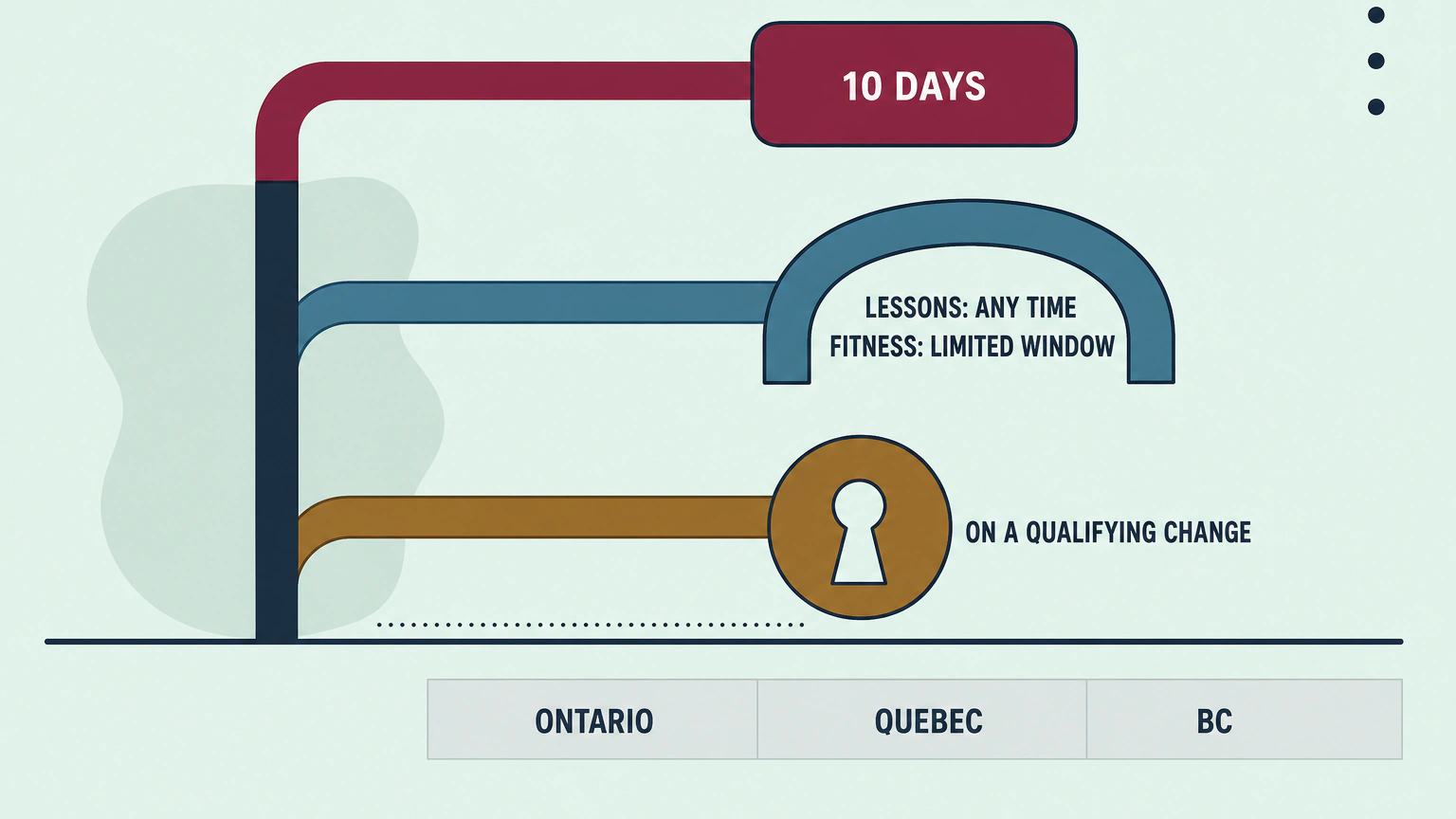
Quebec gives lesson buyers a broad any-time right
Sections 189 to 196 govern contracts of service involving sequential performance whose object is instruction, training or assistance for developing, maintaining or improving a person's health, appearance, skills, qualities, knowledge or intellectual, physical or moral faculties. Dance, martial arts, swim, music and tutoring all read onto that. Section 193 is the one to know: you may cancel "at any time and at his discretion," and the contract is cancelled of right from the sending of the notice. Cancel before the merchant has begun performing and there is no cost or penalty at all (s. 194). After that, the merchant may keep only the price of services actually rendered plus a penalty capped at the lesser of $50 or 10% of the price of the services not rendered (s. 195), and must return the rest within ten days (s. 196). Section 192 also bars payment before the merchant starts and requires at least two approximately equal instalments.
Quebec treats fitness studios separately, and less generously
Section 189 expressly excludes contracts made by a merchant operating a physical fitness studio, defined at s. 198 as an establishment providing goods or services designed to improve physical fitness through weight change, weight control, treatment, diet or exercise. Those run under ss. 197 to 204 instead. The contract may not exceed one year (s. 200). Payment before the merchant begins is barred, and at least two approximately equal instalments are required (s. 201). You may cancel free of charge before the merchant begins performing (s. 202). Afterwards you may cancel within a period equal to one-tenth of the intended duration, and the studio may keep no more than one-tenth of the total price (s. 203). There is no open-ended any-time right here. The studio must also hold a permit (s. 321 (c)).
British Columbia rewrote its coverage test in 2026
British Columbia's class is the "fitness or other personal services contract", defined at s. 17 of the Business Practices and Consumer Protection Act as a future performance contract for fitness or other personal services on a continuing basis "that is designated by regulation." For that definition, reg. s. 1.1 sets the future-performance threshold at a cumulative total price of $50 before taxes and listed costs. B.C. Reg. 272/2004, s. 2 was replaced by B.C. Reg. 10/2026 and no longer names activities. It designates a contract where the supplier supplies physical fitness services offered for the benefit of flexibility, strength or aerobic capacity at an associated facility, or other personal services relating to physical fitness, including instruction, training or assistance given individually or in groups. That's a functional test, so read it against what your provider actually supplies rather than hunting for your activity by name.
Where it applies, the rights are strong. You have 10 days from receiving a copy of the contract (s. 25 (1)), and a maximum duration of two years including the cumulative total of all options and rights to extend or renew (s. 24 (3)). You may also cancel at any time on a material change (s. 25 (2)). Section 25 (3) defines that to include your death, a physical, medical or mental disability substantiated in writing by a medical practitioner or nurse practitioner, or a relocation putting you more than 30 km further away without reasonably comparable alternatives. Then s. 25 (4) covers the supplier closing, substantially changing or relocating so that the distance increases by more than 30 km without a reasonably comparable alternative. Refunds on a material change are due within 15 days, proportional to unused services, less 30% for the supplier's costs where the change is yours (s. 25 (6); reg. s. 3). Break the two-year cap and fail to refund the excess in time, and the court must enter judgment for three times the unpaid amount (s. 24 (7)). One qualifier: reg. s. 2.1 switches that cap off for a contract you can end at any time, or after an initial term of two years or less, on 30 days' written notice without reasons and without cost.
Alberta has no sector-specific gym or lesson cancellation regime
Alberta's Consumer Protection Act has no fitness, lesson or membership regime. The words "fitness", "health club", "gymnasium", "martial arts" and "personal development" appear nowhere in the current consolidation. Its 10-day no-reason right in s. 27 applies to a direct sales contract, which s. 24 (a.1) defines as one negotiated or concluded in person "at a place other than the supplier's place of business." A membership signed at the front desk is outside that, so your contract's own cancellation clause governs, plus the Act's general unfair-practice provisions if you were misled.
Everywhere else
We checked four provinces against the primary legislation and stopped there. Nothing in the Ontario, Quebec, British Columbia or Alberta rules carries across to Manitoba, Saskatchewan, Nova Scotia or anywhere else. To find your own authority, search your provincial consumer-affairs ministry for "consumer protection" together with "fitness" or "prepaid services", open the statute and the regulation made under it rather than a summary, and check the currency date on the consolidation.
| Province | Sector-specific law? | Maximum length | Cancel with no reason | Cancel later, for cause | Source and currency |
|---|---|---|---|---|---|
| Ontario | Yes: personal development services, CPA 2002 ss. 29-36 | One year after all services are available (s. 31 (1)) | Within 10 days of the later of receiving your copy and all services being available (s. 35 (1)) | Within one year if the contract is missing required content (s. 35 (2)); no medical or relocation right | e-Laws, currency date 2026-08-12 |
| Quebec | Yes, two regimes: instruction (ss. 189-196) and physical fitness studios (ss. 197-204) | One year for fitness studios (s. 200) | Instruction: at any time, at your discretion (s. 193). Studios: free before performance begins (s. 202) | Instruction: merchant keeps services rendered plus the lesser of $50 or 10% of services not rendered (s. 195). Studios: within one-tenth of the intended duration, keeping at most one-tenth of the price (s. 203) | LégisQuébec English consolidation, updated to 2026-04-02 |
| British Columbia | Yes: fitness or other personal services contracts, designated by reg. s. 2 as replaced by B.C. Reg. 10/2026, a functional physical-fitness test with no named activities | Two years including every option and right to extend or renew (s. 24 (3)), except a contract meeting reg. s. 2.1's no-cost 30-day cancellation terms | Within 10 days of receiving a copy (s. 25 (1)) | At any time on a material change: death, substantiated medical disability, a relocation increasing the distance by more than 30 km without a comparable alternative, or the supplier discontinuing or substantially changing services or similarly relocating (s. 25 (2)-(4)) | BC Laws; Act and regulation current to 2026-08-11 |
| Alberta | No: no fitness, lesson or membership regime | Not set by statute | None if you signed on the business's own premises; s. 27's 10-day right covers only direct sales contracts concluded away from them (s. 24 (a.1)) | Not set by statute; general unfair-practice provisions apply | Alberta King's Printer consolidation, current as of 2026-07-14 |
Class Contract Rights Finder
Three questions. Your rights are not the same in every province.
- What you can do
- You may have Ontario's 10-day right.
- The rule
- If advance payment is required, your total potential obligation exceeds $50, and no statutory supplier exception applies, you may cancel without a reason within 10 days after the later of receiving your written copy and all services becoming available. Cancellation takes effect on notice; refund is due within 15 days.
- Where it says so
- Consumer Protection Act, 2002, ss. 29, 35(1), 94(2); O. Reg. 17/05, ss. 27, 79(1)
- Do this next
- Check the scope conditions, then send notice to the supplier's agreement address and keep dated proof.
- ONTARIO — COVERED CONTRACTS: 10 DAYS
- QUEBEC — LESSONS: ANY TIME; FITNESS: LIMITED WINDOW
- BC — FUNCTIONAL COVERAGE TEST; ON A QUALIFYING CHANGE
These are the statutes as they stood in August 2026.
This is general information about Canadian consumer law, not legal advice. Statutes change — check the current text before you act.
Before you sign: five questions at the desk
What to ask
Each one comes from a rule in the Act rather than from generic advice, and each has an answer you can check on the spot.
- What starts my 10 days? You want the date you receive the written copy and the date every service, including any facility still being finished, becomes available.
- What is the initiation fee, and what is the annual membership fee? Two numbers, so you can test s. 33's cap yourself.
- What does the monthly instalment plan cost against paying upfront? Get both totals in writing and check the gap against the 25% ceiling in s. 34 (2).
- When and how will you send the renewal notice? The answer should name a method written into the agreement and a window of 30 to 90 days before expiry.
- What happens if I move or get injured? Ontario's rules give you nothing here, so anything offered is goodwill. Get it in the contract, not in conversation.
Where to compare providers first
The cheapest way to avoid a cancellation fight is to sign with a provider you have already checked. You can compare gyms and personal trainers near you, look at dance studios near you, or browse yoga studios and class passes before committing to a term.
Knowing the going rate helps too. Re-read live on 16 August 2026, the dance panel showed a national average of $365 with a fair range of $320 to $639 from 644 cost profiles, and the martial arts panel a national average of $112 with a typical range of $93 to $139 from 925 cost profiles. Those figures are our own aggregate of prices quoted by listed providers, in Canadian dollars rather than a market statistic, and the panel re-resolves to whatever location it decides you are in, so read them as scale rather than as a quote. Our guide to what a BDE certificate actually buys you covers a separate Ontario topic, one the personal development services rules do not govern.
Frequently asked questions
Can a gym refuse to cancel my membership in Ontario?
No, not where the Act applies. Cancellation takes effect when you give notice (s. 94 (2)), so the business's agreement or refusal is not part of the test. A term asking you to sign the right away doesn't work either, because rights under the Act "apply despite any agreement or waiver to the contrary" (s. 7 (1)), and an agreement not made in accordance with the Act is not binding on you (s. 93 (1)).
Do I have to cancel in writing, or is a phone call enough?
Section 92 (3) allows oral notice unless the regulations require otherwise, and the prescribed contract statement asks only for "any means that allows you to prove the date on which you gave notice." So a phone call can be valid notice. Send it in writing anyway, because the date is the fact you may have to prove, and written notice counts as given when sent (s. 92 (4)).
If I cancel, do I get a refund — and how fast?
Within 15 days of your notice. O. Reg. 17/05, s. 79 (1) gives the supplier 15 days after the day you give notice to meet its s. 96 (1) obligations. Cancellation also unwinds related agreements, guarantees, security and any linked credit agreement or promissory note as if they never existed (s. 95), which matters if you financed the membership.
Can I cancel because of an injury, illness or a move?
Not under Ontario's personal development services rules, which contain no medical or relocation right. In British Columbia, yes: s. 25 (2) to (4) allow cancellation at any time on a material change, including a disability substantiated in writing by a medical practitioner or nurse practitioner, or a relocation that increases the distance by more than 30 km without a reasonably comparable alternative.
The gym keeps charging me after I cancelled. What now?
Your agreement ended when you gave notice (s. 94 (2)). Demand a refund of the illegal charges in writing within one year of paying them (s. 98 (1)). The refund is then due 15 days later (O. Reg. 17/05, s. 84). If it doesn't arrive, ask your credit card issuer in writing to reverse the charges within 60 days of the end of that refund period (s. 99; reg. s. 85 (1)), and file a complaint with Consumer Protection Ontario.
Are my child's dance or martial arts classes covered by the same rules?
Yes in Ontario. "Martial arts, sports, dance or similar activities" sits in the definition at s. 20 (1)(a)(iii), and clause (b) adds the instruction and the facility. British Columbia no longer designates activities by name: since B.C. Reg. 10/2026 replaced reg. s. 2, coverage turns on whether the provider supplies physical fitness services or personal services relating to physical fitness.
How long can a prepaid lesson or membership contract last?
One year in Ontario (s. 31 (1)), and one year in Quebec for physical fitness studios (s. 200). Two years in British Columbia, counting the cumulative total of every option and right to extend or renew (s. 24 (3)), unless the contract meets reg. s. 2.1's no-cost 30-day cancellation terms. Alberta's sector-specific rules set no term limit, so the contract's own term governs there.
Does cancelling a gym membership hurt my credit?
A lawful cancellation ends the payment obligation under the cancelled agreement. A disputed balance can still be reported while unresolved, so keep dated proof of the cancellation and any refund demand.
How current this is
Verified on 16 August 2026
We read Ontario's Consumer Protection Act, 2002 and O. Reg. 17/05 on e-Laws at currency date 12 August 2026. The Consumer Protection Act, 2023 has received Royal Assent but is not yet in force: e-Laws' own proclamations table shows no date in force for Schedule 1, ss. 1 to 109, nor for s. 110, the provision that repeals the 2002 Act. Until it is proclaimed, the older Act is still the one that applies.
We read British Columbia's Business Practices and Consumer Protection Act and Consumer Contracts Regulation on BC Laws, both current to 11 August 2026, the regulation last amended 1 August 2026 by B.C. Reg. 10/2026. Quebec's Consumer Protection Act came from LégisQuébec, English consolidation updated to 2 April 2026. Alberta's came from the King's Printer office consolidation current as of 14 July 2026. The prices on our category pages were re-read live on 16 August 2026.
We're describing Canadian consumer legislation in general terms here, not giving legal advice on your contract. Statutes change, so before you act on a specific agreement, confirm the current text and consider a call to your provincial consumer-protection office.