

On this page
- Why water wings won't keep your child safe
- What to put on your child instead
- How to tell if a lifejacket is approved in Canada
- What city pools say about water wings and lifejackets
- Where the rules are law, and where they're advice
- What the Lifesaving Society's lessons use instead of water wings
- Questions parents ask about water wings
Why water wings won't keep your child safe
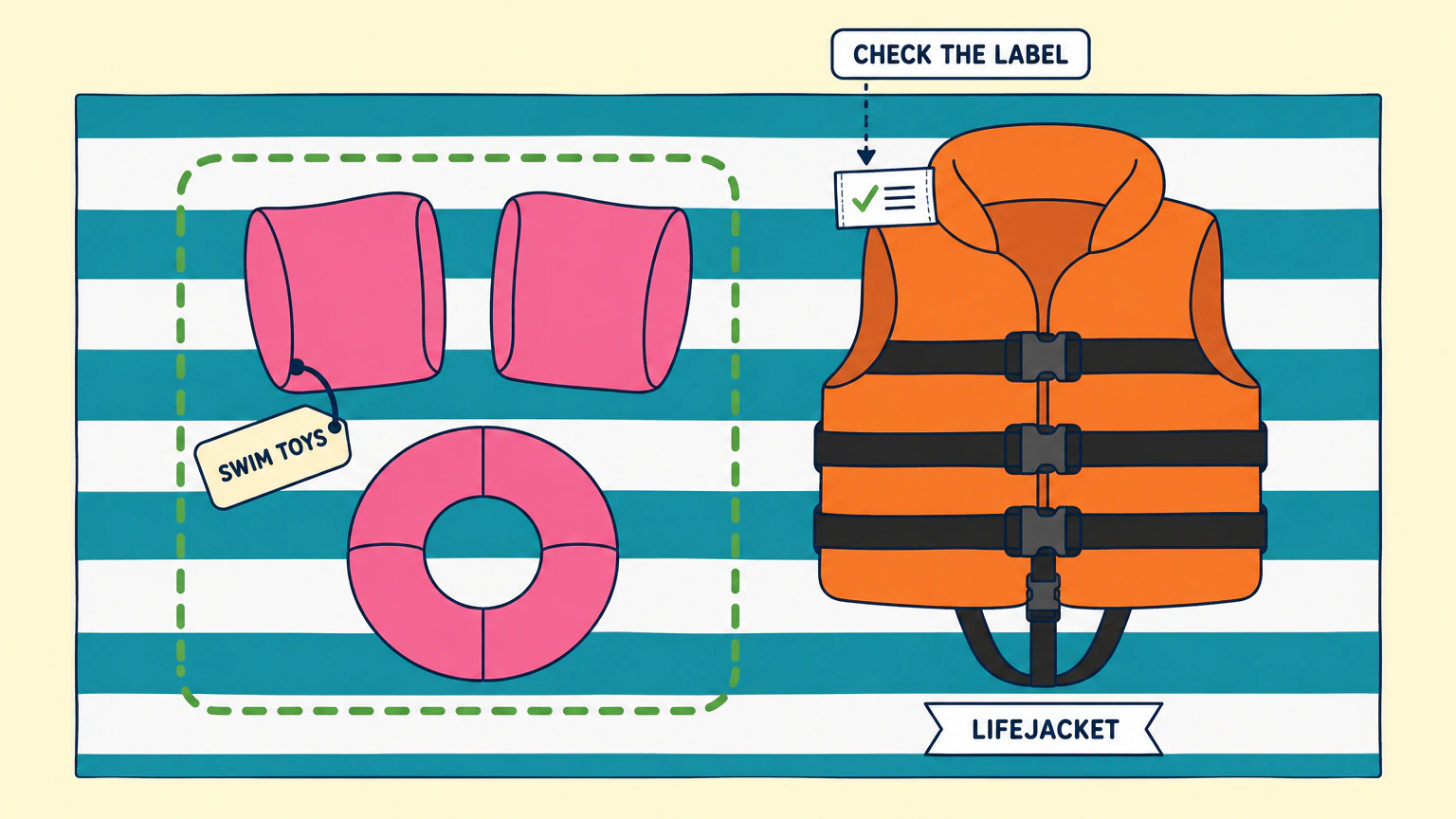
Water wings hang in the same summer aisles as lifejackets, so it's easy to file them as the same kind of gear. The Canadian water safety groups we checked put them on the other side of the line, with the toys.
What Canada's water safety groups say about them
Health Canada is blunt. Children should be closely monitored "even when they use swimming aids such as armbands, floating seats, water wings and neck rings. These devices are not intended to save lives." It adds that swimming aids "can give a false sense of security, which could result in a lack of proper supervision." Health Canada also counts drowning among the leading causes of death for children aged 1 to 4.
The others agree. The Lifesaving Society says water wings "do not save lives." The Canadian Paediatric Society names water wings, neck rings, bathing suits with floats built in and other swim toys, and says they "ARE NOT safety devices." Parachute, the national injury prevention charity, says water rings and blow-up rings "are not safety devices" either.
How water wings let a child down in the water
Water wings hold a child up by the arms. That's why the Lifesaving Society says they don't keep the body upright and the head above water. The arms stay up, but nothing holds the face clear. Water wings can also come off or go soft, and the City of Ottawa warns that they "can deflate or slip, leaving a child dangling under water."
The bigger risk is on the deck. A child in bright floats looks taken care of, so the adult relaxes and reaches for a phone. The Lifesaving Society says drowning "is a silent killer and can happen in as little as 10 seconds," and that most toddler drownings happen when a child is alone, even for "a moment."
Canada's boating rules don't trust air to float a child. On a pleasure craft, a lifejacket or PFD worn by anyone under 16 must be inherently buoyant, which means it floats on foam. Transport Canada bans inflatable PFDs for anyone under 16.
Water wings are air.
What to put on your child instead
The Canadian Paediatric Society and Parachute both say a lifejacket or a PFD can work for a child, "as long as it is designed for children." It also needs a Canadian approval label, which takes seconds to find once you know where to look. And it adds a layer. It doesn't replace an adult within arm's reach.
Swim aid or safety device: what each one is
| Item | Approved in Canada? | What we found | Our advice |
|---|---|---|---|
| Water wings (inflatable armbands) | No | The Lifesaving Society says they "do not keep the body upright and head above water" | A pool toy for play within arm's reach, never protection |
| Neck ring or baby float seat | No | Health Canada says swimming aids like these "are not intended to save lives" | Hold your baby in your arms instead |
| Inflatable ring or tube | No | Parachute says water rings and blow-up rings "are not safety devices" | A toy for a child you're standing beside |
| Swimsuit with built-in floats | No | The Canadian Paediatric Society says these "ARE NOT safety devices" | Fine for play, never in place of a lifejacket |
| Vest with arm floats (puddle jumper style) | Only if its label shows Transport Canada approval | The maker says Puddle Jumper vests are approved in both countries as Level 70 devices. Older US-only labels don't count here. | Read the label on the one you're holding |
| Child PFD with a Canadian approval label | Yes | It keeps a child floating, but not necessarily face up | Good for play near water, with you within arm's reach |
| Child lifejacket with a Canadian approval label | Yes | It can turn a child from face down to face up, and Transport Canada says lifejackets offer "a higher level of protection" | The strongest choice for a weak swimmer or a boat ride |
Lifejacket or PFD: which one fits your day
It comes down to what happens if your child ends up face down. A lifejacket can turn a child face up, the Canadian Paediatric Society says, while a PFD keeps a child floating but not necessarily face up. Transport Canada says lifejackets "offer a higher level of protection, compared to PFDs," and they come only in red, orange or yellow. PFDs are lighter, more comfortable and made to be worn all day.
Children's devices are sized by weight, not age. Transport Canada's small vessel lifejackets come in one size for children under 18 kg (40 lb) and another for 18 to 41 kg (40 to 90 lb). On any child's device, look for a large collar to support the head, a strap between the legs, waist ties, buckles and reflective tape.
Grey Bruce Public Health calls lifejackets "the best choice for weak swimmers." Our take: for splashing in a pool with you right beside them, an approved PFD your child will keep on is fine. For a boat or open water, we'd lean to the lifejacket.
What to do with a baby in the water
Transport Canada's boating guide is clear: "There are no approved lifejackets or PFDs for infants under 9 kg (20 lbs)." The boating rules don't even require a properly sized device for a baby that light, and there's no approved one to buy. Infant-sized vests are sold anyway, and Parachute notes "there are no Canadian safety standards for these devices."
So the safety device is you. The Canadian Paediatric Society says a baby who can't sit without support and is too young for a PFD "should always be held by an adult," and it passes on the Lifesaving Society's ratio of one adult for every baby. Parachute says many babies reach 9 kg (20 lb) "around nine to 12 months of age." From then, a properly fitted, approved device becomes an option.
Under 9 kg (20 lb), hold your baby. Canada has no approved lifejacket or PFD for babies that small, so in and near the water your arms are the safety device.
How to tell if a lifejacket is approved in Canada
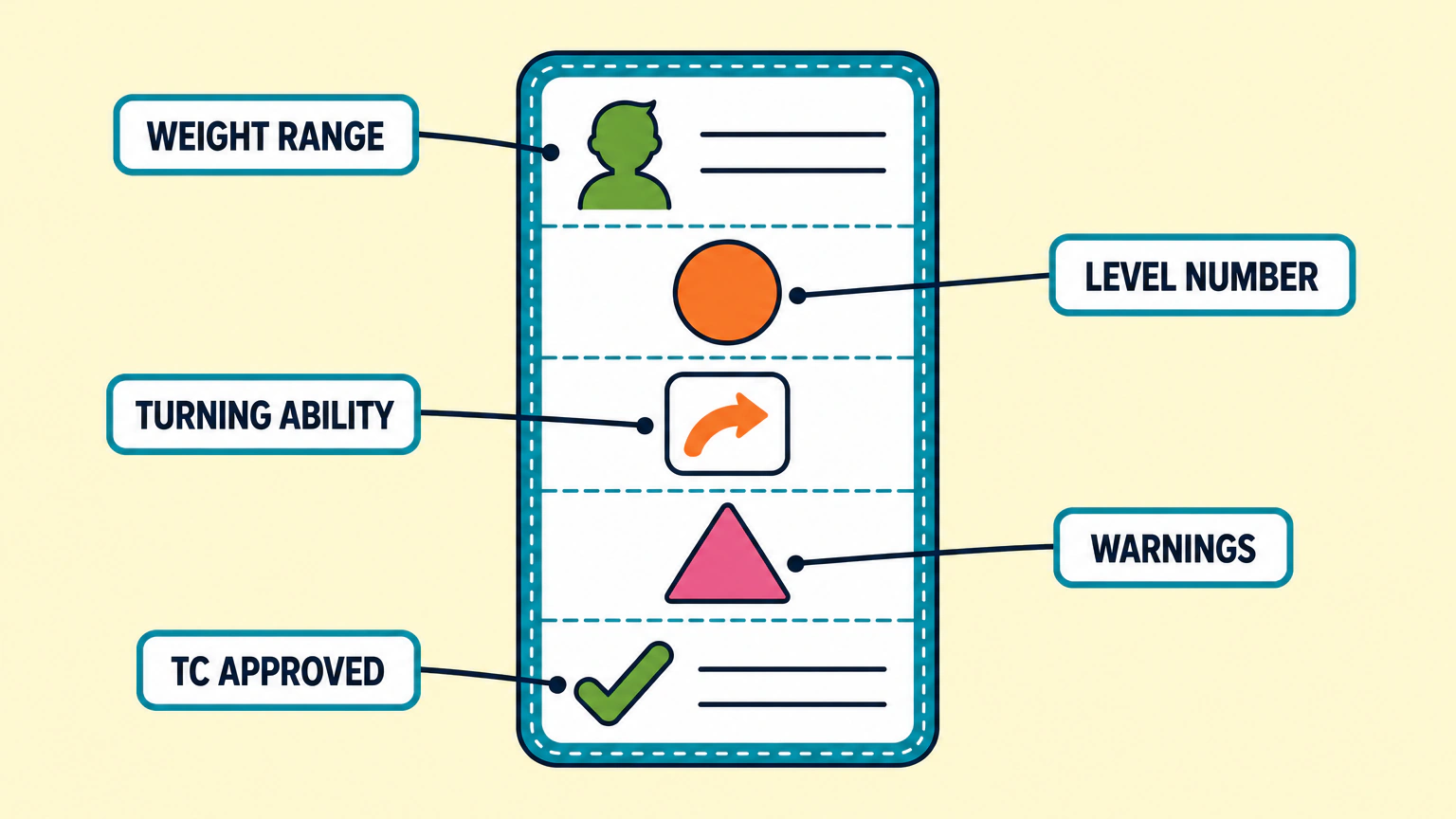
Canada's boating rules say an approved device must "bear a mark or label indicating the approval." So the label is the whole test. The word "vest" on the package approves nothing. Neither does a picture of a lifejacket, or a price tag in US dollars.
Find the approval on the label
The label is inside the device. On an older Canadian label, look for approval by Transport Canada, the Canadian Coast Guard or Fisheries and Oceans Canada. Any of the three counts.
Canada and the US now share lifejacket standards. Transport Canada's boating guide says devices with the new labels "are approved for use in both Canada and the United States," while old-label devices "can still be used in one country or the other, but not both." So a US-only label doesn't count here.
Either way, look for an approval number. A new label carries a "TC Approved" line with its number beside a "USCG Approved" line, and it names the standard (ANSI/CAN/UL 12402). Icons show the performance level, turning ability and warnings, and a new device comes with a hang tag that explains each one. The label also shows the user's weight range and chest size.
Transport Canada adds that a ripped or worn-out device isn't considered approved, whatever its label says.
What the performance level means for your child
The shared standard rates each device by performance level: 50, 70, 100, 150 or 275. Two of those numbers matter most for a child.
Transport Canada says Level 70 buoyancy aids give "the same level of safety" as PFDs made to the old Canadian standards, including the one for children's PFDs. Level 50 is a different story. Its labels must carry the warning "Not recommended for weak or non-swimmers," and Transport Canada approves Level 50 only for sheltered or near-shore water. Levels 100, 150 and 275 stand in for the old lifejacket standards. Inflatable devices, at any level, are approved only for people 16 and older.
So for a child who can't swim yet, we'd look for 70 or higher and never accept 50. That's our call, and it rests on those two Transport Canada rules.
Puddle jumpers in Canada: it depends on the label
A puddle jumper is a vest that joins two padded arm floats, as Today's Parent describes it. Kids like wearing one, and it's less bulky than a lifejacket.
In a 2021 Today's Parent article, Parachute's president and CEO, Pamela Fuselli, said puddle jumpers "haven't undergone the same kind of rigorous testing and they're not made of the same material as a life jacket or a PFD." The magazine added that they aren't approved for boating use by Transport Canada. Grey Bruce Public Health says the same on its water safety page.
But Transport Canada has accepted Level 70 buoyancy aids as PFDs since at least January 2019. And the maker of the Puddle Jumper brand says its vests are "U.S. Coast Guard & Transport Canada-tested and approved for use as a Performance Level 70 personal flotation device."
Both can be true, of different vests. Older vests with US-only labels don't count in Canada, and a lookalike may carry no approval at all. The label on the one you're holding decides.
Swim teachers worry about something else: the upright position. Rishona Hyman, who runs a Winnipeg swim school, told the magazine that "Kids will build muscle memory from being vertical." We'd treat an approved puddle jumper as a PFD for play near you. It's never a reason to step back from the edge, and the swimming itself is what lessons are for.
The 60-second label and fit check
- The label shows approval by Transport Canada, the Canadian Coast Guard or Fisheries and Oceans Canada, or a "TC Approved" line with a number.
- Your child's weight falls inside the weight range printed on the label.
- On a new-style label, the performance level is 70 or higher. A Level 50 label warns "Not recommended for weak or non-swimmers."
- It floats on foam, not air. Transport Canada prohibits inflatable PFDs for anyone under 16.
- It fits snugly and doesn't ride up over your child's chin or ears.
- There's less than 7.6 cm (3 in.) between your child's shoulders and the device.
- The strap between the legs is fastened, along with every other buckle.
- Lift it straight up by the shoulders. It should stay in place, and the zipper shouldn't reach your child's nose.
- There are no rips, broken buckles or faded fabric. Transport Canada doesn't treat a damaged device as approved.
What city pools say about water wings and lifejackets
Pool rules vary by city, and they don't agree on water wings. Of the six city pool systems we checked, every one sets an arm's-reach rule for young children. At any pool, the lifeguard and the posted signs have the last word. Calgary says so outright: "Lifeguards can refuse the use of equipment at any time."
What six city pool systems say about water wings and lifejackets
| City | Who must stay within arm's reach | Water wings and floats | Lifejackets |
|---|---|---|---|
| Toronto (drop-in swims) | Age 5 and under: 1 caregiver aged 14 or older for every 2 children. Ages 6 to 9: 1 for every 4, until a child aged 7 to 9 passes the swim test. | No rule on its drop-in swimming page | No rule on that page |
| Ottawa (city pools) | Age 5 and under: 1 guardian aged 14 or older for every 2 children. Ages 6 to 7, and 8 to 10 without a passed swim test: 1 for every 4. | "We don't recommend water wings as they can deflate or slip, leaving a child dangling under water." | A lifejacket raises the limit to 6 children at ages 6 to 7 and 8 children at ages 8 to 10. No change at age 5 and under. |
| Winnipeg (pools and wading pools) | Pools: under 7, 1 parent or caregiver for every 4 children, in the water and within arm's reach. Wading pools: children under 7 need a parent or guardian aged 12 or older actively watching. | In pools, inflatable toys only with the lifeguard's permission. In wading pools, water wings are allowed. | Pools: a child under 7 who can't swim must wear a lifejacket or PFD and stay in the shallow end. Families are "encouraged to bring their own lifejackets/PFDs" |
| Calgary (city pools) | Under 8: a person aged 14 or older, in the water and within arm's reach, for up to 3 children. | "Baby water wings and tube rings on small children are permitted", within arm's reach and with the lifeguard's prior approval. | Weak or non-swimmers "must wear a PFD or stay shallow" |
| Edmonton (city pools) | Under 8: 1 caregiver aged 15 or older for every 3 children, within arm's reach. | Nothing on its current pool guidelines | Nothing on its current pool guidelines |
| Vancouver (city pools) | Age 7 and under: a guardian aged 16 or older, within arm's reach, for up to 3 children. | Check with pool staff before bringing your own pool items | Nothing specific in its pool guidelines |
Taken from each city's own pool rules pages. Read the signs at your pool too, since Edmonton says each of its pools may add rules of its own.
Ottawa is the only one of the six where a lifejacket changes the supervision math. Water wings never do. Winnipeg goes furthest on lifejackets: in its pools, a child under 7 who can't swim has to wear one. If your child is very young, call the pool before your first visit.
Where the rules are law, and where they're advice
On a boat, the rules are law. Every pleasure craft, canoes and kayaks included, must carry an approved lifejacket or PFD "of an appropriate size for each person on board." For anyone under 16, that device must be inherently buoyant.
Parachute notes that "there is no law requiring people to wear the lifejackets." Some foam devices have wear conditions. An inflatable must be worn in an open boat. And the sample new-style label in Transport Canada's guide says the device "must be worn to be counted" as required equipment, so read yours.
A visitor from outside Canada may use their own home-country device if it fits and is in good shape. The device must also meet the rules of the country where the visitor lives. Take an inflatable tube or toy onto open water, and Transport Canada's guide says enforcement officers will treat it as a pleasure craft.
At a pool or beach, the boating rules don't apply. Health Canada's advice still does: young children and inexperienced swimmers should "always wear an approved lifejacket or personal flotation device when playing around water."
What the Lifesaving Society's lessons use instead of water wings
The Lifesaving Society's lessons teach children to use lifejackets. In its Swim for Life program, a child at Parent & Tot 3 (ages 2 to 3) puts on a PFD on land with help, then practises a jump entry and float "wearing PFD (assisted)." In Preschool 2, children float and glide "wearing PFD or with other buoyant aid," and roll from front to back with the body horizontal. None of the level sheets mentions water wings. The lifejacket message taught at Parent & Tot 3 is "Lifejackets do not replace supervision by an adult." Here's what Canada's swim lesson levels mean if you want the whole ladder.
Skills take time. The Canadian Paediatric Society says children can't swim on their own until they're at least 4, and won't really be competent swimmers until 6 or 7. It also warns that "swimming lessons alone cannot prevent drowning." If you're weighing self-rescue swim lessons for babies and toddlers, treat them as one more layer too.
Find a class through our swim lessons near you, or start with swim lessons in Toronto or swim lessons in Ottawa. If cost is the hurdle, there's help paying for kids' lessons. Then, before the next pool day, do the label check on whatever your child will wear.
Questions parents ask about water wings
Are water wings safe for toddlers?
No. Water wings are a swimming aid, and Health Canada says such aids "are not intended to save lives." The Lifesaving Society adds that they don't keep the body upright or the head above water. Keep your toddler within arm's reach. Once they weigh 9 kg (20 lb) or more, put them in an approved lifejacket or PFD as well.
What age can a child use water wings?
There's no safe age. Water wings aren't safety equipment at any age, and none of the Canadian safety groups we checked names one. They're fine as a toy for a child playing within arm's reach of an adult. For a young child who can't swim yet, an approved lifejacket or PFD that fits their weight does the job water wings can't.
Do water wings help a child learn to swim?
Not the way lessons do. In the Lifesaving Society's Swim for Life program, preschoolers float and glide wearing a PFD or another buoyant aid, and roll in a PFD with the body horizontal. None of its level sheets mentions water wings. Lessons build the skills, and an approved lifejacket covers the gap while those skills grow.
Are puddle jumpers approved in Canada?
Some are. The maker of the Puddle Jumper brand says its vests are approved by Transport Canada and the US Coast Guard as Level 70 devices. Older models with US-only labels, and lookalikes with no approval, don't count here. The label inside the vest is the only answer that matters, so check the one you own.
Is a puddle jumper safer than water wings?
If its label shows Canadian approval, yes, because then it's a PFD and water wings aren't. Swim teachers still worry about the upright position it holds kids in. Rishona Hyman, who runs a Winnipeg swim school, told Today's Parent that kids "will build muscle memory from being vertical." Use it for play near you, and leave the swimming to lessons.
Can a baby wear a lifejacket?
Not an approved one under 9 kg (20 lb). Transport Canada says there are no approved lifejackets or PFDs for babies that small, and the Canadian Paediatric Society's advice is to hold them. Parachute says many babies reach 9 kg somewhere around 9 to 12 months of age. From then, a properly fitted, approved device becomes an option.
Is a swim vest the same as a lifejacket?
Only if its label shows approval, and even then, check which kind it is. A vest without an approval label is a swimming aid, whatever the package calls it. An approved child PFD keeps a child floating, but not necessarily face up. An approved lifejacket can turn a child from face down to face up.
Does my child have to wear a lifejacket at the pool?
It depends on the pool. Winnipeg's pools require one on a child under 7 who can't swim, and Calgary says weak or non-swimmers "must wear a PFD or stay shallow." On a boat, the rules require an approved lifejacket or PFD that fits each person on board, and for anyone under 16 it has to float on foam, not air.