

On this page
The short answer, in one paragraph
Someone told you there are free English classes in Canada. Now you're looking at three program names, two levels of government, and no clear sign that any of it is meant for you.
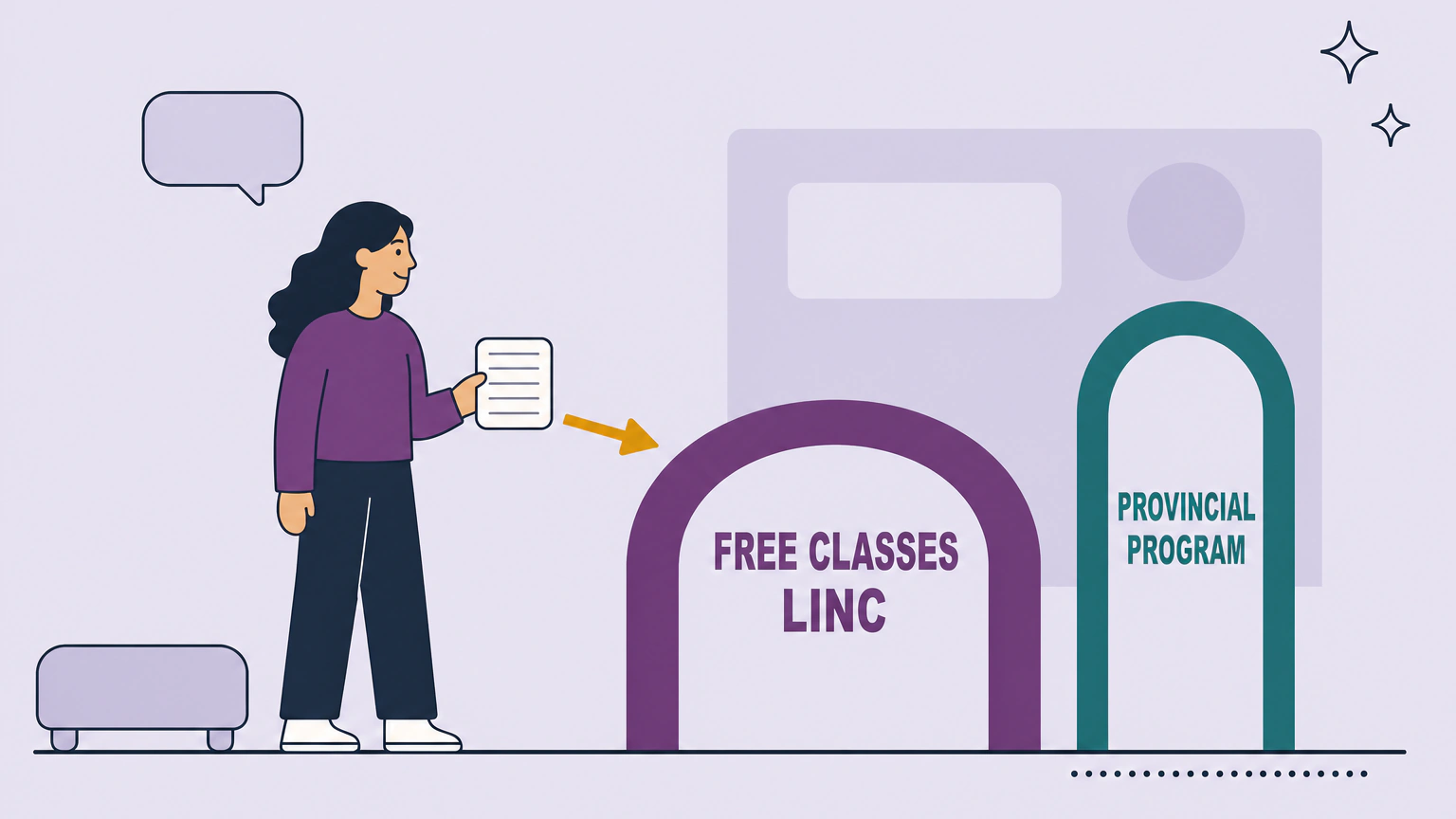
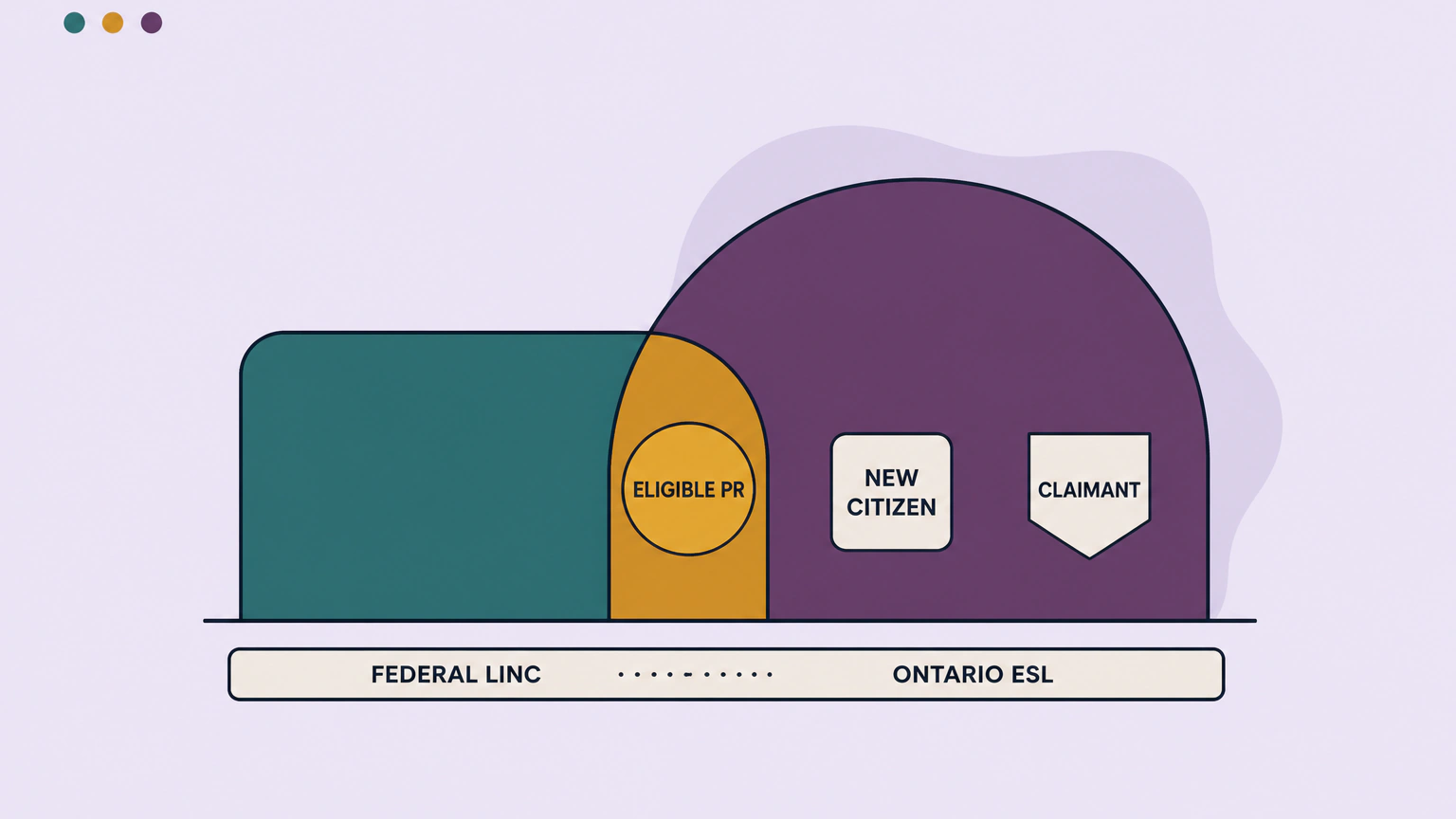
Canada has more than one free English class system, and they do not admit the same people. Federal LINC classes mainly serve permanent residents and protected persons. Since 1 April 2026, economic-class permanent residents and family members in the same application have six years from becoming permanent residents to use federally funded settlement services. Ontario, Quebec and British Columbia run separate programs, so a naturalized citizen or refugee claimant who cannot use LINC may still qualify elsewhere.
Four routes are worth checking: federal LINC and CLIC, Ontario's provincially funded adult ESL, Quebec's francisation, and British Columbia's tuition-free English at public institutions. LINC and Ontario ESL start with an assessment. In B.C., contact the institution. In Quebec, use the province's application process.
LINC and CLIC, the classes the federal government pays for
The federal classes carry two names. In English they are the Language Instruction for Newcomers to Canada, LINC. In French, the Cours de langue pour les immigrants au Canada, CLIC. It's the same offer in the other official language. One correction before you search: people look for Service Canada free English classes, but the department that funds both is Immigration, Refugees and Citizenship Canada.
Who Immigration, Refugees and Citizenship Canada says can attend at no cost
IRCC's current settlement-program rules cover permanent residents, protected persons and several narrower categories. Since 1 April 2026, economic-class permanent residents and family members in the same application can use federally funded settlement services for six years from the date they became permanent residents. That period falls to five years on 1 April 2027. Non-economic permanent residents, resettled refugees and protected persons have no time limit under this change.
Canadian citizens and refugee claimants do not qualify under the current federal terms. Most temporary residents are outside the program too, although IRCC lists limited pathways whose participants can use some or all settlement services. An older Settlement.Org page also says applicants must be at least 18, cannot already be registered in CLIC and must take a language assessment. Its CUAET-AVUCU eligibility line is no longer current: that measure ended on 15 July 2023 and does not appear in IRCC's current settlement-program eligibility terms.
The current federal terms say a language-training client must have reached the legal school-leaving age in the province or territory. That's why the local minimum differs: Settlement.Org says 18, while some B.C. providers enrol from 17. Ask the assessment centre which age applies where you live.
How CLB levels work, and the certificate that counts toward citizenship
Classes are built on the national standards for measuring adult newcomers' language skills: the Canadian Language Benchmarks in English, the Niveaux de compétence linguistique canadiens in French. Your class has a benchmark number, not a grade.
Finish a CLB level and you get a certificate showing your skill at that level. Other pages shorten what comes next into something wrong. IRCC does not say a level 4 certificate proves your citizenship language ability. It says a certificate at CLB 4 or higher in speaking and listening can serve as proof that you meet the citizenship language requirement. Reading and writing at level 4 won't carry that claim, so check what your certificate actually reports before you file anything.
The assessment comes before the class, not after
IRCC sets out three steps, in this order: visit an organization that helps newcomers and get a formal language assessment, register for classes, then start. It's a placement, not an exam you can fail.
If you're checking LINC, book the assessment even if you doubt you qualify. IRCC says newcomer-serving organizations can tell you about the language training available to you. For a provincial program, follow that province's route: Ontario uses CLARS, B.C. sends you to the institution and Quebec takes applications through its own service.
Your province may run a second free door, on wider rules
Federal and provincial language programs run side by side. Ottawa pays for LINC and CLIC through IRCC. Provinces fund their own classes, under their own rules. A refusal from one does not decide whether the other will admit you.
Ontario: free adult ESL through school boards, open to people LINC turns away
Ontario funds adult ESL delivered by school boards across the province: beginner to advanced, in class or online, part-time or full-time, daytime and evening, weekdays and weekends.
To get in you must be an Ontario resident and one of the following: a naturalized Canadian citizen, a permanent resident, a protected person including a Convention refugee, a refugee claimant, an Ontario Immigrant Nominee Program nominee, or a person admitted under a federal caregiver program with a path to permanent residency. Two of those six are exactly the people Settlement.Org lists as shut out of LINC.
The province states the cost in four words: this program is free. Providers may charge a small fee for materials. Registration runs through a CLARS Centre, and the assessment result comes back as your list of eligible programs. For a paid option beside the free one, we list providers across Ontario.
Quebec: francisation instead of LINC, on a completely different rule
Quebec runs its own settlement and language services, so the federal classes aren't the route there. Its francisation program runs through the Ministère de l'Immigration, de la Francisation et de l'Intégration, and the admission conditions depend on the course stream and on your own circumstances.
The published statement is broad: free French courses for anyone 16 and over who lives in Quebec, is past mandatory school age and wants to learn the language. Financial assistance is available under certain conditions. For the full-time immigrant stream the admission conditions run three lines: born outside Canada, 16 or older, living in Quebec. Full-time sessions last about 10 weeks at 25 to 30 hours a week, and part-time sessions 10 or 11 weeks at 6 to 20 hours.
That offer is for French. Quebec also offers English as a second language through adult general education. Quebec-resident adults can take those classes without tuition under the province's rules, though limits apply to some who already hold a secondary-school diploma. Private providers across Quebec remain another option.
British Columbia: tuition-free English at public institutions, but not at every one
British Columbia gates its tuition-free classes by status and institution. Since 1 September 2017, English Language Learning programs for domestic students, meaning Canadian citizens, permanent residents and refugees, have been tuition-free at most public post-secondary institutions in the province. Other costs may still apply. B.C. uses ELL, ESL and EAL for the same courses, so don't read a different acronym as a different program.
The province publishes both lists. Thirteen public institutions offer these courses tuition-free: BC Institute of Technology, Camosun, Capilano, Coast Mountain, Douglas, Kwantlen Polytechnic, Northern Lights, Okanagan, Selkirk, Thompson Rivers, the University of the Fraser Valley, Vancouver Community College and Vancouver Island University. Four public universities charge for them: Royal Roads, Simon Fraser, UBC and the University of Victoria. Check which list your nearest campus sits on before you apply, and if you're already enrolled, ask the financial aid office about the Adult Upgrading Grant.
Everywhere else in Canada: how to find your own province's answer
We checked four funding systems, not thirteen. Alberta, Saskatchewan, Manitoba, the Atlantic provinces and the territories run adult education of their own, and we couldn't open a current provincial language-training page for any of them, so we won't describe rules we haven't read.
The method travels, though. Start federally, because LINC and CLIC operate outside Quebec across the country, and the assessment centre handling the federal program will also tell you what else you can take. Then search your own provincial government site for the phrases provinces actually use: adult English as a second language, English language learning, adult upgrading, language training. Those find the funded programs. The word free rarely does.
| Program | Who funds it | Who qualifies, as published | What it costs | How you start |
|---|---|---|---|---|
| LINC and CLIC | Government of Canada, through Immigration, Refugees and Citizenship Canada | Eligible newcomers under the federal Settlement Program; economic-class permanent residents and family in the same application have six years from becoming permanent residents as of 1 April 2026 | No cost | Language assessment at a newcomer-serving organization, then register |
| Ontario adult ESL | Government of Ontario, delivered by school boards | Ontario residents who are a naturalized Canadian citizen, permanent resident, protected person including Convention refugee, refugee claimant, Ontario Immigrant Nominee Program nominee, or admitted under a federal caregiver program with a path to permanent residency | Free, though providers may charge a small fee for materials | Contact a CLARS Centre for an assessment, which returns your eligible program list |
| Quebec francisation | Government of Quebec, through the Ministère de l'Immigration, de la Francisation et de l'Intégration | Full-time immigrant stream: born outside Canada, aged 16 or over, living in Quebec. Broader statement: all persons aged 16 and over living in Quebec and not subject to mandatory school attendance | No admission or tuition fee; financial assistance available under conditions | Apply through the Quebec government's francisation admission process |
| British Columbia ELL | Government of British Columbia, at public post-secondary institutions | Canadian citizens, permanent residents and refugees, at most but not all public institutions | Tuition-free at the institutions the province lists; fee-based at four named universities | Contact the institution directly for offerings, admission requirements and fees |
A website cannot decide your individual eligibility: the program does. LINC and Ontario go by assessment. B.C. institutions and Quebec's application service run their own admission processes. These are published program rules, not immigration or legal advice, so confirm your case with the program before you enrol.
If neither free door is open to you
Being turned down for a funded seat is common, and it's a rule about categories rather than a judgment about you. Three routes remain, and one of them costs nothing. If the real barrier turns out to be a school subject rather than the language, subject tutoring in Canada is a different search.
Temporary residents, international students and people on work permits
Start with the current lists. Most temporary residents, including foreign students and workers, do not qualify for LINC, though IRCC's terms name limited pathways whose participants can receive settlement services. Ontario's provincial ESL list does not name them either. An absence from a list is not a decision on your case, so ask the program rather than assume.
Then the openings. Quebec is the exception among the programs we checked: people working or studying temporarily there can register for its French courses and may receive financial assistance, subject to the conditions of their own status. Settlement.Org tells the people LINC turns away that they may be eligible for other types of English classes. Take that literally, and ask each agency what it runs outside the federal contract. And some resources ask nothing about immigration status. CBC's Learning English lessons are still online although that program ended in 2020, and Mauril, the free listening platform CBC and Radio-Canada built from their own shows, is open to anyone in Canada.
What paid English classes cost in Canada
When both free doors close, the question turns into a budget. Across the 761 cost profiles behind our own ESL category page, the average sits at $226 and the fair range runs $155 to $460.
| Figure | Amount | What it is |
|---|---|---|
| Our panel's average | $226 | Our own average across submitted cost profiles |
| Typical range | $155 to $460 | Our published fair price range |
| Lowest recorded | $129 | Lowest figure in the profile set |
| Highest recorded | $588 | Highest figure in the profile set |
| Sample | 761 cost profiles | The number of submitted profiles behind the figures |
These are DistinguishedTeaching.ca's own aggregated figures from listings on the site, not a survey of the Canadian market, and the panel adapts to your location, so the figures you see may differ.
What those numbers don't cover is what a school includes: books, an assessment fee, a certificate, a minimum block of weeks. Ask for the total, then browse ESL schools and English classes near you.
How to register without wasting a trip
For LINC or Ontario ESL, ask the assessment centre what it requires before you go. These are the things worth having ready:
- Your permanent resident card, or the document that shows your status in Canada
- Your original landing paper, if you have one
- Photo identification
- Any previous language certificate, including a certificate from an earlier class
- A note of the levels or programs you have already completed
- Your postal code, because it determines which centres serve you
- Your availability, written down: which days, which hours, daytime or evening
- Whether you need child-minding, and the ages of your children
- Whether you need the class to be online, in person or a mix
- A phone number and email address the centre can reach you at
Settlement rarely arrives one system at a time, and driving is usually next on the list: what a government approved driving course actually buys you runs on the same approval logic.
Before you pay a private school, check these five things
Ask for the total price, the hours it buys and the refund terms, in writing, before any money moves. Ask how a level is decided, and treat an assessment as the right answer and a sales conversation as the wrong one. Ask how many students sit in the class you'd join, not the school average. Ask who recognizes the certificate, by name, and what it's recognized for. And ask what happens if you stop halfway, because that's the term people discover too late.
If you're in Ontario, read your rights when you prepay for classes in Ontario before signing anything long. The cooling-off rules that cover gyms and personal development services were not written around language schools, so don't assume you have ten days to change your mind.
Red flag: A school that will not put the total price, the number of hours and the refund terms in writing before you pay. A level assigned in a sales conversation instead of by an assessment. A certificate described as recognized, with no named body that recognizes it. Pressure to pay for a long block of classes on the day you first visit.
Frequently asked questions
Who is eligible for LINC classes?
IRCC's Settlement Program covers permanent residents, protected persons and several narrower categories. Since 1 April 2026, economic-class permanent residents and family members in the same application have six years from becoming permanent residents to use federally funded settlement services. Language-training clients must have reached their province or territory's legal school-leaving age and must take an assessment before class.
Can Canadian citizens take free English classes in Canada?
Not through LINC. The federal Settlement Program excludes Canadian citizens. Provincial programs differ: Ontario's adult ESL admits naturalized Canadian citizens, British Columbia's tuition-free ELL covers Canadian citizens at most public institutions, and Quebec offers free French to eligible residents from age 16 as well as English through adult general education under separate rules.
What is the difference between LINC and ESL?
LINC is one specific program: federally funded classes for newcomers who meet the Settlement Program's current eligibility rules. ESL is the general term for English as a second language, covering everything from a school board's provincially funded class to a private school's paid course. Every LINC class is ESL. Most ESL classes are not LINC.
Do I have to take a language test before I can join a class?
For LINC and Ontario adult ESL, yes. It's a placement, not a pass-or-fail exam: IRCC puts the assessment before registration, and Ontario uses CLARS. Other programs set their own routes. B.C. directs learners to the institution, and Quebec takes applications through its francisation service.
Are there free French or English classes in Quebec?
Quebec offers free French courses to people 16 and over who live in the province and are past mandatory school age, with financial assistance under certain conditions. It also offers English as a second language through adult general education. Quebec-resident adults can receive those services without tuition under provincial rules, although limits apply to some adults who already hold a secondary-school diploma.
Can international students or people on a work permit take free classes?
Most do not qualify for LINC or Ontario adult ESL, but IRCC's current terms include limited temporary-resident pathways. Quebec is another route among the programs checked: temporary workers and students can register for its French courses and may receive financial assistance, subject to their status conditions.
How much do paid English classes cost in Canada?
Across the 761 cost profiles behind our own ESL category page, the average is $226 and the fair range runs $155 to $460, with individual profiles from $129 to $588. Those are our own listing figures rather than a market survey, so use them to sense-check a quote.
Does finishing a LINC level help with a citizenship application?
It can. Complete a Canadian Language Benchmarks level and you receive a certificate showing your skill at that level. IRCC is precise about which one counts: a certificate at CLB 4 or higher in speaking and listening can serve as proof that you meet the citizenship language requirement.
Sources
- IRCC, Language classes funded by the Government of Canada (4 April 2025)
- IRCC, Changes to eligibility for economic class permanent residents (10 March 2026)
- IRCC, Settlement Program terms and conditions (current eligibility terms)
- Government of Ontario, Adult learning: English as a second language (27 March 2026)
- Government of Ontario, Improve your English and French
- Gouvernement du Québec, Learn French (2 July 2026)
- Gouvernement du Québec, Conditions for Admission, full-time French courses for immigrants (16 June 2026)
- Gouvernement du Québec, English as a Second Language program in adult general education (29 October 2025)
- Québec, Basic adult general education regulation, section 33 (current to 1 January 2026)
- Government of British Columbia, Learn English (5 November 2025)
- Settlement.Org, Ontario Council of Agencies Serving Immigrants, LINC program (31 October 2025)
- CBC, Learning English, and the Mauril platform from CBC and Radio-Canada
- DistinguishedTeaching.ca ESL Schools category page, cost panel of 761 profiles