

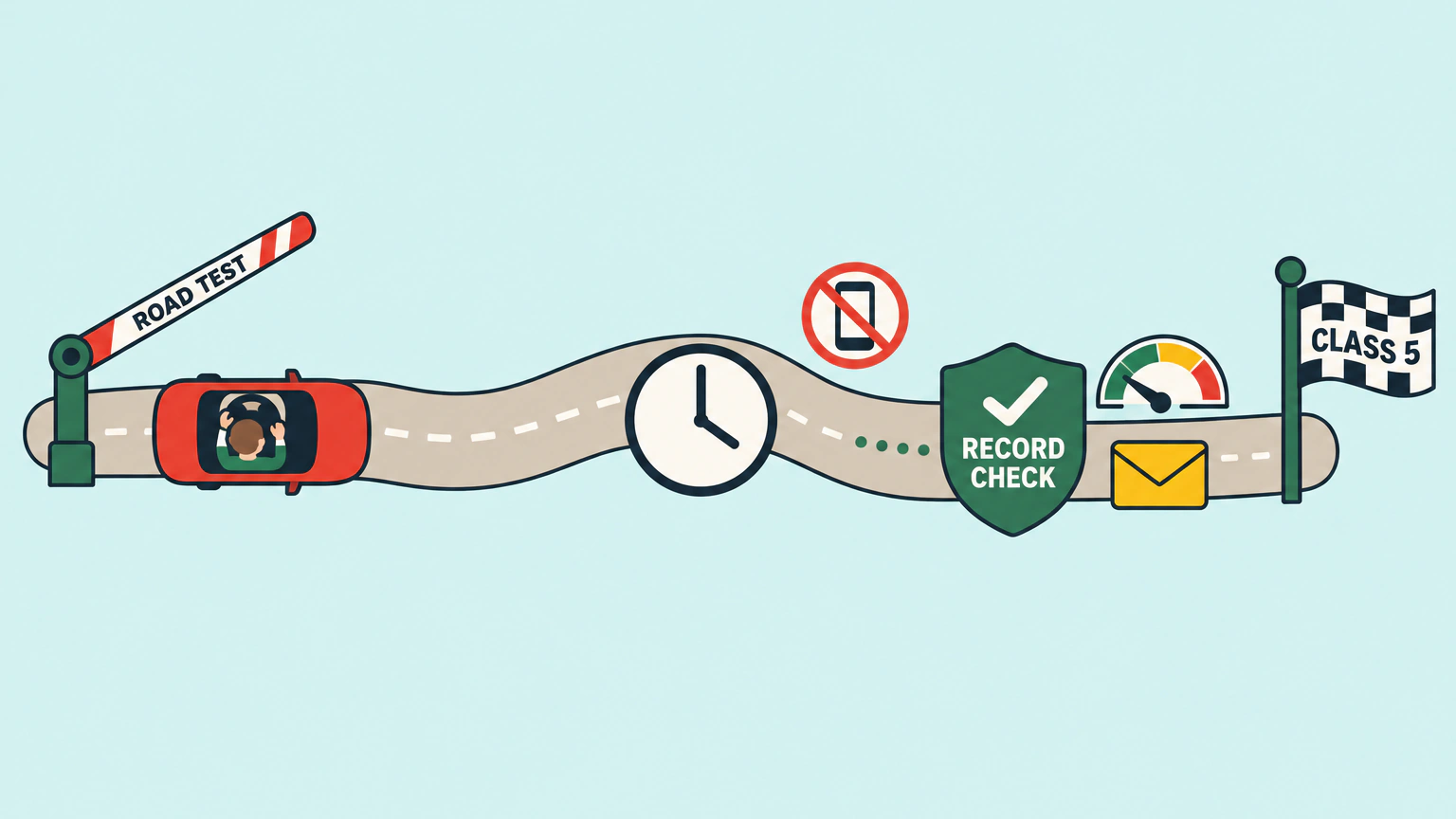
From October 19, 2026, most new drivers in B.C. pass one road test, not two. You still take the Class 7 road test to get your N. After that, a Driving Record Assessment replaces the second road test. Drive your N for 24 months, or 18 with an approved course, or 12 if you're 25 or older, with no prohibition, no suspension and no conviction for excessive speeding or using a phone. Then you upgrade to a Class 5 that carries 12 months of zero alcohol and drugs.
If you're still on your L, the road test ahead of you hasn't changed. If you're already on an N, watch for a letter from ICBC. And if you're 25 or older, the new rules shorten your path, and you may not have heard.
On this page
What changes on October 19, 2026
The road test you still have to pass
The Class 7 road test isn't going anywhere. From October 19, 2026 it's the only road test most B.C. drivers will ever take, and ICBC is plain about why: B.C. and Ontario were the last two provinces in Canada making drivers pass a second road test to reach a Class 5.
Getting to that first test hasn't changed. You need your learner's licence, the Class 7L, for at least 12 months without a prohibition. Nine months if you're 25 or older. Before the L comes the knowledge test: 40 of 50 questions right, $15 an attempt. Since June 2026 you can sit it at home on a computer with a camera, though not on a phone, then visit an office once for ID, a vision test and your photo.
Two learner rules do change on the 19th, and a parent supervising practice drives will care about both. Your supervisor can be 22 rather than over 25, as long as they hold their own Class 5 without the zero-alcohol restriction and sit beside you in the front passenger seat. And a learner can carry more than one passenger when everyone else in the car is immediate family.
What stays: the red L sign, no driving between midnight and 5 a.m., zero alcohol or drugs, and no phones.
What replaces the second road test
Nobody rides with you for a Driving Record Assessment. You don't drive at all.
ICBC checks two things: how long you've held your N, and whether your record over that time is clean by its own criteria. They're short, and worth knowing by heart.
Once you qualify you go to a driver licensing office, by appointment or as a walk-in. From October 19 you can book online, but only at an ICBC driver licensing office, under the service type "Driving Record Assessment." The Province says the assessment is available at all Service BC offices and driver licensing agent offices too, so walking in gives you more choice than the booking tool shows.
You leave with a Class 5 carrying restriction 55: zero blood alcohol and zero blood drug content whenever you drive. It runs 12 months, the expiry date is printed on the back of your licence, and it lifts on its own. Nothing to apply for.
ICBC's stated reason isn't about saving money. Removing the second road test means "reducing barriers to getting licensed, especially for drivers in rural, remote and Indigenous communities," where getting to a road test at all can be the hard part.
How long each stage takes, by age
Age 25 is the line, and the Province drew it deliberately. Its research says new drivers who are 25 or older crash less than drivers aged 16 to 24, even at the same level of experience, so it shortened both stages for them. The learner phase drops from 12 months to nine. The novice phase drops from 24 months to 12.
After the record check, everyone's path is identical again.
| Stage | Under 25 | 25 and older |
|---|---|---|
| Learner (L) driving before the Class 7 road test | At least 12 months | At least 9 months |
| Class 7 road test | Required | Required |
| Novice (N) safe driving before you can upgrade | 24 months, or 18 with an ICBC-approved GLP course finished as a learner | 12 months |
| How you move up to Class 5 | Driving Record Assessment, no road test | Driving Record Assessment, no road test |
| Class 5 with restriction 55 | 12 months of zero alcohol and zero drugs | 12 months of zero alcohol and zero drugs |
| Full Class 5 | When restriction 55 expires, automatically | When restriction 55 expires, automatically |
If you're already in the program, ICBC goes by how old you are on October 19, 2026.
Under 25, and the course that trims six months
Under 25, the novice stage runs 24 months. A graduated licensing program course approved by ICBC, finished while you still hold your L, cuts that to 18. ICBC is specific that starting a course and not finishing it leaves you at 24 months.
An approved course means at least 16 hours in class, at least 12 hours on the road and four flexible hours, all completed within one year while you're a learner. It can also earn two Grade 11 credits. ICBC spells out one more condition on its driver training page and not on its change page: the six months come off only if you keep a clean record, "without at-fault crashes, violations, or prohibitions."
Not every school runs the approved course, so confirm yours is on ICBC's list of approved GLP courses before you pay. If you're weighing whether a course pays for itself, we've looked at what a driving course buys you elsewhere in Canada.
25 and older
Nine months on your L, 12 months on your N, then the record check. That's the whole ladder if you're 25 or older, and the course credit isn't part of it. The Province limits that six-month credit to drivers under 25.
Most 25-plus drivers haven't heard this part. From October 19, 2026, ICBC says Class 7 holders who are 25 or older no longer need to display the N sign, and no longer need a supervisor in the car to carry more than one passenger.
The rest of the novice rules hold. No alcohol or drugs in your blood when you drive, and no phone or other electronic device, hands-free included.
What sends your clock back to the start
Five things on your record can stop the clock, and the last one catches people out.
If one of them lands before you upgrade, ICBC resets your eligibility date and you start the full period over again. Twelve months if you're 25 or older. Twenty-four, or 18, if you're under 25. Not the time you had left, but the whole period.
- A driving prohibition
- A licence suspension
- A conviction for using a phone or other electronic device while driving
- A conviction for excessive speeding, which in B.C. means more than 40 km/h over the posted limit
- Any other ticket that leads to a review of your record and then a prohibition
If you're already on restriction 55, a prohibition or suspension restarts the 12 months from the day your licence is reinstated.
Two of those need unpacking. Excessive speeding has a legal meaning in B.C., and an ordinary speeding ticket isn't it. The catch-all is the one to watch, though. ICBC tells novice drivers that "if you receive one ticket, your driving record may be reviewed and you may face driving prohibitions." A prohibition resets everything, so an ordinary ticket can still reach you through the side door.
The restricted year at the end works the same way. Pick up a prohibition or a suspension during your 12 months on restriction 55, and those 12 months start again from the day your licence comes back. The Province says drivers in that year face greater scrutiny than experienced drivers do. That's the design, not a glitch.
Already driving on an N?
The ICBC letter, the automatic upgrade and a booked Class 5 test
ICBC starts writing to drivers in the program in early fall 2026. If you already meet the criteria, the letter confirms something better than an appointment: a one-time automatic upgrade to a Class 5 with restrictions on October 19, 2026, with no office visit at all.
You stay eligible only if nothing lands on your record between the date of that letter and October 19. No prohibition, no suspension, no electronic device conviction, no excessive speeding. ICBC adds that other factors, such as money you owe it, can affect eligibility too.
Two traps sit inside this. If your Class 7 licence expires before October 19, you have to renew it first or the automatic upgrade can't happen. And if you've moved recently, update your address with ICBC, because the letter goes wherever its records point.
Then there's the test you may already have booked. A test booked for October 19, 2026 or later is cancelled, and ICBC will email to confirm and explain your next steps. One booked before that date goes ahead as normal.
Finding your own date, and what the upgrade costs
ICBC tells Class 7 drivers who are 25 or older that from October 19, 2026 their eligibility date appears on their driving record, listed as the "Earliest Exit Date." It doesn't repeat that in its guidance for drivers under 25, so if you're under 25, pull your record and see what it shows. You can request it through My ICBC and it arrives by email.
Whatever that record says is the authority for your situation. Not an online calculator, not a driving school's estimate, and not us: we can tell you how the rules read, but your own record and ICBC's letter decide your dates.
Upgrading as soon as you're eligible costs $17. Waiting until your licence is near its expiry date and upgrading then costs $75, and gets you a new five-year licence. If you're upgraded automatically, a replacement card showing Class 5 is optional. It's $17 and keeps your old card's expiry date, because your record shows the new class either way.
Inside the Class 7 road test
What the examiner is scoring
The whole thing takes about 35 minutes, including the part at the end where the examiner goes through how you did.
Your examiner rates five skills the entire time: observation, space margins, speed control, steering and communication. You drive a route, and somewhere in it you work through a set of manoeuvres. Intersections, entering and leaving a highway, backing up, lane changes, parking at the side of the road, parking on a hill, reverse stall parking, parallel parking, and two- and three-point turns.
Hazard perception is scored too. At points during the drive the examiner asks you to name the hazards you can see. If English isn't your first language and the word won't come, ICBC says you can point and say "hazard."
Your examiner won't trick you and won't ask you to break the law. They stay quiet apart from directions, and they aren't looking for perfection.
You leave with your result on paper. On the back is a Skills Explainer listing the skills every driver has to show, with your examiner's circles on whatever needs work. ICBC publishes that sheet in Arabic, Farsi, Punjabi, Simplified Chinese and Vietnamese.
Where attempts usually go wrong
ICBC's driver examiners publish their own tips for passing, and one of them is blunter than the rest: "Speeding through school and playground zones is a common reason why drivers fail their test."
Those zones are 30 km/h wherever the 30 signs are posted. Near a school that applies on school days between 8 a.m. and 5 p.m., unless the sign itself extends the hours. Near a playground it runs from dawn to dusk.
The rest of the examiners' list is four habits. Stop fully behind the line, not on it. Shoulder check to your right before every right turn, because that's where the cyclist is. Scan an intersection before you cross it even when your light is green. On a highway on-ramp, use the acceleration lane to reach the speed of traffic without going over the limit.
ICBC's own tip sheet has two surprises in it. You can be marked down for going too slowly in low-risk situations, and for being unnecessarily cautious about gaps in traffic. Timid isn't the same as safe. The other is a relief: touching the curb while you park is "not a FAIL."
Back-up cameras don't have to be switched off in B.C. ICBC says you shouldn't rely solely on the camera while backing up.
If you want one manoeuvre to practise more than the rest, make it left turns at busy intersections. That's where a nervous driver takes a gap that was never there.
On the day
Your test-day list is short, because the car carries most of the requirements. We've set out what to bring, and what gets a car turned away separately, including the ten reasons ICBC most often refuses a vehicle at the counter.
Consider a mock road test with a school shortly before the real one. Book early enough to get a slot that suits your test date.
For the office itself, run through these before you go.
- One primary and one secondary piece of ID from ICBC's accepted list
- The road test fee: cash, Visa, Mastercard, American Express, debit or a personal cheque
- An insured vehicle with a Canadian licence plate, and the plate number to give at the counter
- Arrive at your check-in time
- Phone off or on silent, and GPS, navigation and any recording device switched off
- If you'd like a driver examiner of a particular gender, ask when you check in
Fees, retakes and booking
What ICBC charges
ICBC publishes every one of these fees on its own schedule, and one of them moves on the same day as everything else. The Class 7 road test costs $35 an attempt until October 18, 2026, then $50 an attempt from October 19, 2026.
The Class 5 road test fee still applies to some drivers: newcomers whose licence can't be exchanged, anyone whose licence expired more than three years ago, and drivers RoadSafetyBC asks to re-examine.
If you're 65 or older, road tests are free.
| Item | Fee |
|---|---|
| Knowledge test, each attempt | $15 |
| Class 7 photo learner licence | $10 |
| Class 7 road test, each attempt, until October 18, 2026 | $35 |
| Class 7 road test, each attempt, from October 19, 2026 | $50 |
| Class 5 road test, each attempt | $50 |
| First five-year novice licence | $75 |
| Upgrade to Class 5 as soon as you're eligible | $17 |
| Upgrade at renewal instead, with a new five-year licence | $75 |
| Road test cancelled with less than 48 hours' notice | $25 |
| Road tests for drivers 65 and older | Free |
| Total from October 19, 2026: first-try passes, both licences, upgrade when eligible | $167 |
That $167 assumes you pass everything the first time and upgrade as soon as you're eligible. It leaves out lessons, a school car and any retest.
If you don't pass, and how to book safely
Not passing costs you time as well as the fee, and the wait stretches with each attempt.
| Attempt | Earliest you can retake |
|---|---|
| After your first try | 14 days later |
| After your second try | 30 days later |
| After your third try, or any later one | 60 days later |
You pay the road test fee each time.
Those waits are the earliest you could test again, not a slot ICBC holds for you, so rebook as soon as you're allowed. Before you do, read the feedback on your result form. ICBC redesigned it to tell learners exactly what to work on, which makes it the cheapest coaching you'll get.
You can book, reschedule or cancel online, and phoning won't turn up times the website doesn't have. If your schedule is flexible, a standby road test at an office may get you in sooner. Cancel with less than 48 hours' notice and it's $25.
One more thing, and it costs nothing. You can ask for a driver examiner of a particular gender when you check in, or by phone beforehand, and ICBC says you won't be asked why. If it can't accommodate you that day, it reschedules your test with no late cancellation fee.
Red flag: Book your road test directly with ICBC. It says third-party booking sites aren't affiliated with it, and any site selling ICBC test routes didn't get them from ICBC, which doesn't release them. Booking itself is free. You pay only the test fee, at the office. Bookmark the official booking page and cancel through the same place.
Where a driving school still earns its fee
One thing lessons don't buy is time. No number of lessons shortens your novice stage. The only thing that does is an ICBC-approved GLP course finished while you're a learner under 25, and that's worth six months.
- The school is licensed under the Motor Vehicle Act, and your instructor holds a professional driver training instructor licence
- It isn't on ICBC's list of suspended or closed driving schools
- For the 18-month path, the course is on ICBC's list of approved GLP courses
- You have its written statement of services and policy statement, with hours, fees and refund policy
- You get a receipt, and you sign a road test booking permission form only if the school is booking for you
- You never share your ICBC security keyword, not even with your driving school
Lessons are for the driving test and the record. From October 19, 2026 every unsuccessful Class 7 attempt costs $50 and at least two weeks, so a first-time pass is worth paying for. And the habits a good instructor drills, speed discipline and leaving the phone alone, are exactly what the Driving Record Assessment measures for the next year or two. For a new B.C. driver, winter adds snow and reduced traction, which is why winter driving lessons are worth a look.
When you're ready to book lessons, start with driving schools in Vancouver, Surrey driving schools or driving schools in Victoria. Outside those three, our British Columbia listings reach every B.C. city we cover.
Frequently asked questions
Is the Class 5 road test being removed in B.C.?
Yes, for novice drivers moving up from a Class 7. From October 19, 2026 a Driving Record Assessment replaces it, and a second road test booked for that date or later is cancelled. ICBC emails to confirm. The Class 7 road test stays exactly as it is. Some newcomers do still take a Class 5 road test.
Do I still take a road test if I move to B.C. with a licence from somewhere else?
It depends on the licence's home jurisdiction and how much non-learner driving you can prove. From a jurisdiction on ICBC's exchange list, 24 months of experience at 25 or older, or 36 months under 25, gets you a Class 5 with no restrictions. Less experience gets a restricted Class 5 or a Class 7. From anywhere else, you take a vision screening plus whatever testing your experience calls for.
How long is the road test in B.C.?
About 35 minutes, including the feedback at the end, and ICBC gives the same estimate for the Class 7 test and the Class 5 test. Allow more time than that at the office, because check-in and the examiner's look over your car both happen before the driving starts.
What happens if I fail my road test three times in B.C.?
You wait longer between tries, not forever. ICBC's waits are 14 days after a first unsuccessful attempt, 30 days after a second, and 60 days after a third or any later one. The fee is due each time, which from October 19, 2026 is $50 for a Class 7 test. Use the feedback on your result form to decide what to practise.
Will an ordinary speeding ticket stop me from upgrading?
Not on its own. The criteria name excessive speeding, meaning more than 40 km/h over the limit, and convictions for using an electronic device. But ICBC warns novice drivers that one ticket can bring a review of their record and a driving prohibition, and a prohibition restarts your wait.
Can you fail a Driving Record Assessment?
Not the way you fail a road test, because nobody watches you drive. ICBC checks whether you've held your N long enough, and whether a prohibition, suspension, or an excessive speeding or device conviction appears in that time. If one does, the answer is "not yet" and your date moves.