

Some providers do publish. An hour of one-to-one training runs about $55 to $75 at a YMCA and about $56 to $95 at a city recreation centre. Toronto studios and in-home trainers quote $80 to $150. GoodLife puts a free consultation on its personal training page, but no session price. And the two moves that change your bill most have nothing to do with haggling: buy more sessions at once, or split the hour with a friend.
On this page
- The short answer, and why every page gives you a different number
- What the public and nonprofit options charge
- What private studios and the big chains charge
- Sharing a session is the biggest discount on the board
- Four things that move the number on your invoice
- Before you pay for a package
- Frequently asked questions
The short answer, and why every page gives you a different number
What a session costs where somebody actually publishes a price
Four Canadian providers put a real number on a public page. Here they are, in plain money.
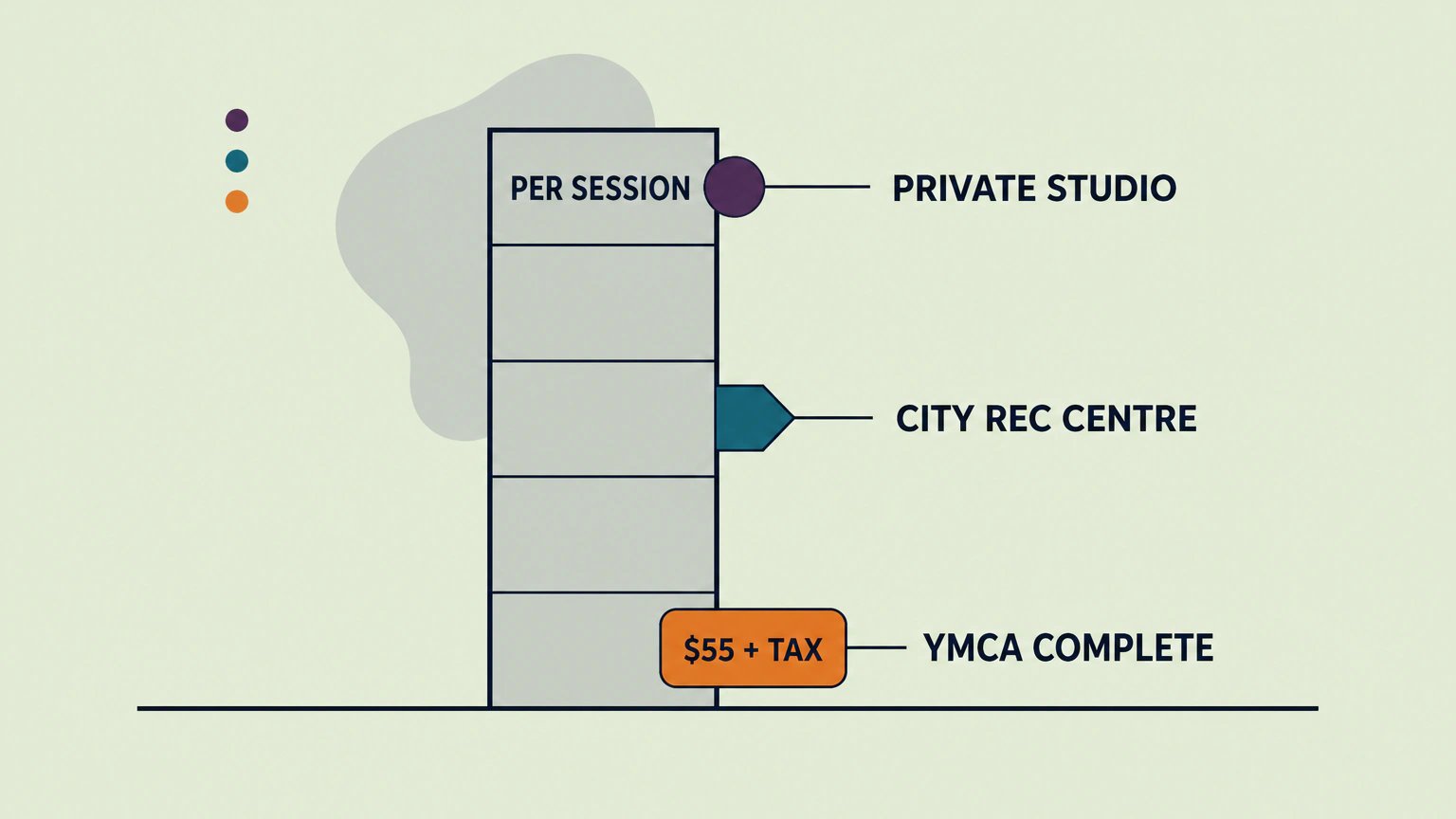
The YMCA of Three Rivers charges $55 an hour if you hold its Complete membership, $60 on the Classic tier and $75 with no membership at all. The City of Mississauga charges $56.23 a session once you buy eight or more. Buy Calgary's twenty-session package for $1,360 and you're paying $68 a session. Walk into a Toronto studio and the quoted range jumps to $80 to $150 for the same hour.
That's the whole spread, from the cheapest published rate we found to the busiest downtown market. Roughly triple, for one hour with a trainer.
Why the ranges you find online disagree
Go looking for the average personal trainer cost in Canada and you'll come back with five answers.
Bark says $40 to $65. Fit Factory Fitness says $60 to $90 in a commercial gym. VIMALIFE says $80 to $150 for the hour. Fitness on the Go starts at $100. Fitness Avenue puts an in-home Toronto session at $110 to $150.
Now look at who's talking. A lead marketplace that sells your enquiry to trainers, two Toronto studios and a national in-home company that all sell training, and a shop that sells home gym equipment. Every one of them has a stake in where you land, and not one points you at a rate card you can open and read for yourself.
We won't give you a sixth range. We're doing something duller: counting only the prices somebody put in writing under their own name, and telling you whose name it is.
What the public and nonprofit options charge
City recreation centres put the whole package price in writing
Your city might be the cheapest trainer in town, and Calgary and Mississauga both put their prices online.
Calgary publishes its whole ladder. An introductory session, which is a consultation plus one session, costs $205. Three sessions cost $285, five cost $415, ten cost $725, and twenty cost $1,360. Each package buys a consultation and a program built for you, for strength and cardio work or for training in the water.
Two things to know before you plan around it. Calgary states that all prices include GST, so what you read is what you pay. And the City doesn't permit outside personal training at any of its sites, for safety and liability reasons, so your own trainer can't meet you there.
Mississauga runs the other useful model. No membership, no minimum purchase, one posted rate whether you buy one session or eight.
Table A. Where a one-to-one session price is actually published
| Provider | Published rate for one-to-one | What that price includes | Tax |
|---|---|---|---|
| City of Calgary recreation centres, Alberta | Intro session (consultation plus one session) $205.00; 3 sessions $285.00; 5 sessions $415.00; 10 sessions $725.00; 20 sessions $1,360.00 | A consultation and a personalized program for strength and cardio training, or training in the water | All prices include GST |
| City of Mississauga community centres, Ontario | $66.15 a session for 1 to 7 sessions; $56.23 a session at 8 or more, 60 minutes | No membership and no minimum purchase; trainers hold over two years of post-secondary education in a health-related field | Mississauga doesn't say |
| YMCA of Three Rivers, Ontario | $55 a session for Complete members; $60 for Classic members; $75 for non-members | One hour, bought in bundles of 2, 4, 8 or 12 | Plus tax |
| YMCA of Greater Toronto, Ontario | As little as $60 a session with a monthly subscription of at least one session a week | A subscription rather than a bundle; the same post puts a certified trainer in downtown Toronto at $90 to $120, and sometimes $200 or more | Not stated |
| GoodLife Fitness, national | No session price on its personal training page, which offers a free consultation instead | A consultation, then a trainer match | Not applicable |
These are the providers we could find publishing a price, and they all sit in Alberta and Ontario. It isn't a national average and we won't dress it up as one. If you live somewhere else, start with your own city's recreation page, because that's where numbers like these tend to live.
What the YMCA charges, and what a member rate really means
Ask how much YMCA personal training costs and the honest answer starts with a question back: which Y? Each association sets its own rates.
The YMCA of Three Rivers, in southwestern Ontario, publishes three prices for the same hour. $55 plus tax for Complete members, $60 for Classic members, $75 for non-members, sold in bundles of 2, 4, 8 or 12. The YMCA of Greater Toronto says on its own blog that training there can run as little as $60 a session on a monthly subscription of at least one session a week.
Read a member rate the way your bank account will read it. Saving $20 a session is only a saving if you were buying the membership anyway. If you weren't, add the monthly fee to the session price before you compare it with anywhere that sells training to the public, which is exactly what Mississauga does.
The trade-off: Ontario's contract rules skip these sellers
Now the part almost nobody mentions, and it cuts against the cheap end.
Ontario's personal development services rules apply to a prepaid gym or class contract when advance payment is required. The total potential payment obligation, excluding borrowing costs, must be more than $50. They provide a 10-day cooling-off period and generally limit the agreement to one year. But the Province's own page lists who sits outside those rules: a not-for-profit or charitable organization, with the YMCA named as the example, and any facility run by or funded by a municipality or by Ontario itself.
So the cheapest sellers here are the ones those protections don't reach. That's a trade rather than a trap. Just make it on purpose, and read what Ontario's rules say about a prepaid contract before you sign with a private gym instead.
What private studios and the big chains charge
GoodLife publishes a consultation, not a price
If you've been hunting for GoodLife personal training package prices, save yourself the search. They aren't on its personal training page.
We read the whole personal training page at GoodLife Fitness, which calls itself Canada's largest fitness company. It runs 2,089 words about trainers, results and a free consultation, and it names no session price at all. The single dollar figure on the page is an enrolment offer on memberships. GoodLife does say it has more certified personal trainers than any other club in Canada. That's the company talking about the company. Still not a price.
There's nothing sinister in that. GoodLife sends you to a consultation instead. It does put the whole job on you, so walk in with three questions and don't leave without answers: what does one session cost at the smallest package you sell, what's the total with tax, and how long do I have to use them?
What studios and in-home trainers say a session costs
Private studios do publish ranges, and the shape stays consistent even when the numbers don't.
A half-hour session runs roughly $50 to $90. A full hour runs $80 to $150, and the top of that keeps climbing for premium coaching. In-home training adds a travel variable. Fitness on the Go says trainers may charge extra for locations more than 30 minutes away, and it puts Toronto and Vancouver above smaller Canadian markets.
Five of the pages competing for this question put a number on it.
Table C. What the pages ranking for this question say, and who is saying it
| Who published it | What it says a session costs | What kind of business is saying it |
|---|---|---|
| Bark Canada | $40 to $65 on average, $30 at the low end, $90 at the high end | A lead marketplace that sells customer enquiries to trainers |
| Fit Factory Fitness, Toronto | $60 to $90 at a commercial gym, $80 to $130 with an independent trainer, $120 to $180 and up for premium coaching | A Toronto training studio |
| VIMALIFE, Toronto | $50 to $90 for 30 minutes, $80 to $150 and up for 60 minutes | A Toronto training studio |
| Fitness on the Go | $100 for a single session, falling to $85 a session in a 20 session package | A national in-home training company |
| Fitness Avenue | In-home sessions at $110 to $150 in Toronto and $75 to $105 in Edmonton | A fitness equipment retailer, repeating Fitness on the Go's city figures |
Not one of those five names a provider whose rate card you can open. That's how one page lands on $40 a session and another on $180 and up, in the same country, the same year.
Sharing a session is the biggest discount on the board
Partner and semi-private training
Against the lowest published one-to-one rates, bring one person with you and the price per head drops by about a third. Same trainer, same hour.
Mississauga charges $56.23 a session one-to-one at eight sessions or more, and $35.98 a person for semi-private at that volume. The YMCA of Three Rivers charges $75 for partner training, which works out to $37.50 each. That's the semi-private personal training cost in plain terms: the same coach, for roughly two-thirds of the money.
Table B. What sharing the session does to the price per person
| Format | Published example | Per person, per session |
|---|---|---|
| One-to-one, 8 sessions or more | Mississauga, $56.23 a session | $56.23 |
| Semi-private, two people, 8 sessions or more | Mississauga, $35.98 a person | $35.98 |
| Partner training, two people | YMCA of Three Rivers, $75 a session | $37.50 |
| Small group, two people, 10 sessions | Calgary, $800.00 for the group | $40.00 |
| Group training, three to six people | Mississauga, $18.39 a person | $18.39 |
Small group training, and when sharing stops working
Push the group to between three and six people and Mississauga's rate falls to $18.39 a person for the hour. That's under a third of its one-to-one rate, trainer still in the room.
There's a limit, and it's worth saying out loud. The coaching splits too. If you're learning a barbell lift from scratch, coming back from an injury, or training beside someone whose fitness is nowhere near yours, a shared hour buys you a fraction of a trainer's attention at the moment you need all of it.
If a shared, structured hour is what you actually wanted, you have cheaper routes than a training package. Look at Pilates studios across Canada or yoga studios and class passes before you commit to twenty sessions.
Four things that move the number on your invoice
How many sessions you buy at once
Volume is the biggest lever you have, and Calgary shows you the whole curve.
Three sessions cost $285, which is $95 each. Ten cost $725, or $72.50 each. Twenty cost $1,360, which lands at $68. Buying the big package saves you $27 a session against the small one, a little over a quarter off.
Fitness on the Go publishes the same pattern: $100 for a single session, $95 in a five-pack, $90 at ten and $85 at twenty.
Now the counterweight. A package is only cheaper if you use enough of it. Twenty sessions at $68 is a fine rate and a bad buy if you use eleven, because those eleven cost you about $124 each. Buy the size you'll genuinely use in the time you have, then buy again.
Whether the session runs 30 minutes or 60
Half an hour is not half price. VIMALIFE's published Toronto ranges put 30 minutes at $50 to $90 and an hour at $80 to $150, so the short session costs roughly three-fifths of the long one.
Thirty minutes suits someone who already trains, knows the movements, and wants a coach for form and pacing. The hour suits a beginner, anyone working around an injury, or a session that includes an assessment. If you're new, the hour is usually the better dollar.
Whether tax sits on top or is already in
Two quotes ten dollars apart can be the same price.
Calgary says plainly that all its prices include GST, so $68 a session is $68. The YMCA of Three Rivers prints "plus tax" beside every rate, so $55 isn't $55 by the time you pay. Halifax publishes its fitness memberships before tax too. Mississauga's page says nothing about tax in either direction.
We won't guess what you'll pay on top, because it depends on who's selling and where they are. One question makes it stop mattering: what's the total, tax included, for the package I'm buying? Get the answer in the same email as the price.
Who is actually coaching you
The word trainer isn't doing much work on its own. Two Canadian certifications are worth checking, and both are voluntary.
The CSEP-CPT comes from the Canadian Society for Exercise Physiology. You can't sit it without at least two years, 60 credits, of post-secondary study in kinesiology, human kinetics, physical education, exercise science or fitness and health promotion. CSEP puts the number certified at over 4,000. canfitpro's Personal Training Specialist is a course you buy, from CA$848 to CA$1,299 plus tax, with a CPR requirement and a practical exam you have to pass at 80 per cent.
Neither one is a licence. One neighbouring title is. In Ontario, kinesiology is a regulated health profession, run by the College of Kinesiologists of Ontario under the Kinesiology Act, 2007. Personal training doesn't appear on that list at all. So a kinesiologist can be checked against a public register. With a trainer, ask what they hold, who issued it and how you can verify it.
Before you pay for a package
Five things to settle in writing
The consultation is a sales meeting. That's fine and everyone knows it. The terms get discussed once and remembered differently. Settle these five before any money moves.
- The price per session at the package size you will realistically finish, not the biggest package on the sheet
- Whether tax is on top of that number, and what the all in total comes to in writing
- How long a session runs, and whether the consultation, the program design and the reassessment are inside the price or extra
- What happens to sessions you have paid for and not used: an expiry date, a refund rule, whether they transfer
- Who is coaching you, what credential they hold, and if the word kinesiologist is being used, their registration number
Red flag: three things that should slow you down.
- A price that only appears after a consultation, plus pressure to sign the same day
- A prepaid package from a covered Ontario seller that runs longer than a year, which the personal development services rules generally do not allow
- Sessions that expire in weeks, with nothing in writing about what happens to the ones you lose
Do the last piece of homework before you sign. Get the per-session price at a package size you'll finish, in writing, with tax included, and hold it against your city's recreation centre and your nearest Y. If you'd rather start from a shortlist, compare personal trainers and gyms near you and collect three quotes instead of one.
Frequently asked questions
How much should I expect to pay a personal trainer in Canada?
Expect $55 to $95 an hour where the price is published, the range across YMCA and city recreation centre rates in Alberta and Ontario. A private studio or an in-home trainer will quote $80 to $150, and more in downtown Toronto or Vancouver. GoodLife doesn't put a session price on its personal training page and sends you to a free consultation instead, so plan for that step.
How much is a personal trainer per month?
At a published rate of $60 a session, one session a week costs about $260 a month and two a week about $520. Do that arithmetic with a real rate from a real rate card, not a national average, because the number you were quoted is the only one that will hit your account.
How many sessions do you need with a personal trainer?
The Canadian providers above don't give you one fixed number. Buy the smallest package a provider sells, use it, then decide. Mississauga sells single sessions with no minimum and the YMCA of Three Rivers sells bundles of two, so you can test a trainer without buying twenty hours of them first.
How much does YMCA personal training cost?
The YMCA of Three Rivers publishes $55 a session plus tax for Complete members, $60 for Classic members and $75 for non-members, in bundles of 2, 4, 8 or 12. The YMCA of Greater Toronto says its training starts as little as $60 a session on a weekly subscription. Each Y association sets its own rates, so check the one you'd actually attend.
Can personal training sessions expire?
Yes, they can. An expiry date is a contract term like any other, so it belongs in writing before you pay, along with what happens to unused sessions and whether they transfer to someone else. If you're buying from a private gym in Ontario, what Ontario's rules say about a prepaid contract covers the cooling-off period and the one-year limit.
Is a 30 minute session enough, or should you book 60?
Thirty minutes is enough if you already know the movements and want a coach for form, pacing and accountability. Book the hour if you're new, working around an injury, or the session includes an assessment. On published Toronto ranges the short session costs about three-fifths of the long one, so the hour is usually better value per minute.
Is getting a personal trainer worth the money?
Whether $150 an hour is worth it depends on your budget, goals and the trainer. At under $40 a person for a semi-private hour, which is what Mississauga and the YMCA of Three Rivers publish, the question changes shape entirely. Good coaching earns its money. Shop the cheap published end first, then decide whether a premium trainer is worth the gap.