

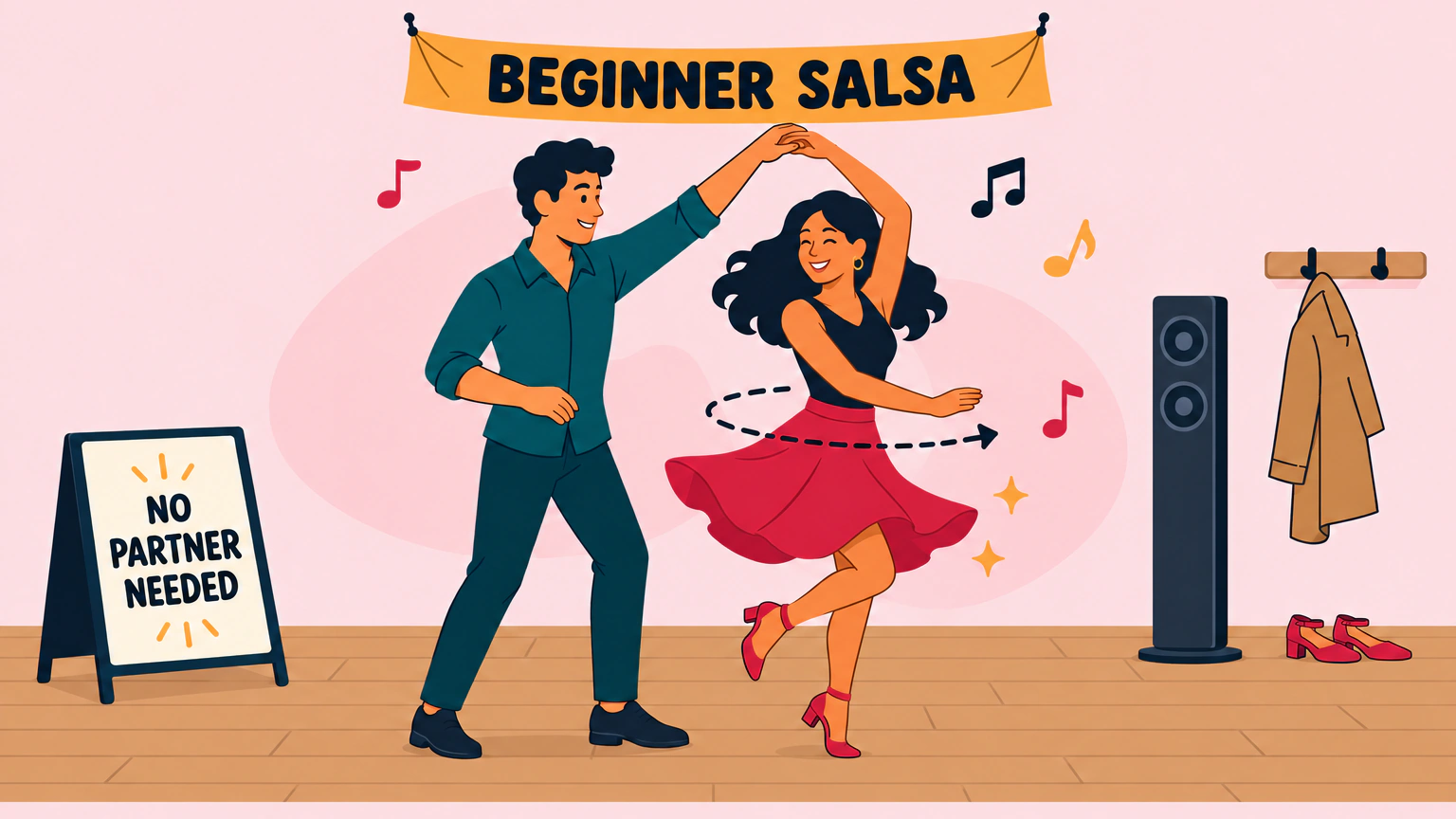
You don't need a partner. Your first class will most likely teach On1 or Cuban casino rather than On2. Teachers put a comfortable night at a social anywhere from two months to a year away, depending on how often you dance.
We got those numbers the slow way, by reading the published prices and level rules on each studio's own site.
On this page
- What salsa is, and where it comes from
- On1, On2 or Cuban: which salsa your class will teach
- What a beginner salsa course costs in Canada
- How long it takes to learn salsa
- Your first class: what happens, and what to wear
- Where to practise between classes
- Before you pay for a salsa course
- Common questions about starting salsa
What salsa is, and where it comes from
Salsa is the dance that goes with salsa music, and Wikipedia describes it as "typically danced with a partner, although there are elements of solo footwork as well." The word itself is Spanish for "sauce." Johnny Pacheco, Fania Records and the Fania All-Stars popularized the name in New York in the 1960s and 1970s, for dance music "with roots in Cuba and mid-20th-century New York." The steps have a longer past: salsa dance grew out of older Afro-Cuban and Caribbean social dances, especially son cubano, danzón, mambo, cha-cha-chá and rumba. If you're still choosing, our guide to the other dance styles lays out what else is on a Canadian studio timetable.
On1, On2 or Cuban: which salsa your class will teach
Every style shares one count. "Salsa is counted in eights," says Quartier Latin Dance Studio in Montreal. "In both timings you take three steps, pause, take three steps, pause." The difference is where the break lands, and the break is simply the step where you change direction.
| Style | Where the break step falls | How it moves on the floor | Where we found it taught |
|---|---|---|---|
| LA style (On1) | Beats 1 and 5, with pauses on 4 and 8 | Back and forth along a straight line, the slot | Beginner classes at Dance Vancouver, Baza in Vancouver and CD Dance Collective in Calgary |
| New York style (On2, often called mambo) | Beats 2 and 6, with pauses on 4 and 8 | Along the slot, like LA style | After the basics: Baza starts it at Level 4, and Dance Vancouver lists it as Mambo |
| Cuban (casino) | Usually beat 1, which Cuban dancers call a tiempo | Partners circle each other, and rueda puts several couples in a ring with a caller | VanCuba in Vancouver, La Rumba in Calgary and Pure Havana in Ottawa |
Counts from Quartier Latin Dance Studio's On1 and On2 guide. In every style you step three times and pause, twice in each eight-count.
On1 breaks on the downbeat, "the beat you'd clap on without thinking." On2 breaks on 2, "where the conga drum plays its sharp slap." Wikipedia credits Eddie Torres with helping to formalize On2 timing in New York. For most learners, On2 comes later: "Fewer beginner classes start here, so it's more often a second timing than a first," Quartier Latin says.
We'd start with whatever your nearest beginner class teaches, On1 or Cuban, and choose between them by the socials you want to go to. Several studios don't say which timing they teach. Toronto Dance Salsa, Dance ConneXion and City Dance Corps are among them, so ask. The On1 vs On2 choice isn't a life sentence, either. Quartier Latin says "your steps and turns carry over if you add On2 later," and adds: "If you learn On1 first, your timing carries over to casino."
What a beginner salsa course costs in Canada
Salsa dance studios sell beginners a short block of four to eight weekly classes, so the headline price can fool you. The number that matters is the price per class.
| Studio and city | Beginner course | Price as listed | Per class, before tax |
|---|---|---|---|
| Toronto Dance Salsa, Toronto | Salsa Level 1, seven 1-hour classes from November 1, 2026 | $153 plus HST | $21.86 |
| Dance ConneXion, Toronto | Beginner Salsa Level 1, eight 1-hour classes | $180 plus HST, or $27 plus HST to drop in | $22.50 |
| City Dance Corps, Toronto and Oakville | One four-week salsa course after the intro | $120 | $30.00 |
| Latin Energy, Mississauga | Salsa Beginner Level 1, five 1-hour classes from November 17, 2026 | $109.95 plus tax, on sale at $87.96 plus tax | $21.99, or $17.59 on sale |
| Baza Dance Studio, Vancouver | Salsa Intro (On1), 1-hour classes | $167 for seven Monday classes, $190 for eight on Thursdays | $23.86, or $23.75 |
| VanCuba, Vancouver area | Cuban salsa Beginner, six 90-minute classes from November 1, 2026 | $160 plus GST | $26.67 |
| CD Dance Collective, Calgary | LA-style Salsa Level 1, four 50-minute classes in September 2026 | $60, or $100 for a couple | $15.00 |
| La Rumba Cuban Dance Company, Calgary | Cuban Salsa Casino Beginner, four 1-hour classes in October 2026 | $95 | $23.75 |
| Vibe Salsa, Ottawa | Six 1-hour Tuesday classes from November 10, 2026, social included | $55, or $18 to drop in | $9.17 |
Prices as each studio lists them on its own site for its fall 2026 sessions, with tax shown only where the studio shows it. Per-class figures are our arithmetic, before any tax.
Two Toronto studios land close together: Toronto Dance Salsa at $21.86 a class and Dance ConneXion at $22.50, both plus HST. City Dance Corps, also in Toronto, is the dearest per class, at $30 for its regular four-week courses. VanCuba's $26.67 looks steep until you see that it buys 90 minutes, which brings the hourly rate down to $17.78. CD Dance Collective in Calgary ran $15 for 50-minute classes. Vibe Salsa in Ottawa is the outlier, at about $9 a class with the social included.
Tax deserves its own question. The Toronto-area studios add it on top: most print HST, and Latin Energy prints "+Tax." VanCuba adds GST. Baza and the Calgary and Ottawa studios don't mention tax at all, so ask before you compare. Our gym cost guide explains how sales tax lands on a class fee province by province.
If you're not sure you'll like it, an intro offer is the cheapest way to find out. San Tropez in Montreal sells 14 days of unlimited beginner classes for $39, against its regular $25 drop-in. Dance Vancouver gives new students two weeks of unlimited classes at their level and below for $50, or $80 for a couple. City Dance Corps sells new students its four-class intro for $59 plus HST, which is $14.75 a class, before its $120 courses. Of the Montreal schools we checked, the one with a current price list sells an intro pass, not a fixed course, so we've left Montreal out of the course prices.
Our planning ranges for dance classes
These are the ranges on our own dance and ballroom category pages, built from published Canadian offers.
| What you're buying | Our planning range | What the price covers |
|---|---|---|
| Adult group dance class | C$20 to C$25 | One scheduled group class, per person |
| Six-class beginner dance course | C$100 to C$160 | Six weekly 60-minute classes, per person |
| 10-class adult dance pass | C$150 to C$220 | Ten group classes, per person |
| Group ballroom course | C$120 to C$300 | Six to eight weekly classes of 45 to 60 minutes, per person |
From the Cost of block on our dance lessons and ballroom dance classes pages. They're planning ranges in Canadian dollars, drawn from selected published Canadian offers, not national averages or quotes from the studios we list.
Set the nine studios beside those ranges. Five of the nine per-class prices sit inside our C$20 to C$25 for an adult group class, Latin Energy's only at its regular price. City Dance Corps and VanCuba sit above it. CD Dance Collective and Vibe Salsa sit well under it.
The one-block Level 1 courses in Toronto and Vancouver (Toronto Dance Salsa, Dance ConneXion, Baza and VanCuba) run $153 to $190, near or above the top of our C$100 to C$160 six-class range. That's mostly because three of them are seven or eight classes long. City Dance Corps is the exception. It sells Level 1 as two four-week courses, and we've priced just one of them. A group ballroom course spreads wider, at C$120 to C$300 for six to eight classes, so check the class count before you hold one against a salsa quote. You can compare dance classes near you on our category page, and we list partner dance classes separately if you'd rather take a partner program.
How long it takes to learn salsa
The basic step comes fast: Quartier Latin says most beginners have "the basic step and the beat in the first month." Everything after that depends on what you count as learned.
Why teachers give such different answers
Ask four teachers and you'll get four answers. Quartier Latin says most beginners "feel comfortable at a social after two to three months of weekly classes." The Dance Dojo, an online school, says most students are "dancing socially and actually enjoying it within 3 to 6 months of consistent practice," and it defines consistent as "practicing 3 to 4 times a week, not just attending one weekly class." Toronto Dance Salsa says "about 6 months" of lessons plus going out and practising "at least twice a week" before patterns start to feel "natural."
Danza Academy, a Philadelphia studio, splits the answer by hours. One whole song with a partner takes "about 3 to 6 months" at three to five hours a week, it says, and "6 to 12 months" at one or two. Its planning window for social comfort is "6 to 12 months of regular dancing."
Our read is that they're measuring different finish lines (your first social, patterns that feel automatic, ease on a busy floor) and assuming different amounts of practice. Danza's hours-a-week split is the honest variable, and it's the one you control. Two or three months of weekly classes gets most beginners through a first social. Going out to practise is what turns that first night into real ease, and the teachers who measure that stretch put it at six months or more.
How many classes before the next level
A firmer measure than anyone's opinion is the rule each studio sets for moving up.
| Studio | What comes before the next tier | Weekly classes, at least |
|---|---|---|
| Dance ConneXion, Toronto | Level 1 and Level 2, eight weeks each, before Intermediate Salsa Level 3 | 16 |
| VanCuba, Vancouver area | Beginner, then an Improver level that "usually consists of two stages", before Intermediate | Usually 18, at 90 minutes each |
| City Dance Corps, Toronto and Oakville | The four-week intro, then eight classes at each of Levels 1 and 2, before Level 3 | 20 |
| Latin Energy, Mississauga | Levels 1 to 4, five weeks each, before Level 5 Intermediate, or "at least 24 salsa dance lessons" | 20 |
| Baza Dance Studio, Vancouver | Salsa Intro, then "at least 3 rounds" of Salsa Fundamentals and an instructor assessment, before Level 3 | 28 |
From each studio's own level descriptions, assuming one class a week and no repeats. Baza's count uses its seven-week Monday sessions, and VanCuba's Improver is counted as two six-class courses.
At these five studios, the next tier sits 16 to 28 weekly classes in. That's roughly four to six and a half months of classes, before any break between sessions. City Dance Corps offers experienced dancers from other studios "a complimentary assessment" to place them, and Baza requires an instructor assessment before Level 3. Baza also offers a review rate if you want to repeat Salsa Intro, so going around again is normal, not a failure.
Your first class: what happens, and what to wear
Your first class will be gentler than you're imagining. "Beginners start with that one step on their own, then add partner work and a first simple turn," Quartier Latin says. Dance ConneXion's Level 1 lists "timing, basic steps, right & left turns, cross-body lead, partner connection."
Clothes are the easy part. Toronto Dance Salsa tells men "Jeans and a t-shirt with sneakers is perfect," and tells women "You do not need to wear heels." Quartier Latin disagrees on the denim ("Avoid jeans that restrict hip movement"), so we'd pick stretchy over stiff.
Shoes are the one thing worth getting right. "For shoes, anything with a smooth sole works: avoid running shoes with rubber soles that grip the floor too much," Quartier Latin says, while San Tropez says "clean indoor shoes that stay securely on your feet are fine" for your first classes. Toronto Dance Salsa is happier with sneakers, so if yours are the grippy kind, wear the smoothest pair you own. Just leave the dress shoes at home. One Toronto Dance Salsa student wore them to Level 1 and, fifteen minutes in, had to sit down and "ask for band aids."
Real dance shoes, with suede or leather soles that make spinning easier, can wait. Toronto Dance Salsa says to buy them "About 10 to 15 weeks into regular weekly classes," which usually means after a first course. "Not before."
Where to practise between classes
Classes teach you the patterns. Socials teach you to dance them with strangers, to real songs. The three we found cost $15 or less. Latin Energy's Candela Latin Nights in Mississauga run on the third Saturday of the month from 7:00 to 11:30 PM, and the $15 cover "Includes the lesson." Vibe Salsa in Ottawa says "All lessons include free access to the social," and a social on its own is $10. City Dance Corps runs a weekly practice, free for qualifying members and $9 for non-members and class-pack holders, on Wednesdays in Toronto and Thursdays in Oakville.
One rule for the floor comes from Quartier Latin. "Montreal socials mix both timings," it says, and "the leader sets the timing and the follower matches it." If you're not sure which one you're dancing, asking "On1 or On2?" before the song starts is "a normal question."
Before you pay for a salsa course
Six questions, one email. The answers will tell you more than any studio's home page.
- Divide the price by the number of classes, and ask how long each class runs. A 90-minute class and a 50-minute class aren't the same purchase.
- Ask whether tax is added at checkout. Most of the Toronto-area studios we checked add HST, VanCuba adds GST, and several other studios don't say either way.
- Ask which timing the class teaches: On1, On2 or Cuban. Then check that it matches the socials you plan to go to.
- Ask whether a practice night or social is included, and what it costs if it isn't.
- Ask the last week a beginner can still join, and whether a late start is prorated.
- Get the refund and cancellation rules in writing before you pay. In Ontario, ontario.ca says prepaid dance classes can count as personal development services. The Consumer Protection Act covers a for-profit studio's contract when you have to pay in advance and it totals more than $50.
If the answers hold up, compare dance classes near you and book the intro class first. If your studio is in Ontario, our cancellation guide spells out what Ontario's rules give you.
Common questions about starting salsa
Do you need a partner to take salsa classes?
No. Every beginner course we priced that raises the question takes singles: City Dance Corps says "No partner needed," Baza says "registering with a partner is not required," and VanCuba and Latin Energy both say "No partner required." Quartier Latin explains: "Partners rotate during class, so you dance with everyone in the room. Coming alone is the normal way to start." Bringing someone can still save money, as with CD Dance Collective's $100 couple price against $60 each.
Is salsa hard to learn?
The steps aren't, but the timing is. Quartier Latin has beginners start with one step on their own and says "Rhythm matters more than fancy moves." The Dance Dojo puts it first too: "Timing comes first because everything else depends on it." The basic itself is short: step on 1, 2, 3, pause on 4, step on 5, 6, 7, pause on 8. How quickly it feels easy comes down to how often you practise.
Can you learn salsa by yourself?
Partly. Footwork and timing, yes. The Dance Dojo says "Smooth-soled shoes (or socks at home), and a bit of floor space are enough to begin," and City Dance Corps runs Salsa Shines classes, "Footwork, no partnering." Leading and following is the part you can't do alone. That takes other people, which is what class rotation and socials are for.
How much are private salsa lessons?
Expect about $70 to $115 for an hour alone. Pure Havana in Ottawa charges $70 for a one-hour individual class and $120 for a couple. Our planning range for a private solo dance lesson is C$75 to C$115 for 60 minutes. Our ballroom ranges put a couple's 45-to-60-minute lesson in that same C$75 to C$115, so a second person may add little, though Pure Havana's adds $50. Ask for the total.
Can you join a salsa course after it starts?
Often, for a week or two. Dance ConneXion prorates courses in progress and recommends complete beginners join "no later than the third week after the course begins." CD Dance Collective's $20 drop-in was "only available for the first two classes" of its September course. Vibe Salsa is looser, with $18 drop-ins and a $40 flex pass for any four classes.