

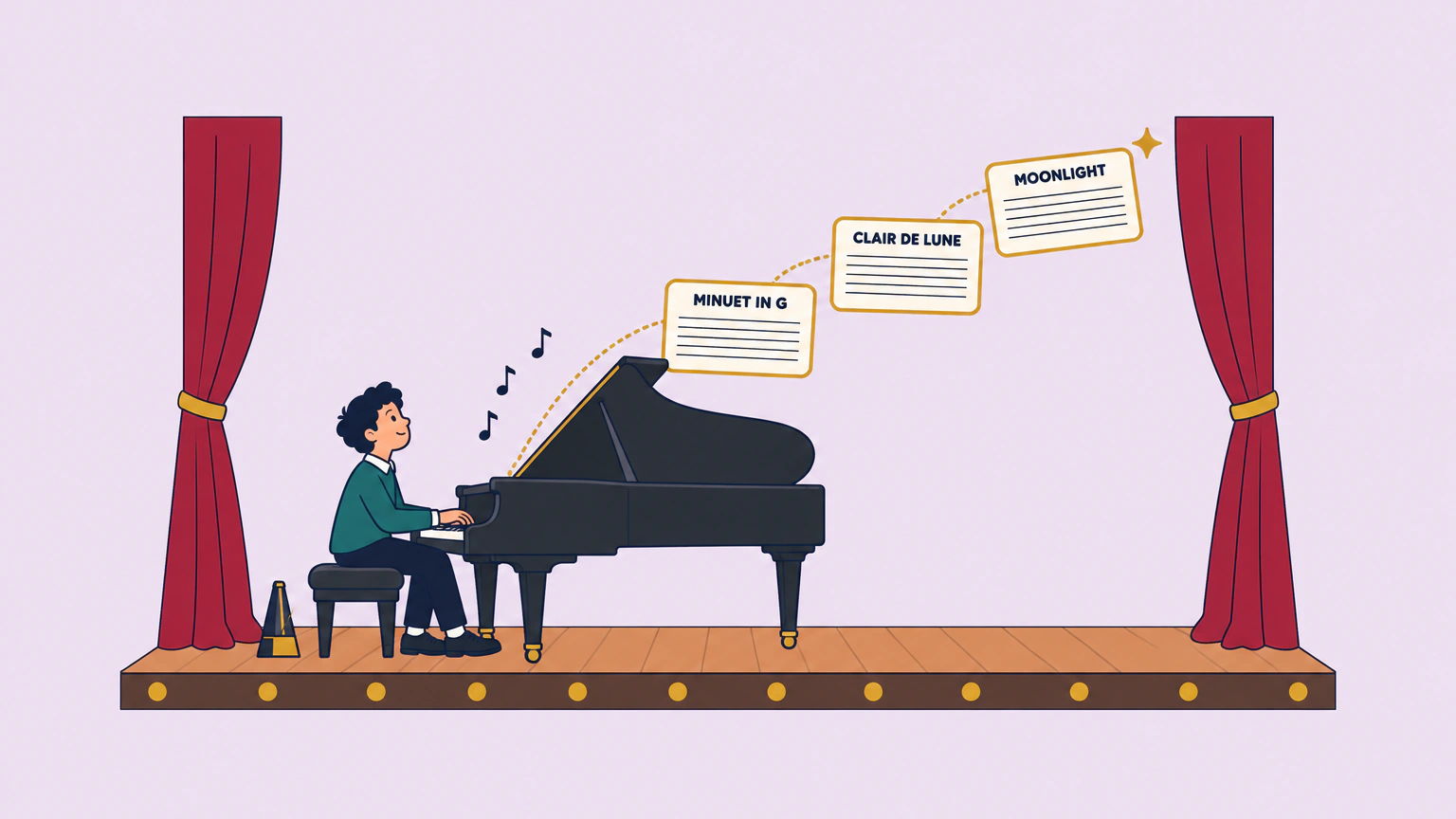
Here's that answer, straight from the lists published by the Royal Conservatory of Music (RCM). Für Elise is a Level 7 piece on the RCM's piano syllabus, Clair de lune is Level 10, and the complete Moonlight Sonata sits on the ARCT diploma list beyond Level 10. Pop songs work differently. River Flows in You is Level 8 and Leonard Cohen's Hallelujah is Level 3 in the editions the RCM names, and Piano Man appears at both Level 4 and Level 7, because the arrangement, not the song, sets the level.
That last point changes how you read every "easy" list online. The rest of the famous ones follow, plus what to do when your piece isn't on any list at all.
On this page
- Where the famous classical pieces sit on the RCM syllabus
- Pop and film songs: the arrangement sets the level
- Why the beginner lists online don't match the syllabus
- How long it takes to reach each level
- How to look up any piece's level yourself
- Finding a teacher who'll get you to your piece
- Frequently asked questions
Where the famous classical pieces sit on the RCM syllabus
The classical placements all come from one document, the RCM's Piano Syllabus, 2022 Edition. It runs from Preparatory A and B through Levels 1 to 10, then on to two diplomas, the ARCT and the LRCM. Inside each level, pieces are sorted into lists by style, such as Baroque, Classical and Romantic, and an exam program draws one piece from every list. Many are printed in the RCM's own Celebration Series books, but the syllabus also accepts the other published editions it names. For the system itself, start with our guide to how the RCM levels, theory exams and fees work.
| Piece | Composer | Where the RCM puts it | What counts as the piece |
|---|---|---|---|
| Minuet in G major, BWV Anh. 114 | Christian Petzold | Level 3, List A | The whole minuet |
| Sonatina in C major, op. 36 no. 1 | Muzio Clementi | Level 3, List B | Any one of its three movements |
| Waltz in A minor, B 150 | Frédéric Chopin | Level 6, List C | The whole waltz |
| Of Foreign Lands and Peoples | Robert Schumann | Level 6, List C | The first piece of Kinderszenen |
| Für Elise, WoO 59 | Ludwig van Beethoven | Level 7, List B | The whole piece |
| Prelude in E minor, op. 28 no. 4 | Frédéric Chopin | Level 7, List C | The whole prelude |
| Invention No. 1 in C major | J.S. Bach | Level 7, List A | The whole invention |
| Sonata in C major, K 545 | W.A. Mozart | Level 8, List B | The first movement |
| The Little Shepherd | Claude Debussy | Level 8, List D | One piece from Children's Corner |
| Gnossienne No. 3 | Erik Satie | Level 8, List D | The whole piece |
| Nocturne in E-flat major, op. 9 no. 2 | Frédéric Chopin | Level 9, List C | The whole nocturne |
| Minute Waltz, op. 64 no. 1 | Frédéric Chopin | Level 9, List C | The whole waltz |
| Fantasia in D minor, K 397 | W.A. Mozart | Level 9, List B | The whole fantasia |
| The Easy Winners | Scott Joplin | Level 9, List D | The whole rag |
| Clair de lune | Claude Debussy | Level 10, List D | The third piece of Suite bergamasque |
| Prelude in C-sharp minor, op. 3 no. 2 | Sergei Rachmaninoff | Level 10, List D | The whole prelude |
| Prelude and Fugue in C major, BWV 846 | J.S. Bach | Level 10, List A | The prelude and fugue together |
| Liebestraum No. 1 | Franz Liszt | Level 10, List C | The whole piece |
| Liebestraum No. 3 | Franz Liszt | ARCT, List C | The whole piece |
| Moonlight Sonata, op. 27 no. 2 | Ludwig van Beethoven | ARCT, List B | The complete sonata |
| Sonata in A major, K 331, with the Rondo alla turca | W.A. Mozart | ARCT, List B | The complete sonata |
| Fantaisie-Impromptu, op. 66 | Frédéric Chopin | ARCT, List C | The whole piece |
| La campanella | Franz Liszt | ARCT, List F | One of the concert etudes |
| Gymnopédie No. 1 | Erik Satie | Not on the syllabus | Ask about a Teacher's Choice spot |
| The Entertainer | Scott Joplin | Not on the syllabus | Ask about a Teacher's Choice spot |
| Canon in D | Johann Pachelbel | Not on the syllabus | Depends on the arrangement |
From the RCM's Piano Syllabus, 2022 Edition. Each list is a style group, and an exam takes one piece from each list.
The famous pieces you can reach in the first few years
A few famous pieces come early. The Minuet in G major (BWV Anh. 114) is a Level 3 piece, in List A. The syllabus credits it to Christian Petzold, not Bach, and lists it from the Anna Magdalena Bach notebook. Clementi's Sonatina in C major, op. 36 no. 1 is Level 3 too, in List B, and any one of its three movements counts as a piece.
Two more favourites wait at Level 6, both in List C: Chopin's Waltz in A minor and Schumann's Of Foreign Lands and Peoples. These are the pieces a child can stand up and play at a first or second recital.
Level 4 has no theory exam attached, but from Level 5 a written one joins the certificate. Our guide to what the theory exams involve walks through it.
Für Elise, and why the whole piece waits a while
Für Elise (WoO 59 in Beethoven's catalogue) is a Level 7 piece, in List B with the Classical-style music. That's a real milestone. A Level 7 exam asks for three pieces, one each from Lists A, B and C, plus two etudes (short studies that each drill a technical skill), and you need 60 marks out of 100 to pass.
So why does the opening turn up in lessons years earlier? Because the famous part is the easy part. Piano Bubble's analysis puts the first 43 bars at a much easier standard than bar 44 onwards, where four- and six-note chords, grace notes and faster runs arrive. The first page comes long before the whole piece, and that opening section makes a sensible first goal.
A keen Level 6 student has a shortcut, because the syllabus allows a swap from the same list one level up. Für Elise can replace a Level 6 List B piece. The catch is that the examiner marks it at the Level 7 standard.
Two of its Level 7 neighbours are famous in their own right: Chopin's Prelude in E minor (List C) and Bach's Invention No. 1 in C major (List A). Past Level 7, the favourites get bigger.
The favourites that wait for the top levels
A lot of the music people hum sits at Levels 8 to 10. The first movement of Mozart's Sonata in C major, K 545, is Level 8, and so is Debussy's The Little Shepherd. Chopin's Nocturne in E-flat major, op. 9 no. 2, and his Minute Waltz arrive at Level 9.
Level 10 is the big one. Clair de lune sits in its List D, as the third piece of Debussy's Suite bergamasque, alongside Rachmaninoff's Prelude in C-sharp minor. Bach's well-loved Prelude in C major is a Level 10 piece too, but only together with its fugue. Liszt's Liebestraum No. 1 is Level 10, while the famous No. 3 waits for the ARCT.
The exam changes shape up here as well. From Level 9, repertoire pieces must be played from memory or marks come off. The Level 9 repertoire program should stay within 15 minutes. Level 10 asks for five pieces in up to 30 minutes.
Where the Moonlight Sonata actually sits
This is the one that surprises people. Beethoven's Moonlight Sonata (op. 27 no. 2) appears only on List B of the ARCT diploma, as a complete sonata. Its famous first movement isn't listed on its own anywhere from Level 1 to Level 10, and the ARCT expects complete works unless the syllabus says otherwise. That means all three movements, fast finale included.
The ARCT is a serious step. You need your Level 10 certificate first, the RCM "strongly" recommends at least two years of study after Level 10, and the pass mark rises to 70.
Mozart's Sonata in A major, K 331, works the same way. Its last movement is the Rondo alla turca (the Turkish March), and only the complete sonata is listed, also on ARCT List B. Chopin's Fantaisie-Impromptu and Liszt's Liebestraum No. 3 are ARCT List C pieces, and La campanella is one of the concert etudes in List F.
Nobody needs permission to learn that first movement for the joy of it. To put an unlisted movement in an exam outside the standard swaps, though, you'd file the RCM's Examination Substitute Piece Request Form before the registration deadline. And when a popular list calls that movement "intermediate", it's making its own judgment, not the RCM's.
Famous pieces the syllabus doesn't list at all
Satie's Gymnopédie No. 1, Joplin's The Entertainer and Pachelbel's Canon in D aren't in the Piano Syllabus, and none of them is on the 2022 or 2025 Popular Selection List either. Schumann's Träumerei isn't listed on its own, and the complete Kinderszenen it belongs to is a Licentiate diploma piece.
Their listed cousins make a decent consolation. Satie's Gnossienne No. 3 is Level 8, and Joplin turns up twice, with The Easy Winners at Level 9 and Solace at Level 10.
An unlisted piece can still reach an exam through a Teacher's Choice swap, as long as it's comparable in length, difficulty, style and musical quality. That swap is allowed in List C at Levels 3 to 7, List C or D at Levels 8 and 9, and List C, D or E at Level 10. A Teacher's Choice piece can take an etude's place instead. The examiner also marks how fitting the choice was. So for these pieces, the level is your teacher's judgment, and that's a perfectly good answer.
Pop and film songs: the arrangement sets the level
Pop, film, jazz and musical-theatre songs live in a separate document, the RCM's Popular Selection List, published as an addendum to the piano syllabus. The 2025 edition sorts its songs by level, from Level 1 to Level 10, and names the exact book or sheet music for every entry, because one song can come in an easy arrangement and a hard one. The syllabus accepts a song from any edition of the list, so two 2022 favourites, Let It Be and Bohemian Rhapsody, still count.
| Song | Written by | RCM level | Edition the list names |
|---|---|---|---|
| Hallelujah | Leonard Cohen | 3 | Leonard Cohen for Easy Piano |
| Both Sides Now | Joni Mitchell | 3 | The New Standards, Easy Piano |
| Heart of Gold | Neil Young | 3 | Neil Young: Greatest Hits |
| Merry-Go-Round of Life | Joe Hisaishi | 3 and 7 | Studio Ghibli Recital Repertoire 1, Elementary or Intermediate |
| Piano Man | Billy Joel | 4 and 7 | The Best of Billy Joel, Easy Piano, or Piano Solos |
| Star Wars (Main Theme) | John Williams | 4 and 8 | BigTime Piano: Popular, or the Dan Coates piano solo |
| Big Yellow Taxi | Joni Mitchell | 4 | Alfred's Popular Hits, Level 4 |
| Perfect | Ed Sheeran | 2 and 4 | Next First 50 Popular Songs You Should Play on the Piano, or City of Stars, Mercy and More Hot Singles |
| Hedwig's Theme | John Williams | 6 | Dan Coates easy piano sheet music |
| I Giorni | Ludovico Einaudi | 6 | Einaudi Graded Pieces for Piano, Grades 3 to 5 |
| Imagine | John Lennon | 7 | Piano, vocal and guitar sheet music |
| River Flows in You | Yiruma | 8 | The New Composers: Piano, Vol. 1 |
| Comptine d'un autre été | Yann Tiersen | 8 | The New Composers: Piano, Vol. 1 |
| Clocks | Coldplay | 8 | Coldplay for Piano Solo |
| Let It Be | John Lennon and Paul McCartney | 9 (2022 list) | Piano, vocal and guitar sheet music |
| Bohemian Rhapsody | Freddie Mercury | 10 (2022 list) | Queen: Piano Solo Collection |
| Blues for Smedley | Oscar Peterson | 10 | Oscar Peterson: Jazz Piano Solos |
From the RCM's Popular Selection List, 2025 Edition, plus two songs found only in the 2022 edition. The syllabus accepts a piece from any edition of the list.
One song, two levels
Piano Man is the clearest example. The list puts it at Level 4 in The Best of Billy Joel, Easy Piano, and at Level 7 in Best of Billy Joel: Piano Solos. The Star Wars main theme sits at Level 4 in Faber's BigTime Piano: Popular book and at Level 8 in Dan Coates's piano solo. Merry-Go-Round of Life is Level 3 in an elementary Studio Ghibli book and Level 7 in the intermediate one. Even Ed Sheeran's Perfect turns up twice, at Levels 2 and 4.
Watch the numbers printed on the covers, too. A method book's own level isn't an RCM level, and the list proves it. Misty, from BigTime Piano: Jazz and Blues, Level 4, sits at RCM Level 6. So does City of Stars, from Alfred's Popular Hits, Level 5.
Pro tip: Buy the book the list names. The RCM picked each edition so students prepare the right arrangement for the level, and a different version of the same song can be a lot easier or a lot harder.
Where a pop song fits in an RCM exam
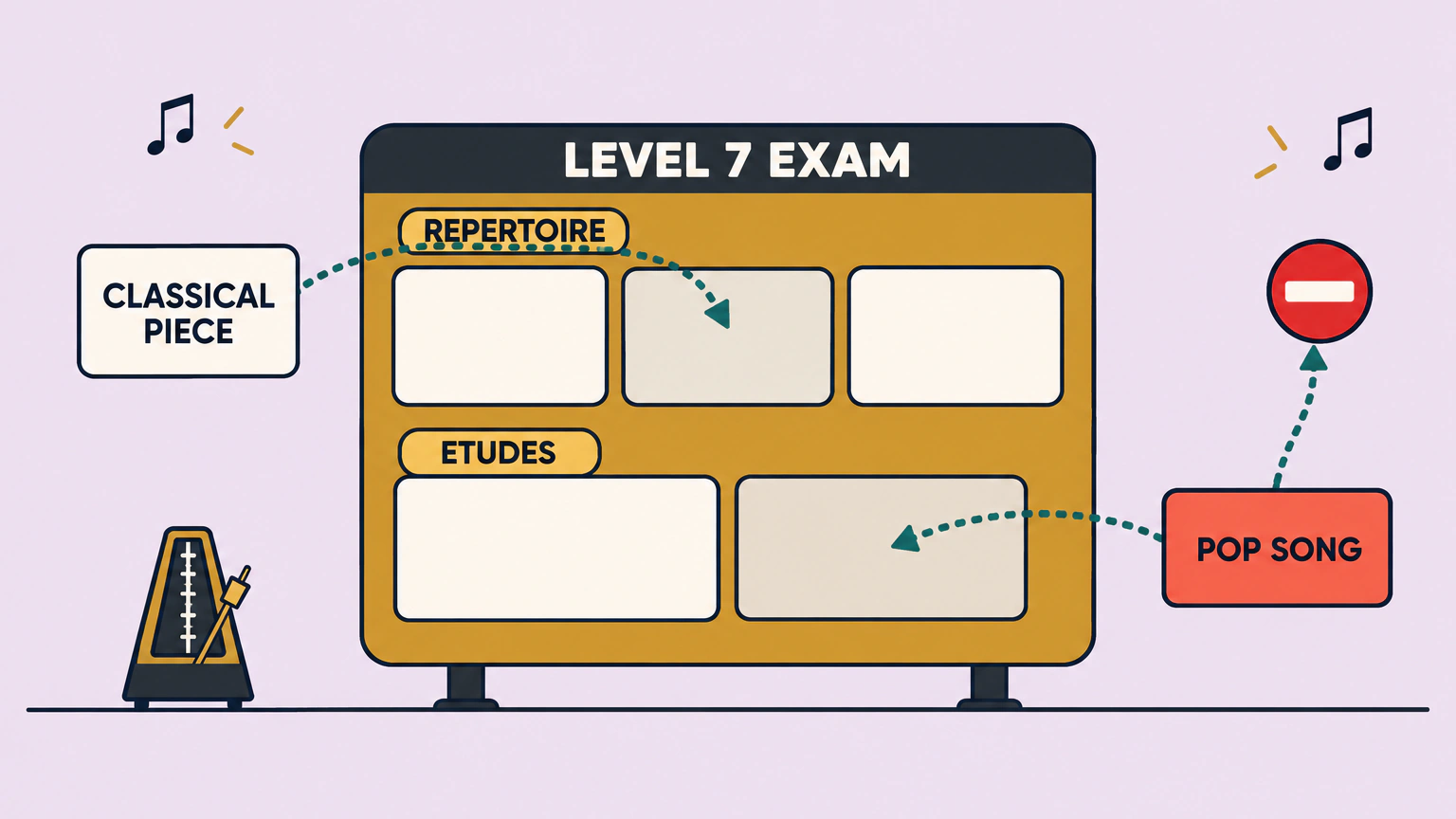
A pop song can stand in for one of the two etudes in an exam, never for one of the repertoire pieces. That's the rule that trips families up. A Level 7 student still plays three pieces from the syllabus lists, and the song takes one etude's place. It can come from the student's exam level or the level immediately above, from any edition of the list, and you don't need the RCM's approval first. Level 10 students gained the option with the 2022 syllabus.
Read the small print under each entry. Many come with playing instructions, such as leaving out a repeat or jumping straight to the coda (the closing section), and the student is expected to follow them.
The Canadian songs on the list
The list has a proud Canadian streak, and it starts early. Leonard Cohen's Hallelujah, Joni Mitchell's Both Sides Now and Neil Young's Heart of Gold are all Level 3. Mitchell's Big Yellow Taxi and Shawn Mendes's Mercy follow at Level 4. Young keeps climbing, with Harvest Moon at Level 6 and Like a Hurricane at Level 7.
French Canada has its own corner. Two songs from the songbook Chansons du Québec, Vol. 2 sit at Level 8: Pour une histoire d'un soir and Séisouso.
And at the very top, Montreal-born Oscar Peterson has three Level 10 pieces: Blues for Smedley, Roundalay and The Strut. If your teenager thinks the Royal Conservatory is all powdered wigs, Level 10 would like a word.
Why the beginner lists online don't match the syllabus
If you've already searched for famous piano songs for beginners, the results may have confused you. Pianote's list of famous classical pieces puts Chopin's Prelude in E minor and River Flows in You in its Beginner band, with Chopin's Waltz in A minor as an honourable mention. The RCM places those three at Levels 7, 8 and 6. Merriam Music's Top 10 Popular Piano Songs For Beginners includes Clair de lune and the Rondo alla turca, and sells an easy-piano Clair de lune right beside the entry.
Nobody's doing anything wrong. They're using a different scale. Easy arrangements exist for almost every famous piece, and Merriam's page offers "Easy Piano" sheet music beside seven of its ten songs. Pianote says it outright: "Rating pieces based on 'difficulty' is hard." And as Für Elise shows, the famous first page of a piece can be far easier than the whole thing.
So the first question to ask about any "beginner" list is a simple one. Which version does it mean?
How long it takes to reach each level
The rule of thumb teachers use
There's no official clock. We couldn't find a level-by-level timeline in the RCM's own syllabus, so families lean on teachers' rules of thumb. Muzart, a Toronto music school, says preparing for an RCM exam typically takes 8 to 12 months of focused study per level. PianoTV, a piano-teaching channel, puts the average student at a Grade 8 level by the end of high school (Grade is the older name for Level). By its count, Grade 10 typically takes ten years, with a year or two of learning before Grade 1. Later starters, it adds, can sometimes move faster, because they spend less time on the basics.
Put those together for a child who starts at seven, and the whole of Für Elise is usually several years away. That's normal. It's also why the opening comes first.
Why the climb slows after the middle levels
The jumps get bigger after Level 8, and not only because the music is harder. Each new piece takes longer to learn the higher you go, even as skills grow. At Level 9, the repertoire program is memorized. The certificate also needs Level 8 Theory, Level 9 Harmony or Keyboard Harmony, and Level 9 History. Level 10 then asks for five pieces, one from each of five lists. A student aiming for the ARCT needs 75 overall at Level 10, or at least 70 percent in every section, before that two-year runway even starts.
None of that should put you off. And if you want to know exactly where your own goal piece sits, you can look it up yourself in about five minutes.
How to look up any piece's level yourself
Both documents are free PDFs on the RCM's Syllabi and Syllabi Errata page, and your browser's search box does most of the work. Here's the routine.
- Open the RCM's Syllabi and Syllabi Errata page and download the Piano Syllabus, 2022 Edition.
- Search the composer's surname, then the catalogue number, such as WoO 59 or BWV Anh. 114, because titles change between books and numbers don't.
- Note the level printed at the top of the page and the list letter above the piece.
- Check whether the entry is a whole piece or a single movement.
- For a pop, film or jazz song, search the Popular Selection List instead and write down the book it names.
- Open the errata file on the same page before you buy any music.
- If the piece isn't listed, ask your teacher whether it could be a Teacher's Choice piece.
Finding a teacher who'll get you to your piece
A good teacher is the real shortcut to a goal piece. When you're comparing teachers, ask three things. Do they prepare students for RCM exams? Which edition would they teach your goal piece from, the original or an arrangement? And can a favourite piece sit beside the exam work, so the motivation lasts?
Our listings of piano teachers near you are organized city by city, from piano teachers in Vancouver to piano teachers in Calgary. We explain how we choose our Best of winners in plain terms. Before you sign up for a year, check what a year of piano lessons costs.
Then bring the piece to a first lesson and ask the teacher to show you where it sits.
Frequently asked questions
What RCM level is Für Elise?
Für Elise is Level 7. The complete piece is on the Level 7 list of the RCM's Piano Syllabus, in List B with the Classical-style pieces. The famous opening is much easier than the section that starts at bar 44, where chords and grace notes pile in. That's why students often play the first page long before they're ready for the whole thing.
What level is the Moonlight Sonata?
It isn't on any numbered level. The RCM lists the complete sonata on the ARCT diploma's List B, which comes after Level 10, and the first movement isn't listed on its own. Popular lists that call the first movement an intermediate piece are using their own scale, so ask your teacher how it compares with what you're playing now.
What RCM level is River Flows in You?
It's Level 8, on the RCM's Popular Selection List, in the edition the list names. As a popular selection it can replace one of the two etudes in a Level 8 exam, or in a Level 7 exam, because a pop piece may come from the level above. A simplified version will feel easier, but it isn't the arrangement the list chose.
Is Für Elise harder than Clair de Lune?
No, Clair de lune is harder by the RCM's measure. Für Elise is on the Level 7 list and Clair de lune on the Level 10 list. At Muzart's rule of thumb of 8 to 12 months per level, that's two or three years of lessons apart. Both come in easier arrangements, so compare the exact versions you're looking at.
Can you play a pop song in an RCM piano exam?
Yes, from Level 1 to Level 10, but only in place of one etude, never one of your repertoire pieces. The song has to be on the Popular Selection List at your exam level or the level above, in the edition the list names. Songs from the 2022 list still count, and you don't need the RCM's approval first.
How long does it take a beginner to learn Für Elise?
The complete Für Elise is a Level 7 piece, and at one Toronto school's rule of thumb of 8 to 12 months per level, a child starting from scratch is usually several years away. The famous opening is far easier than the middle section, so that first page can come much sooner if your teacher thinks you're ready.
What level is Canon in D on piano?
It doesn't have an RCM level. Pachelbel's Canon isn't in the Piano Syllabus or on the 2022 or 2025 Popular Selection List, so its difficulty depends entirely on the arrangement in front of you. Ask your teacher to compare it with a listed piece you already know.