

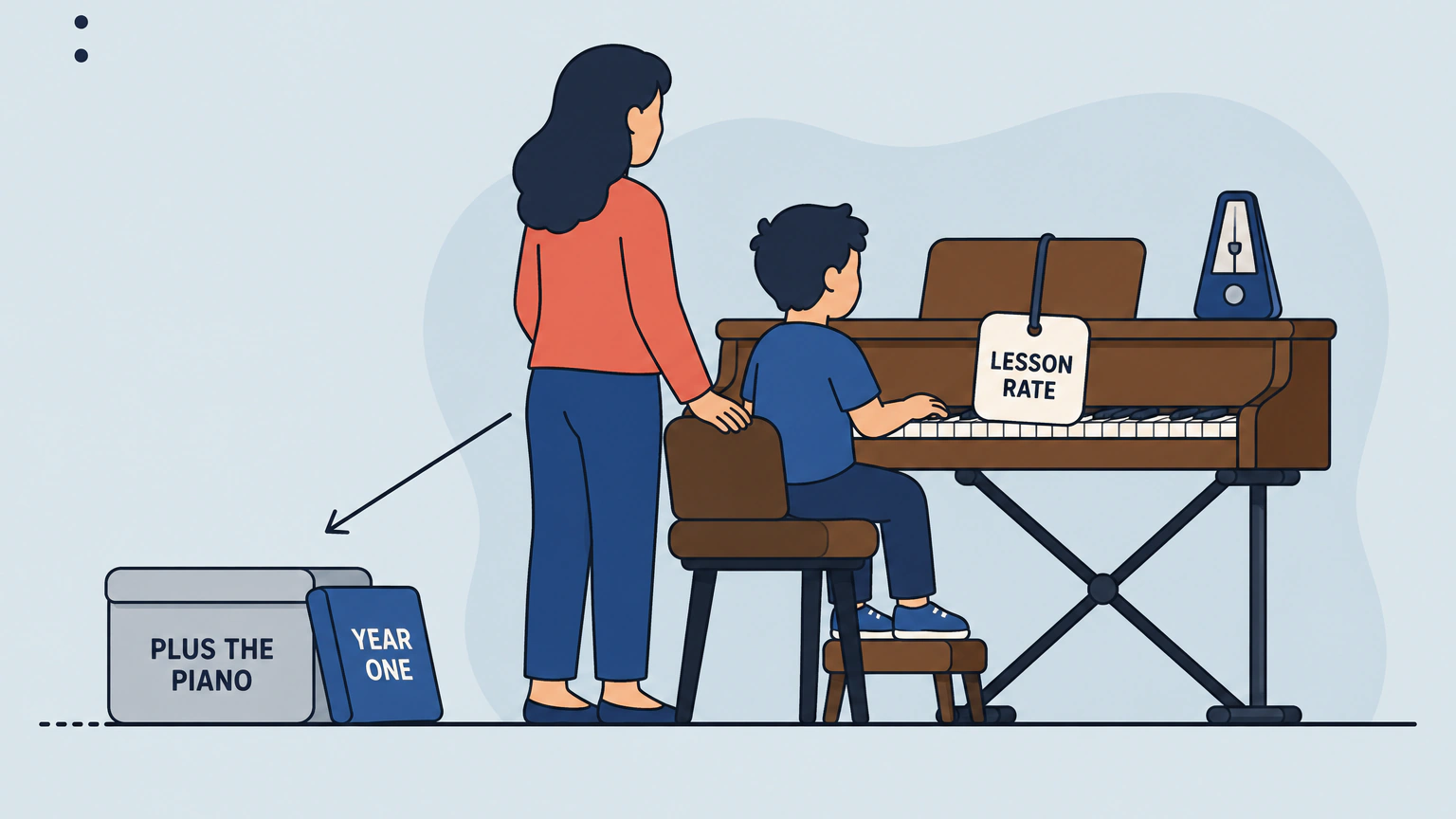
A half hour of private piano lessons costs about $25 to $55 in Canada, and which end you land on depends mostly on the door you walk through. An hour runs $65 to $85 at the Toronto studios that publish their prices. A weekly half hour, then, is somewhere near $100 to $220 a month.
That's the rate. The rate isn't the cost. Rent an 88-note digital piano and you're adding $46 to $70 a month on top of it, and books, tax and a first exam all land on the same household budget. Nobody quotes you those. So we will.
On this page
What a piano lesson actually costs in Canada right now
Two families in the same city can pay nearly twice what the other pays for the same half hour, and neither of them is being cheated. The spread is real. It comes down to who is teaching, and what the school around that teacher is carrying.
The published rates, from a national chain to a Toronto studio
Start at the bottom, because almost nobody does. Long & McQuade teaches out of stores across the country, and it says its own average out loud: "on average they are between $25 and $31 per half hour private lesson." It also promises "No registration fees" and takes each month's payment by automatic withdrawal on the fifth.
The ceiling is a Toronto address. ABC Academy publishes $55.38 for the same thirty minutes, tax included. Between those two sit the studios most parents actually phone, and their cards look like this.
| School and where | 30 minutes | 60 minutes | What the school says the price includes |
|---|---|---|---|
| Long & McQuade, stores across Canada | $25 to $31 (its own stated average) | not published | No registration fees; automatic withdrawals on the fifth of the month |
| Toronto Piano Teachers, Toronto | $32.50 | $65 | "Starting from"; online lessons are priced separately in US dollars |
| Greater Toronto Music School, Toronto | $30 to $50 | $60 to $90 | Its own published range across instruments |
| Neighbour Note, Toronto (studio or online) | $40 | $80 | Also prices 45 minutes at $60 |
| Neighbour Note, Toronto (in home) | $45 | $85 | The in-home premium is $5 a lesson at every length |
| ABC Academy, Toronto | $55.38 | $72.55 | "Tax included, no registration fee, no hidden fees" |
Five of these six publish Toronto or GTA prices, and the sixth is a national chain. In British Columbia, a Vancouver piano retailer's guide puts private piano wider, at $40 to $100 an hour. Every figure is the school's own published price rather than a quote for any particular student, and all of them are Ontario and British Columbia numbers. If you live anywhere else in Canada, ask two local schools and Long & McQuade's nearest store for a written rate before you treat any of this as your benchmark.
What our own cost profiles show
Our own piano page carries a number of a different kind. It comes from 853 cost profiles that families and teachers have sent us, and it averages $387, with most of them landing between $314 and $438.
Read that carefully, because it isn't a lesson rate. Nothing on the page says what period it covers. It's what people report paying, and the page resolves its own location rather than covering the country: on our last look it came up under Toronto. So take it as a rough sense of what families commit to, and don't judge a single quote against it. The same page ranks piano teachers near you, and the city version lists piano teachers in Toronto.
The shape across our other music categories is worth a glance while you're there. Guitar profiles average $139 and singing $277, against piano's $387. If your child is still deciding, our guitar teachers listings carry the same kind of figure.
Why the same thirty minutes can carry three different prices
Some schools run a ladder. The same thirty minutes costs more or less depending on which instructor tier your child lands in, and you often don't learn which tier that is until after you've registered.
ABC Academy publishes a comparison of GTA rates, and it shows one Toronto school running three prices for an identical half hour: $56.71, $63.37 and $70.05, rising with the tier. That's a competitor's chart rather than the school's own card, which is exactly why you'd check it yourself.
The same chart puts the Royal Conservatory above every studio on it, using an hourly figure it borrows from another company's market survey. We tried to open the Conservatory's own lesson fees to quote them properly and couldn't get in. So take the direction and leave the number: conservatory-tier teaching prices above the studios.
Two questions, then, before you sign anything. Which tier is this quote? And what happens to the price if my teacher leaves?
How you are billed, and why that decides your monthly number
A rate is the price of one lesson. A bill is a commitment. The two can sit a long way apart, and this is the part of the conversation that decides what leaves your account in February.
Per lesson, per month, or per term
Three models, and they tie you down in very different ways.
A per-lesson quote tells you the unit price, not when payment is due or how easily you can stop. Get both terms in writing before you compare it with a monthly or term invoice.
Per month is the chain model. Long & McQuade asks for each month's lessons in the first week of that month and runs automatic withdrawals on the fifth. The money leaves on a schedule, which is convenient right up until you want it to stop.
Term billing varies. Neighbour Note accepts payment monthly or by a three-month semester. It requires two weeks' notice to stop and does not refund lessons already paid. Ask for the same details wherever you enrol.
The missed lesson, and who eats it
Here's the clause almost nobody reads and nearly everybody eventually needs.
Months aren't equal. Four Tuesdays in February, five in March. If your contract prices lessons one at a time, that fifth Tuesday is another $40 out of the account. If it prices a term, it isn't. Ask which one you're on.
Then ask about make-ups. Neighbour Note provides them with 24 hours' notice and limits rescheduled lessons to three per semester. They do not carry into the next semester. Another school can set different terms, so get yours in writing.
Get the answer in writing before the first lesson. That clause can be the difference between a make-up and a lost lesson.
What to ask before you sign
None of this needs a lawyer. It needs eight questions and about four minutes on the phone, and the answers will tell you more about a school than its website ever will. Write them down as you go, because by Friday you'll be comparing three of these conversations from memory.
- Is this price per lesson, per month, or for the whole term?
- If I stop in November, what do I owe?
- What happens if my child is sick, and how long do I have to use a make-up?
- Does a five-week month cost more than a four-week month?
- Is there a registration fee, and is it charged again next year?
- Is tax included in that number, added to it, or not charged at all?
- Which teacher am I actually booking, and does the price change if that teacher leaves?
- Which books do we need before the first lesson, and roughly what do they cost?
The piano nobody quotes you
You can't practise on a lesson. Whatever you're paying the teacher, something with keys has to be living in your house by the second week, and that number arrives on its own separate invoice.
What a digital piano rents for
Buying can wait. Renting keeps the instrument line monthly while you find out whether lessons stick. Long & McQuade publishes rates for several starter keyboards.
| Instrument | Keys | Rent per month | Ten months of rent |
|---|---|---|---|
| Yamaha PSR-E583 | 61, unweighted | $41 | $410 |
| Yamaha P45 | 88, weighted | $46 | $460 |
| Roland FP-10 with stand | 88, weighted | $56 | $560 |
| Yamaha P225 | 88, weighted | $58 | $580 |
| Roland FP-30X | 88, weighted | $70 | $700 |
Rates are before tax and vary by store. The current catalogue pull resolved to Web Sales in Ontario.
Ten months of a weighted 88 is $460 to $700. At the two ends of the lesson range, the rental adds about 32% to 46% to the lesson bill. Notice too how little the 61-key saves. Forty-one dollars against forty-six is a $5 gap, and it buys you a different instrument rather than a cheaper one.
What happens to the rent if you buy
Long & McQuade says it can arrange a buyout at any time during the rental. Its current FAQ does not publish a rental credit percentage, so ask the store for the buyout figure before you sign.
Its current rental page says you can return early and receive a refund for unused time. Rental quotes depend on the location and equipment and can change.
When a keyboard is enough, and when it is not
A teacher will ask two things about whatever is in your living room. How many keys, and are they weighted.
For a student headed toward RCM exams, weighted touch matters. The RCM prefers an acoustic piano for remote exams from Preparatory through Level 8. It permits a weighted touch keyboard with at least 76 keys and prefers 88.
A 61-key unweighted keyboard does not meet those remote exam requirements. Ask the teacher how soon the student will need a larger instrument.
If you already own an acoustic piano, have it tuned before the first lesson and ask the teacher what she thinks of it. A free piano that won't hold its pitch isn't a saving.
Why the lesson and the piano can carry different tax lines
A piano lesson and a piano rental can sit on the same bill and carry different tax treatment. The lesson can be exempt while the instrument and books remain taxable.
The teacher who charges no tax at all
A piano lesson that builds musical skills toward a set goal and tracks the student's progress is exempt from GST/HST. The CRA says this applies at every level. Its examples cover private instruction and a music academy.
The $30,000 small-supplier threshold does not decide the tax on an exempt music lesson. Registration matters for taxable sales, but it does not turn a qualifying lesson into a taxable one.
The rented piano that does
A rented piano and the books you buy are different. Long & McQuade says its rental rates exclude tax. In Ontario, budget 13% HST on the instrument rental and 5% on a qualifying printed book.
A tax-included price does not prove that the lesson itself is taxable. Ask for each line separately when instruction, books and rental share one invoice.
The city class the statute exempts
Public-sector children's programs have a separate exemption.
The Excise Tax Act exempts a public sector body's supervised music program when it is aimed mainly at children 14 or younger. Programs with substantial overnight supervision are excluded from that route.
This provision also covers programs aimed mainly at underprivileged people or people with a disability. It is separate from the music-lesson exemption that can apply to private instruction.
Red flag: GST/HST added to a piano lesson deserves a question. Ask whether the charge covers only instruction or includes taxable items such as books or instrument rental. If a taxable invoice is $100 or more, the CRA says the supplier must show its GST/HST account number. If a school you found through us quotes one number and bills another, that's what our guarantee is for.
Year one, added up
So: a seven year old, starting in September, one half hour a week across a ten-month term. Forty lessons. Here's what the year costs her family.
| What it is | Low | High | Where the number comes from |
|---|---|---|---|
| Weekly 30-minute lesson, 40 lessons | $1,000 | $2,215 | 40 lessons at Long & McQuade's stated $25 floor, up to ABC Academy's published $55.38 |
| Digital piano, rented 10 months | $460 | $700 | Yamaha P45 at $46 a month up to Roland FP-30X at $70, before tax |
| First books | $20 | $60 | One RCM Preparatory A repertoire book is $19.95 at Long & McQuade; the high end assumes three books [ASSUMPTION] |
| Registration fee | $0 | $0 | Long & McQuade and ABC Academy both advertise none. Another school may charge one |
| GST or HST | $24 | $94 | 5% on the low rental and book lines. At the high end, 13% on the Ontario rental and 5% on qualifying printed books |
| First RCM exam, if you take one | $0 | $118 | Optional; Preparatory is $75 and Level 1 is $118 on the RCM's own Canadian schedule |
| Year one | about $1,504 | about $3,187 | Sum of the rows above |
The assumptions are in the table rather than hidden underneath it. Forty lessons is a weekly half hour across a ten-month term. The low column uses the lowest published lesson and rental figures with 5% GST on the rental and book. The high column uses Ontario tax on the dearer rental and books, plus one exam.
A first year for a seven year old, line by line
The spread is $1,504 to $3,187, and the distance between them isn't luck. It's four decisions.
The lesson line moves most. Forty half hours at Long & McQuade's floor is $1,000. The same forty at a Toronto studio's published $55.38 is $2,215. That one choice accounts for $1,215 of a $1,683 spread.
The piano is next, and it's the easiest to steer: $460 against $700 over ten months, and the cheaper one is a perfectly good weighted 88.
Tax belongs on the taxable extras, not on a qualifying piano lesson. In this table, it adds about $24 to $94 for the rental and books.
The exam is optional and plenty of first-year students never sit one. Books are the small line nobody warns you about, so ask which ones before the first lesson rather than in the shop afterwards.
If even the low end is still more than the month has room for, two things are worth an hour of your evening. Start with whether your province pays any of it back, because Manitoba, PEI and Yukon run children's arts amounts that music fees can qualify for. Then look at help paying for lessons. Neither is a long shot, and both are money that otherwise just sits there.
Frequently asked questions
How much do piano lessons cost in Canada?
About $25 to $55 for a half hour, and $65 to $85 for an hour, going by what Canadian schools publish. A weekly half hour works out to roughly $100 to $220 a month. The floor is Long & McQuade, which states its own average as $25 to $31 per half hour private lesson. The upper end of that range is Toronto studio pricing.
How much are piano lessons per hour?
In Toronto, $65 to $85 an hour at the studios that publish rates. Toronto Piano Teachers starts at $65, Neighbour Note charges $80 in studio and $85 in your home, and ABC Academy asks $72.55 with tax included. A Vancouver piano retailer's guide puts private piano across British Columbia wider than that, at $40 to $100 an hour.
Are piano lessons cheaper for children than for adults?
The rate cards we checked price by lesson length, delivery method and teacher tier, not by student age. That does not prove every school treats adults and children alike. Ask whether adult lessons use the same card and whether an hour is expected.
Do music teachers charge HST?
Piano lessons that meet the CRA's music-lesson test are exempt from GST/HST at every level, even when the supplier is registered. Tax can still apply to books, instrument rental or other taxable items on the same bill. Ask the school to separate the lines.
Are lessons at Long and McQuade cheaper?
On its own published average, yes. It states $25 to $31 per half hour private lesson and no registration fees, against $30 to $55 for thirty minutes at the Toronto studios we checked. It's upfront that rates vary by location, instrument and the teacher's experience, so your nearest store may not sit at the bottom of that range. Ask for its rate in writing.
Do we need a real piano, or will a keyboard do?
For the RCM route, the $41 portable does not meet the remote exam requirements. The $46 P45 does. That $5 difference buys 88 weighted keys instead of 61 unweighted keys. Ask the teacher whether a smaller keyboard is enough for the first stage of study.
What does a first piano exam cost in Canada?
Preparatory is $75 and Level 1 is $118 on the Royal Conservatory's Canadian fee schedule, and neither one is compulsory. Plenty of first-year students never sit an exam at all. If your teacher recommends it, the fee is separate from lessons and goes to the Conservatory rather than the school. For the full ladder, see what the exams actually cost.