

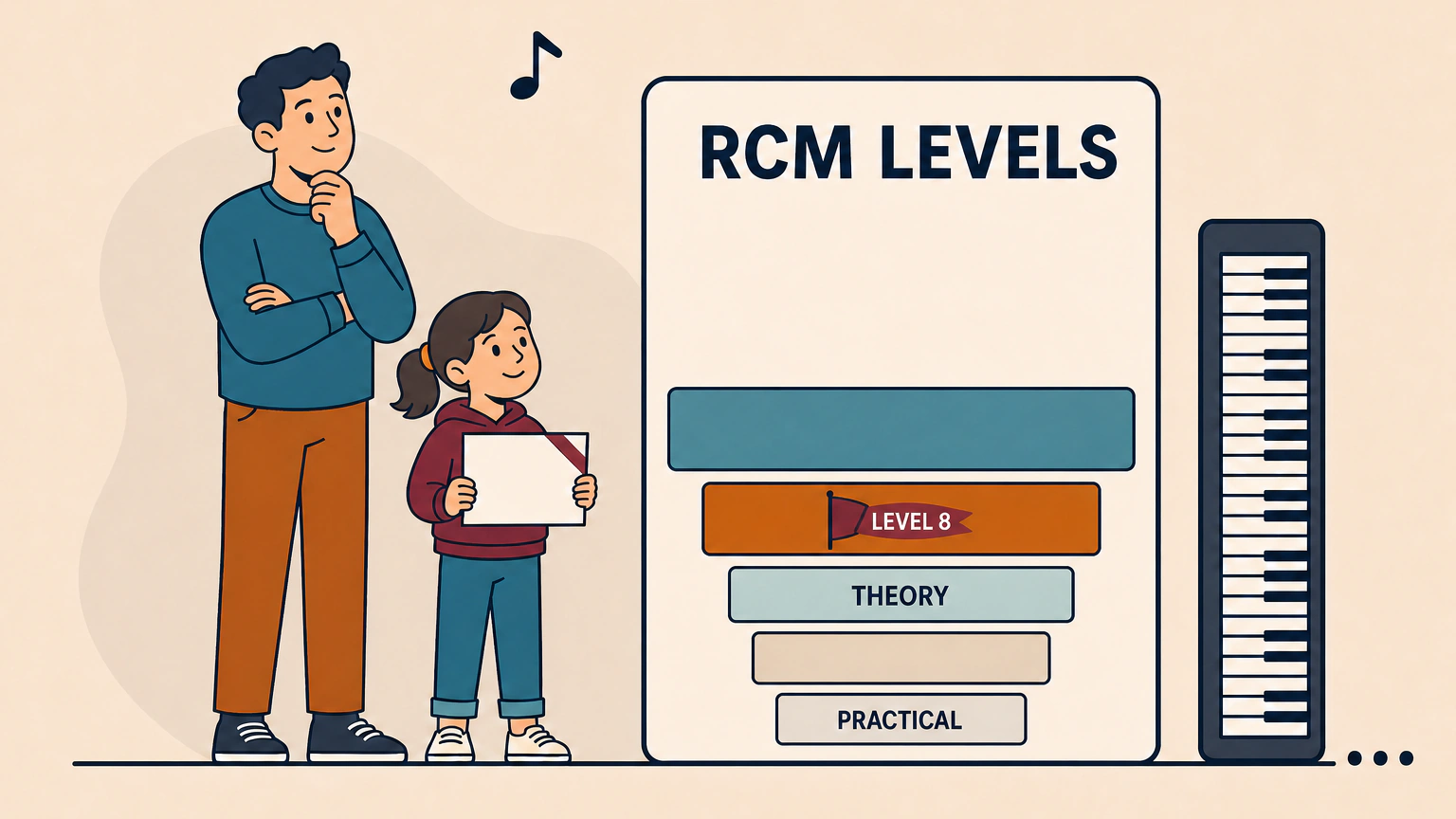
In Ontario that last part gets specific. Level 7 Practical plus Level 7 Theory earns one Grade 11 music credit, course code AMX3M. Level 8 plus Level 8 Theory earns one Grade 12 credit, AMX4M. Those two Grade 12 exams cost $489 in Canada at current RCM rates, and Ontario's own policy accepts a second examining body for the identical credit at $404. So here are the RCM levels explained the way you need them: what each step asks for, what it costs, when to register, and where it starts counting.
On this page
- What the RCM levels actually are
- What each level requires, and where theory joins
- What RCM exams cost in Canada
- When the exams happen, and the date that actually matters
- The payoff most families miss: high school credits
- The other examining body Ontario accepts
- What a typical candidate actually scores
- Is the exam route right for your child?
- Frequently asked questions
- How to check your own province
What the RCM levels actually are
The ladder: Preparatory, Levels 1 to 10, then ARCT
The Certificate Program opens with the Preparatory level or levels, climbs through Levels 1 to 10, and finishes with the Associate Diploma, the ARCT. Every rung has a Certificate of Achievement waiting at the end of a practical examination.
Above the ARCT sits the Licentiate Diploma, the LRCM. The program pages call it a piano diploma. The Canadian fee schedule lists LRCM exams in violin, composition and theory. Both pages belong to the RCM.
Piano gets two entry rungs, Preparatory A and B. Every other instrument starts with an Introductory or Preparatory practical. And this is not a piano-only system: strings, brass, woodwinds, guitar, harp, organ, accordion, percussion, recorder, voice, and speech arts and drama all get examined. If you've been through how Canada's swim levels work, the shape will feel familiar. A fixed sequence, a published standard, someone outside the studio doing the marking.
Why you'll hear "Grade 8" and "Level 8" for the same thing
The RCM says "Level" now, and its own pages haven't all caught up. The certificate tables say Level 8. The policies page prints "Grade 10 ARCT Pre-requisite." Treat them as the same rung.
And if your first search went sideways: outside music, RCM usually means revenue cycle management, and in Canada it collides with the RCMP. That's why you got medical billing.
What each level requires, and where theory joins
What happens in a practical exam
Your child plays. Someone they have never met listens, and writes. The RCM's description of a practical examination covers repertoire, études or vocalises, aural skills, sight reading or singing, and, on string, brass and wind instruments, orchestral excerpts. The order of the items is the student's choice, worked out with the teacher.
Then there's the detail the fee schedule doesn't show. Where a piece needs accompaniment, you provide it. From Preparatory to Level 4 a recording will do, and you bring the device. From Level 5 up you're arranging a live collaborative pianist. Since 1 February 2024, ignoring the accompaniment policy can cost a candidate up to 10 marks, so it isn't a soft rule.
From Level 5, theory is a co-requisite
Through Level 4, the practical exam is the whole certificate. Nothing else to book, nothing else to pay for.
From Levels 5 through 8, the Comprehensive Certificate needs the matching theory paper too: Level 5 with Level 5 Theory, Level 6 with Level 6 Theory, and so on up the ladder. Co-requisite means alongside, not before. The RCM puts theory and practical at different points in the same session precisely so a student can sit both inside one year.
What changes at Level 5 is your planning. Two exams to get ready for. Two fees to find.
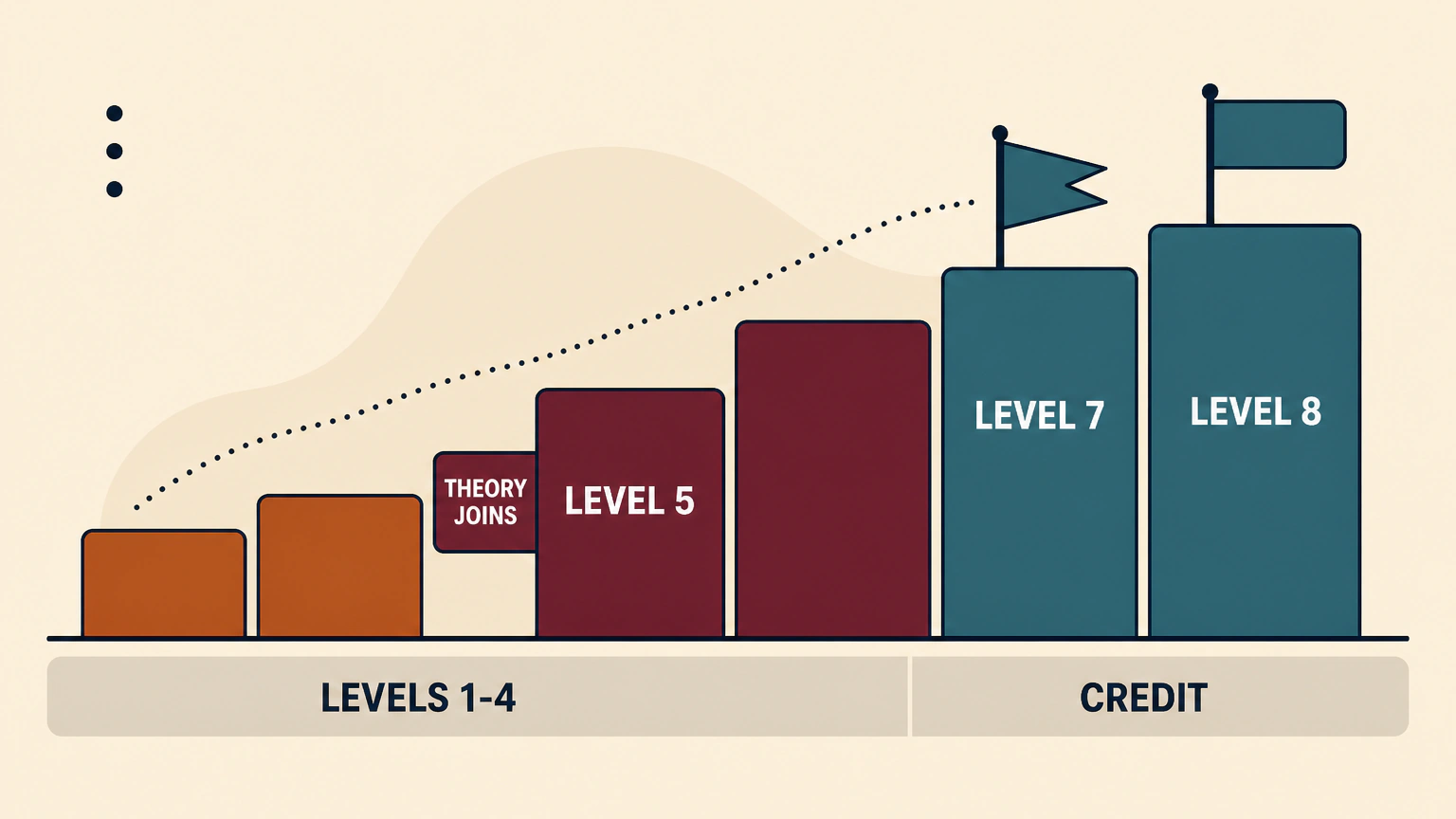
The Levels 9 and 10 surprise: it's Level 8 Theory, not Level 9
There is no Level 9 Theory. That looks like a typo. It isn't, and the gap is where family planning goes wrong.
The Level 9 certificate wants the Level 9 practical plus Level 8 Theory, Level 9 History, and either Level 9 Harmony or Level 9 Keyboard Harmony. Level 10 keeps all of that and stacks Level 10 History and either Level 10 Harmony and Counterpoint or Level 10 Keyboard Harmony on top. Two more facts tighten the screws. The History papers run in the May session only, once a year. And for Grade 10 piano, every theory co-requisite has to be finished within five years of the first successful Grade 10 exam.
| Level | Practical exam | Theory required for the certificate |
|---|---|---|
| Preparatory A / Preparatory B | Preparatory A or B | None |
| Level 1 | Level 1 | None |
| Level 2 | Level 2 | None |
| Level 3 | Level 3 | None |
| Level 4 | Level 4 | None |
| Level 5 | Level 5 | Level 5 Theory |
| Level 6 | Level 6 | Level 6 Theory |
| Level 7 | Level 7 | Level 7 Theory |
| Level 8 | Level 8 | Level 8 Theory |
| Level 9 | Level 9 | Level 8 Theory + Level 9 History + Level 9 Harmony or Level 9 Keyboard Harmony |
| Level 10 | Level 10 | Level 8 Theory + Level 9 History + Level 9 Harmony or Keyboard Harmony + Level 10 History + Level 10 Harmony and Counterpoint or Level 10 Keyboard Harmony |
Source: the RCM, "Recognizing Achievement, Canada." Non-piano candidates begin with an Introductory or Preparatory practical.
Pro tip: the exam year that costs five exams. With Level 8 Theory already banked, a Level 10 Comprehensive Certificate still needs the practical plus four separate higher-level theory papers. Ask your teacher for the full co-requisite list for your target level before the year starts, then split those papers across two sessions instead of one. History only runs in May, so that split has to be planned rather than improvised.
What RCM exams cost in Canada
These are the RCM's published Canadian fees, from its schedule "Examination and Other Service Fees, Canada." The page says so itself: Canadian rates only. A figure you found on an American page comes from a different schedule.
Practical exam fees by level
The climb is gentle for years, and then it isn't. Preparatory is $75. Level 1 is $118, and the fees rise a little at a time to $240 at Level 7. Level 8 steps up to $302 and Level 9 to $322. Then Level 10 jumps to $510, and the ARCT Performer exam costs $850.
Theory exam fees, and what a full year really costs
Theory papers start at $149 at Level 5 and reach $187 at Level 8. Above that they're sold one at a time: $214 for each Level 9 paper, $241 for each of the Level 10 pair.
Pair every practical with its co-requisite and you get the figure that actually leaves your account. $359 at Level 5. $410 at Level 7. $489 at Level 8. Go after a Level 10 certificate in a single year with Level 8 Theory already banked and it's $1,420.
One Canadian detail almost nobody mentions: the RCM says candidates with a Registered Education Savings Plan may be able to use those funds for private study at Level 9, Level 10 and ARCT. Worth a call to your plan provider.
| Level | Practical fee (CAD) | Theory co-requisite fee (CAD) | Total for the certificate |
|---|---|---|---|
| Preparatory | $75 | None | $75 |
| Level 1 | $118 | None | $118 |
| Level 2 | $144 | None | $144 |
| Level 3 | $175 | None | $175 |
| Level 4 | $186 | None | $186 |
| Level 5 | $210 | $149 | $359 |
| Level 6 | $226 | $159 | $385 |
| Level 7 | $240 | $170 | $410 |
| Level 8 | $302 | $187 | $489 |
| Level 9 | $322 | See note | See note |
| Level 10 | $510 | See note | See note |
| ARCT Performer | $850 | See note | See note |
Note on Levels 9, 10 and ARCT: these certificates need several theory papers, so there's no single figure to quote. Level 9 Harmony $214, Level 9 History $214, Level 10 Harmony and Counterpoint $241, Level 10 History $241, plus Level 8 Theory at $187 if that one isn't already passed. The RCM sets these fees, republishes them each academic year, and prices them for Canada only.
And what the lessons behind the exam cost
Exam fees are the small part of the bill. You've been paying the other part for years. Across our network of piano instructors near you, the cost panel shows an average of $387, a spread from $262 to $646, a figure of $75 that the panel labels an average per hour rate, and a typical price range of $314 to $438, drawn from 853 cost profiles. The panel for guitar teachers shows an average of $139 from 551 profiles, and singing lessons $277 from 687 profiles.
Read those as our own aggregate from our provider network, not a market statistic. The panel adapts to where the visitor is sitting, so it's a benchmark rather than a quote. And if you're about to pay for a term of lessons up front, look at your rights on a prepaid lesson contract first. That's the money that's hard to get back.
When the exams happen, and the date that actually matters
The four sessions in the 2026-27 Canadian calendar
Four in-person Canadian sessions a year, each with its own theory and practical dates. Three of them carry both theory papers and practicals. April 2027 is a piano practical session only, with no theory sitting, so it's no help to a student who still owes a paper.
Registration deadlines close months ahead
Registration for the December 2026 and January 2027 session opens 9 September 2026 and closes 3 November 2026, so a family that has its "should we do an exam" conversation over the holidays has already missed it.
Registration for May and June 2027 opens 12 January 2027 and closes 2 March 2027. Level 9, Level 10 and ARCT History are offered in the May session only. Put the deadline in your phone the day your teacher raises it.
| Session | Registration opens | Registration deadline | Theory exams | Practical exams |
|---|---|---|---|---|
| August 2026 | 1 April 2026 | 2 June 2026 | 7 and 8 August 2026 | 10 to 22 August 2026 |
| December 2026 / January 2027 | 9 September 2026 | 3 November 2026 | 11 and 12 December 2026 | 18 to 30 January 2027 |
| April 2027 (piano only) | 10 November 2026 | 5 January 2027 | Not available | 12 to 17 April 2027 |
| May / June 2027 | 12 January 2027 | 2 March 2027 | 14 and 15 May 2027 | 7 to 26 June 2027 |
Source: the RCM's "Examination Dates, Canada," for the in-person sessions.
The payoff most families miss: high school credits
How Ontario's rule works
Here's the rule in the province's own terms. Section 7.3.4 of Ontario Schools, Kindergarten to Grade 12: Policy and Program Requirements lets a secondary school principal award a maximum of two optional university/college preparation credits for music studied outside school, coded Music, External (Conservatory), AMX3M for Grade 11 and AMX4M for Grade 12.
They're awarded on presentation of the official forms or certificates. The mark that lands on the transcript is the average of the practical and the theory. For the RCM, Grade 11 means Level 7 Practical with Level 7 Theory, and Grade 12 means Level 8 with Level 8 Theory.
The policy defines "practical" as any instrument on which performance is examined, and says it includes voice. So a student working with voice teachers in Ontario qualifies on exactly the same terms as a pianist. Speech arts is the one exclusion.
The limits nobody mentions
They are optional credits, and that word is carrying a lot of weight. They can't fill the compulsory arts credit. They can't fill the Group 2 requirement. They can't satisfy the related-course requirement for a co-operative education program. What they can do is sit on top of in-school music credits, which is the point for a student already in the school band.
Two ceilings apply in Grades 11 and 12. Take both external music credits and your child may not then earn further Grade 10 to 12 music credits through the prior learning assessment and recognition process, PLAR. And a combined maximum of four credits covers dual credit programs and outside music study together.
What the rest of the country recognizes
Outside Ontario the shape holds and the numbers move. The RCM publishes a chart covering thirteen jurisdictions, and the common pattern is Level 6 to Level 8 practical with matching theory, reaching Grades 10, 11 and 12 in turn. Manitoba starts a grade lower, at Level 5 for Grade 9. British Columbia and Yukon allow a second credit at each grade on a different instrument category, which matters if your child plays two instruments.
Five jurisdictions do not fit that shape, and the chart says so rather than inventing a level. New Brunswick and Nova Scotia route certification through a Challenge for Credit process. Quebec applies results flexibly to Secondaire IV or V. The two territories list theory levels with no practical requirement at all.
| Province or territory | RCM level that earns a credit | Credit earned | Notes |
|---|---|---|---|
| Alberta | Level 6, 7, 8 with matching theory | Grade 10, 11, 12 courses | Brass, percussion, recorder and harp reach Grade 10 at Level 4. Marks show under "Private Music Evaluations". |
| British Columbia | Level 6, 7, 8 with matching theory | Grade 10 (UMRC10), 11 (URMC11), 12 (URMC12) | Second credit per grade on a different instrument category; Levels 9 and 10 also earn Grade 12. |
| Manitoba | Level 5, 6, 7, 8 with matching theory | Grade 9, 10, 11, 12 | Starts a grade lower than most provinces. |
| New Brunswick | No level table published | Challenge for Credit | Grades 11 and 12 only, limit of two challenge credits; apply in writing to the principal. |
| Newfoundland and Labrador | Level 6 with Level 6 or 7 Theory; Level 8 with Level 8 Theory | Grade 11, Grade 12 | All instruments plus voice. |
| Northwest Territories | Theory level as published; confirm the practical requirement with the territory | Grade 10, 11, 12 | Chart lists Level 6, 7 and 8 Theory with no practical. |
| Nova Scotia | Level 6, 7, 8 with matching theory | RC Music 10, 11, 12 through Challenge for Credit | Certified work is not re-examined; exam marks may count toward the course grade. |
| Nunavut | Theory level as published; confirm the practical requirement with the territory | Grade 10, 11, 12 | Same theory-only listing as the Northwest Territories. |
| Ontario | Level 7 with Level 7 Theory; Level 8 with Level 8 Theory | Grade 11 (AMX3M), Grade 12 (AMX4M) | Confirmed against Ontario policy 7.3.4. Maximum two optional credits. |
| Prince Edward Island | Level 6, 7, 8 with matching theory | Grade 10, 11, 12 | Brass, percussion, recorder and woodwinds reach Grade 10 at Level 4. |
| Quebec | No fixed level | Secondaire IV or V | Instrument and level flexible; results applied to the year of enrolment. |
| Saskatchewan | Level 6, 7, 8 with matching theory | Grade 10, 11, 12 | Brass, woodwinds and percussion qualify one practical level earlier. |
| Yukon | Level 6, 7, 8 with matching theory | Grade 10 (URMC10), 11 (URMC11), 12 (URMC12) | Second credit per grade on a different instrument category; Levels 9 and 10 also earn Grade 12. |
Sourcing. The Ontario row comes from the province's own policy, section 7.3.4. The rest is as the RCM publishes it on its "High School Credits, Canada" chart, which warns that accreditations "are subject to change" and sends readers to their own education ministry. The levels shown are the ones for piano, voice, guitar and strings; several provinces set a lower practical level for other instrument families. One discrepancy is worth naming. The RCM says elsewhere that its certificates are eligible for credit "in every province in Canada," which its own chart doesn't quite support, since two provinces offer a challenge process rather than a direct conversion.
Red flag: confirm with your province before you register. A threshold on that chart is a starting point, not a guarantee, and the RCM says as much itself. Search your ministry's site for external or conservatory music credits before you commit to a level, and ask your child's school guidance counsellor how the credit gets recorded. Do it before you pay, not after.
The other examining body Ontario accepts
Conservatory Canada, and why you've probably never heard of it
Conservatory Canada is a national examining body based in London, Ontario. Classical and contemporary streams across piano, voice, guitar, strings and other instruments, plus theory and history, with its own Canadian fee schedule and provincial accreditation chart.
It's far less visible than the RCM, and not one of the third-party guides ranking for this topic mentions it. Ontario's policy names it alongside the RCM, and for a family watching what this costs, we think that's the most useful sentence in the document.
The numbering does not line up, and that matters
Now the trap. Ontario asks for Conservatory Canada Grade VII Practical and Grade III Theory for the Grade 11 credit, and Grade III Theory is not a Grade 3 level exam.
Conservatory Canada's own equivalence table runs Theory 1 against RCM Level 5 Theory, Theory 2 against Level 6, Theory 3 against Level 7 and Theory 4 against Level 8. Get it backwards and the mistake is expensive: a student who sits Theory 7 thinking it matches RCM Level 7 has written at ARCT standard. That's a wasted fee and a long afternoon.
What each route costs at the credit thresholds
Both routes buy the identical transcript entry. Priced against each body's published Canadian schedule, the Grade 12 credit is $489 through the RCM and $404 through Conservatory Canada, and at Grade 11 the gap is $61.
Money isn't the only input, though. Repertoire differs. Syllabus editions differ. Examiner familiarity differs, and most teachers work fluently in one system rather than both, so switching part-way up a ladder is a conversation to have with your teacher, not simply money saved.
| Ontario credit | RCM requirement and fees | Conservatory Canada requirement and fees | Difference |
|---|---|---|---|
| Grade 11 (AMX3M) | Level 7 Practical $240 + Level 7 Theory $170 = $410 | Grade VII Practical, complete, $199 + Theory 3 $150 = $349 | $61 |
| Grade 12 (AMX4M) | Level 8 Practical $302 + Level 8 Theory $187 = $489 | Grade VIII Practical, complete, $239 + Theory 4 $165 = $404 | $85 |
Requirements from Ontario's policy section 7.3.4; fees from each body's own published Canadian schedule. The Conservatory Canada figures are the "complete" practical fee, and both bodies also publish partial-exam and supplemental options.
What a typical candidate actually scores
The classification bands
Marks at Levels 1 to 10 are out of 100 and land in one of four bands. 60 to 69 is a Pass. 70 to 79 is Honours. 80 to 89 is First Class Honours, and 90 to 100 is First Class Honours with Distinction. The RCM prints those labels in American spelling, as "Honors," on its own site.
One threshold is also a gate. ARCT eligibility needs 75 overall at Grade 10, or 70 per cent in each section.
The national averages, and what they tell you
Now the figures that should lower your blood pressure. For piano in the 2024 academic year, the RCM's published national averages drift downward as the ladder steepens: Preparatory A 88.0, Level 1 84.3, Level 5 79.7, Level 8 78.6, Level 10 76.0.
Look at Level 8. The typical Canadian candidate scores 78.6, an Honours result rather than a First Class one, and it's the most reassuring number here. The system isn't built to hand out distinctions. A pass is a pass.
Theory runs the other way. The 2024 averages for Level 5 to Level 8 Theory sit between 88.0 and 90.4, above the corresponding piano practical averages.
Is the exam route right for your child?
When exams are worth it
Exams hand a student three things weekly lessons often don't: a deadline somebody else set, a published standard, and an honest assessment from a stranger. A child drifting without a goal will often come alive once there's a date on the calendar.
From Level 7 up in most provinces the certificate also becomes documentation a school converts into a diploma credit with a mark attached. And a graded record from a nationally recognized body travels. It's portable evidence for a university music application.
When they are not
Plenty of children should not be entered, and saying so out loud isn't a failure of nerve.
A child who plays for pleasure and dreads being assessed can lose the pleasure and gain very little. A family on a fixed budget may prefer to put $489 toward lessons rather than a pair of exams. A student whose interests lie in jazz, songwriting or a band may be better served playing that music well.
A late start is no reason to stay away, though. The RCM's published requirements for Levels 1 to 10 list only that level's own examinations, and the one prerequisite it prints on the graded ladder is the Grade 10 standard for ARCT eligibility. A fourteen-year-old who plays well can be entered where their playing sits, not where their birthday says it should.
Questions to ask your teacher before you register
- Which level are you recommending, and what are you basing that on?
- What are the full theory co-requisites for that level, and which of them can wait?
- Which session are you aiming for, and when is its registration deadline?
- Do I register, or do you register on my child's behalf?
- Is my child's current lesson frequency enough to be ready, or does it need to increase?
- Which syllabus edition are we working from, and do I need to buy new books?
- Does my child need a collaborative pianist for this instrument and level, and who arranges that?
- If we are aiming at a high school credit, are we going through the RCM or Conservatory Canada, and why?
Frequently asked questions
How many RCM levels are there?
Eleven graded levels, with a diploma tier above them: Preparatory, then Levels 1 through 10, concluding with the ARCT Associate Diploma, and the LRCM above that. A Certificate of Achievement is available at every level by passing a practical exam, and from Level 5 theory co-requisites are required for the Comprehensive Certificate.
Are RCM exams mandatory to learn piano?
No, and you can say no without apology. RCM examinations are an optional layer of assessment sitting on top of private lessons, and a student can study for years without ever registering for one. Plenty of teachers use RCM repertoire and syllabus material without entering anybody for an exam. The exams exist to certify a standard, not to permit learning.
How much does an RCM exam cost in Canada?
Practical fees run from $75 at Preparatory to $302 at Level 8, $510 at Level 10 and $850 for ARCT Performer. Theory papers cost $149 to $187 from Level 5 to Level 8. Add the theory co-requisite and a Level 5 certificate comes to $359, Level 7 to $410 and Level 8 to $489, all in Canadian dollars.
Can you skip RCM levels?
Yes, in practice. The RCM's published requirements for each level list only that level's own examinations, with nothing saying the level below must be passed first, and the single prerequisite printed on the graded ladder is the Grade 10 standard for ARCT eligibility. The theory co-requisites for whichever level you attempt still apply.
What happens if you fail an RCM exam?
The pass threshold is 60 per cent, and a student who doesn't complete a level successfully may retake it, with the examiner's written comments as the map. Practical marks are final. A theory mark can go back for re-calculation if questions were mis-tabulated or left unmarked, or for re-evaluation if the marking was inconsistent, and each of those carries a fee.
Which RCM level earns a high school credit?
In Ontario, Level 7 Practical plus Level 7 Theory earns a Grade 11 credit (AMX3M), and Level 8 plus Level 8 Theory earns a Grade 12 credit (AMX4M), to a maximum of two. Other provinces differ. Level 6 to Level 8 with matching theory is the common band, and Manitoba starts at Grade 9. Check your own province before you plan a level around it.
RCM or Conservatory Canada, which should we choose?
Ontario accepts both for the same two credits, and Conservatory Canada is cheaper at each threshold: $349 against $410 for Grade 11, and $404 against $489 for Grade 12. The transcript entry is identical either way. The deciding factor is usually your teacher, because repertoire, syllabus and examiner familiarity differ between the two bodies.
How to check your own province
Take five minutes before you pay for anything.
Open your provincial or territorial ministry of education website and search for external music credits or conservatory music credits. Find the level required for your child's instrument family, not the headline one, because brass, woodwinds, percussion, recorder and harp are frequently set a level lower than piano, voice, guitar and strings. Then ask your school's guidance office how the credit gets recorded.
Fees and dates are republished each academic year and provincial rules change, so confirm the current figures before you register. We can tell you what the published rules say. Your ministry and your child's school are the ones who apply them.