

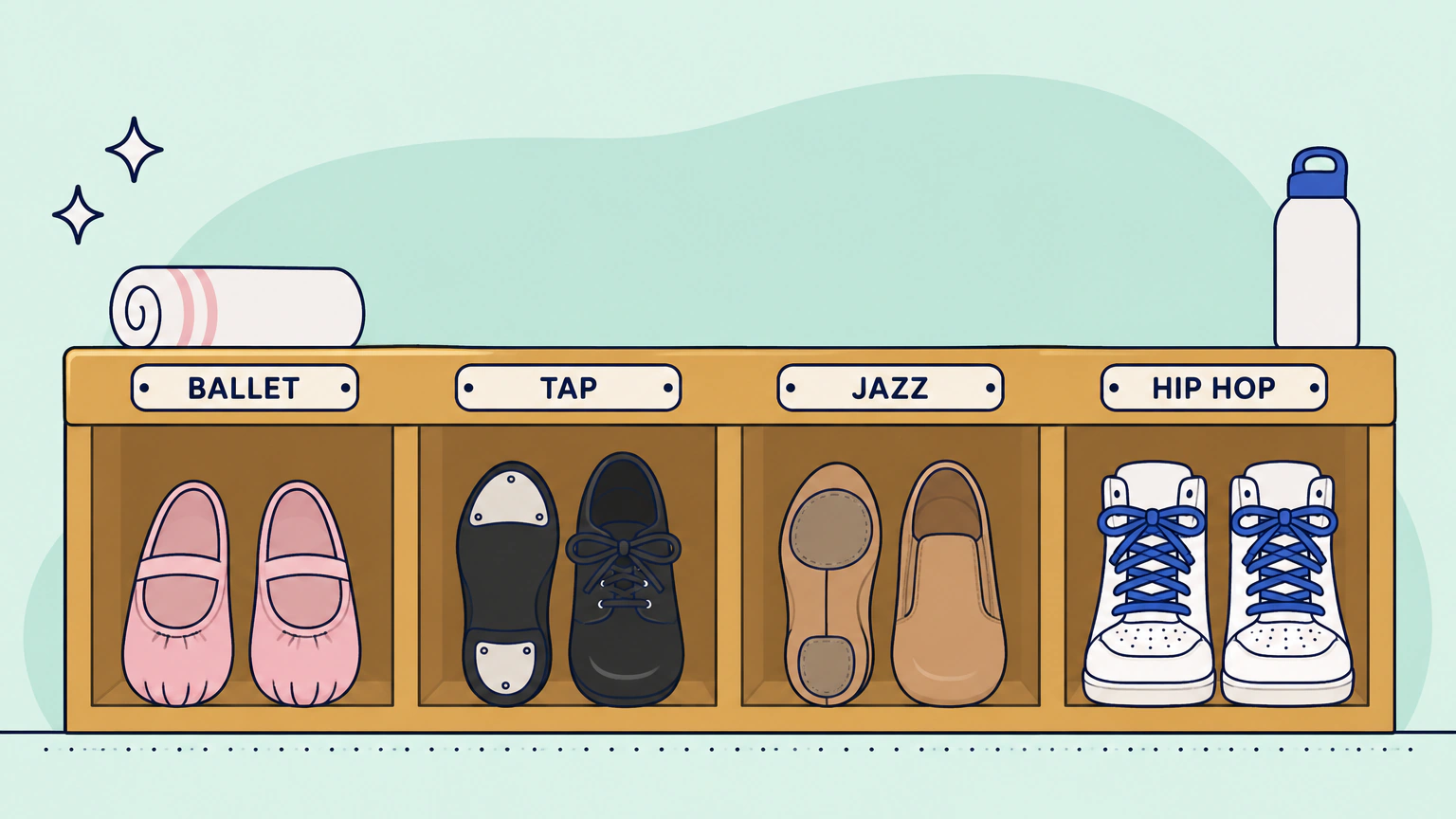
Across the Canadian studio schedules we read, the timetable comes down to about eleven classes: creative movement, ballet, jazz, tap, hip hop and breaking, lyrical, contemporary, acro, musical theatre, ballroom and Latin, and pole. Children can start a named style at about 3 or 4. Only ballet, jazz, tap, modern and acro come with a graded exam syllabus from the three examining bodies we checked, the Royal Academy of Dance, Cecchetti Canada and the Canadian Dance Teachers Association.
We read current schedules from studios in four provinces, the exam boards' own pages and published fee lists. Start with the class your child keeps asking about, then check its exams and what a season really costs before you pay for anything.
On this page
- The classes you'll find on a Canadian studio timetable
- Ballet, jazz and tap
- Lyrical, contemporary and modern
- Hip hop and breaking
- Acro, and what to ask before your child starts tumbling
- Ballroom, Latin and pole
- Dance exams: what they are and whether your child needs them
- What dance classes cost in Canada
- Questions to ask before you pay for a season
- Common questions about starting dance
The classes you'll find on a Canadian studio timetable
Here are the types of dance classes you're most likely to meet, side by side. Read the youngest age as the youngest class we found on a real schedule. It's a starting point, not a rule. And a "None" in the exam column only means no syllabus from those three bodies. Plenty of good teaching happens outside one.
| Class | What a first class works on | Youngest class we found | Graded exam syllabus (RAD, Cecchetti Canada, CDTA) |
|---|---|---|---|
| Creative movement | Moving to music with props, songs and pretend play | 10 months with a parent, 3 to 4 in a preschool class | RAD's Dance to Your Own Tune, ages 2 and a half to 5, watched but not marked |
| Ballet | Basic positions, alignment and ballet's French vocabulary | 3 to 4 | RAD, Cecchetti Canada and CDTA |
| Jazz | Style, energy and performing for an audience | 3 to 4 mixed with hip hop, 4 to 5 on its own | CDTA |
| Tap | Rhythm and clean, clear steps made with the shoes | 5 to 6 | CDTA |
| Hip hop and breaking | Grooves, isolations, locking and popping, plus set choreography | 3 to 4 mixed with jazz, 4 on its own, 6 to 7 for breaking | None |
| Lyrical | Ballet and jazz set to the feeling of a song's lyrics | 9 to 11 | None |
| Contemporary and modern | Breath, weight and expressive movement. Contemporary has no single set technique | 13, paired with jazz | CDTA, for modern |
| Acro | Dance mixed with gymnastics, from bridges and cartwheels up to aerials | 4 to 5 | CDTA, as acrobatic dance |
| Musical theatre | Jazz dancing with acting and singing | 4 to 5 | None |
| Ballroom and Latin | Partner dances such as the waltz, tango, cha-cha-cha and jive | Adult classes, none on the children's schedules we checked | None. Canada DanceSport lists recognized competitions |
| Pole | Spins, simple tricks and the strength to hold them | 7 in an Edmonton kids' class, 18 at a Calgary studio, or 16 with studio approval and a parent | None |
Ages come from the current schedules of Halifax Dance, Studio Dance Arts in Sault Ste. Marie, J'Danse Studio in Toronto, Etudes Dance Studio in Edmonton and Aradia Fitness in Edmonton and Calgary, and from the City of Port Coquitlam's fall 2026 guide. Your studio may start a style a year earlier or later. "None" means none of the three examining bodies in the column heading offers that style.
Two patterns jump out. Most named styles open between 3 and 6 in the schedules we checked, while lyrical waits until about 9 and contemporary until about 13. And the exam column splits the timetable in two: syllabus classes, where a child can work toward graded exams, and open classes, where nobody is marking anything. Once you've matched a class to your child, look for dance classes near you and see which of these styles local studios run.
Ballet, jazz and tap
These three are the backbone of a children's timetable. Halifax Dance and Studio Dance Arts both run all three across their full recreational schedules. And the Canadian Dance Teachers Association (CDTA) examines every one of them.
Ballet
A first ballet class is mostly building blocks. Halifax Dance says its adult Level 0 Ballet covers "basic positions, alignment, and movement vocabulary," and its children's Pre Ballet takes dancers from age 4. In Port Coquitlam, the city's intro ballet starts at 3 to 4, and a basics class for 6 to 10 year olds promises "foundational ballet steps."
Ballet also has the most exam routes. A studio may teach the Royal Academy of Dance (RAD) syllabus, the Cecchetti Canada syllabus or the CDTA one. North Calgary Dance Centre, for example, says its ballet classes "follow the Royal Academy of Dance syllabus with fully certified teachers." When you compare ballet schools, ask each one which syllabus it teaches.
Then comes the shopping list. Studio Dance Arts asks for a black leotard, pink tights and pink ballet slippers. For boys, it's black shorts, a white T-shirt and black slippers with white ankle socks. Halifax Dance has gone the other way, with "an inclusive dress code designed to support comfort and celebrate individuality." Either way, get the studio's own list before you set foot in a shoe shop.
Jazz, tap and musical theatre
Jazz is the high-energy one. Halifax Dance's open jazz class focuses on "style, energy, and performance quality," and its children's jazz starts on its own at 5 to 6. Port Coquitlam folds it into a jazz and hip hop intro for 3 and 4 year olds. Studio Dance Arts asks for tan jazz shoes.
Tap is the noisy one, in the best way. It's rhythm and clean, clear steps, and Halifax Dance's adult Level 1 Tap lists "clarity, rhythm, and foundational steps." Children's tap starts at 5 to 6 there, and Studio Dance Arts wants black lace-up tap shoes. One catch for older beginners: Halifax Dance's teen tap class asks for one to two years of experience, so a teen starting from scratch should ask where the studio would place them. CDTA has a syllabus for both jazz and tap.
Musical theatre mixes everything. J'Danse Studio in Toronto says it integrates "jazz dance technique, acting skills, and vocal expression," and its mini classes start at 4 to 5. Studio Dance Arts runs Musical Theatre Labs for ages 9 and up, and its page puts the deal bluntly: "NO RECITAL. NO COMPETITION. JUST TRAINING." If your family wants the training without a recital season attached, that's the class to ask about.
Lyrical, contemporary and modern
The difference between lyrical and contemporary dance trips up a lot of parents, and the line really is blurry. Dance Magazine describes lyrical as "a mix of ballet and jazz that often features an emotional interpretation of a song's lyrics." Contemporary "doesn't have a codified technique," the same magazine says. It traces today's competition contemporary back to the lyrical style of the 1990s.
Lyrical tends to arrive later. Studio Dance Arts adds it only at its junior level, ages 9 to 11, in tan jazz shoes. None of the children's schedules we checked lists contemporary on its own. The closest is Etudes Dance Studio's jazz and lyrical or contemporary class in Edmonton, for about 13 and up, and Etudes says its ages are approximate.
Modern is the one with a syllabus here, because CDTA examines it. For adults, Halifax Dance runs an open modern class "focusing on breath, weight, and expressive movement."
Hip hop and breaking
Of all the types of dance for kids, hip hop may be the easiest sell to a reluctant child. J'Danse calls it "the best entry point for children who have resisted other dance styles." Its classes cover "foundational grooves, isolations, breaking, locking, and popping alongside set choreography." None of the three examining bodies has a hip hop syllabus.
The ages run young. Halifax Dance starts Mini Hip-Hop at 4 and runs breaking as its own track from 6 to 7, while J'Danse teaches hip hop "from age 4 through adult level." Shoes vary more than you'd guess. Studio Dance Arts asks only for clean indoor gym shoes. J'Danse names one specific white sneaker for every hip hop class.
One Canadian fact your child will love: Phil Wizard, who started breaking on the streets of Vancouver in 2009, won the first Olympic gold medal in men's breaking at Paris 2024, as Team Canada reported. If your child already copies dance videos at home, hip hop classes are the obvious place to start.
Acro, and what to ask before your child starts tumbling
Acro is dance mixed with gymnastics, running from "basic bridges and cartwheels through to advanced aerials," in J'Danse's words. Classes start at 4 to 5 at J'Danse and 5 to 7 at Halifax Dance. CDTA examines it as acrobatic dance.
This is the class where the teacher's training deserves a direct question. Acrobatic Arts, which certifies dance teachers, describes its course as "a comprehensive training program for dance educators to safely teach AcroDance." J'Danse says all three of its acro teachers hold Acrobatic Arts certification. Studio Dance Arts says its acro is "Taught by an ADTA Certified Acro instructor (Acro Dance Teachers Association)."
So ask which certification your child's teacher holds. Then ask how new skills are introduced, and who spots a child the first time they try one. We'd want clear answers before a child goes upside down.
The practical side is simple. Expect bare feet and fitted activewear. Studio Dance Arts runs acro as a separate 11-week session at $187 plus HST.
Ballroom, Latin and pole
In the schedules we checked, both are adult classes first, though one Edmonton pole studio runs a class for kids.
Ballroom and Latin
Ballroom splits into two families. The World DanceSport Federation lists five Standard dances (the waltz, tango, Viennese waltz, slow foxtrot and quickstep), which are "generally danced in a closed position," with the partners keeping their hold throughout. The five Latin dances are the samba, cha-cha-cha, rumba, paso doble and jive.
If a couple gets serious, competition in Canada runs through Canada DanceSport. It speaks for DanceSport athletes and officials here and publishes a list of recognized competitions. Its four regional groups are in Quebec, Ontario, Alberta and British Columbia.
For a child, though, ballroom is a rare find. None of the three examining bodies lists a ballroom syllabus, and none of the children's schedules we checked runs it. Social Latin classes such as salsa and bachata are a different, more casual partner format. For a date night or an adult starting fresh, ballroom and Latin classes are the place to look.
Pole
Age rules vary more here than for any other class we looked at. Aradia Fitness Calgary requires students to be 18 for group classes, or 16 "with studio approval," and a parent or legal guardian has to come to the first visit to complete the waiver. Aradia Fitness Edmonton runs Pole Sport for Kids for ages 7 to 15, built around "strength, coordination, and confidence," with basic spins and tricks. Trinity Pole Studio in Toronto says "We welcome all ages and sizes," and asks for no experience before its beginner class.
Prices are easy to compare, because pole studios sell by the class. Aradia Calgary charges $30 for a single 60-minute class. Trinity's Foundations Pass is $145 for five classes a month. If you're an adult who's curious, browse pole dancing classes and book one drop-in before you commit to a pass.
Dance exams: what they are and whether your child needs them
Exams matter most if your child takes ballet, because it's the one style all three bodies cover. The Royal Academy of Dance and Cecchetti Canada examine ballet. CDTA examines acrobatic dance, ballet, jazz, modern and tap.
Exams are a choice. Cecchetti Canada says so in writing: "There is no obligation for a Cecchetti Canada member teacher to enter students into exams." Some studios keep them off the bill. Etudes Dance Studio in Edmonton lists "NO extra examination fees" among the costs it doesn't charge.
At the RAD, the youngest children take a demonstration class, where the examiner watches but doesn't mark anyone. Next come class awards, and then graded exams. Each one happens either at your own studio, when an examiner visits, or at a studio the RAD picks, where children from several schools are examined together.
A few levels carry a required minimum age, and a child has to reach it by 31 December of the calendar year they take the exam. At the other end there's no ceiling. RAD sets no maximum age for any of its exams, so an adult can sit them too.
| RAD level | RAD's minimum age | Fee at your own studio | Fee at an RAD venue |
|---|---|---|---|
| Dance to Your Own Tune (watched, not marked) | 2 and a half to 5, recommended | $56 | $76 |
| Pre-Primary in Dance (class award only) | 5, recommended | $73 | $93 |
| Primary in Dance | 6, recommended | $93 | $113 |
| Grade 1 | 7, recommended | $98 | $118 |
| Grade 5 | 7, recommended | $117 | $137 |
| Grade 8 | 11, recommended | $132 | $152 |
| Intermediate Foundation | 11, required | $169 | $189 |
| Intermediate | 12, required | $185 | $205 |
Fees are RAD Canada's per-candidate fees for the 2026-27 exam year, which runs from 1 August 2026 to 31 July 2027. At your own studio, an RAD examiner visits your school. At an RAD venue, candidates from several schools come to a studio the RAD provides. A required age must be reached by 31 December of the calendar year the exam takes place, and RAD sets no maximum age.
Fees change with each exam year, which starts on 1 August. At your own studio, Primary in Dance went from $91 in 2025-26 to $93 this year, and every fee in the table rose by $2 to $4. Ask your teacher for the current figure before you budget. CDTA adds one more wrinkle: "In select provinces, students may be eligible to receive high school credits for successful completion of CDTA examinations." Your studio can tell you whether that applies where you live.
What dance classes cost in Canada
Who runs the class moves the price far more than the style does. A city recreation program, a non-profit society and a private studio can all teach ballet to a six-year-old, and their bills look nothing alike.
| Who runs it | Class | What the price covers | Published price |
|---|---|---|---|
| City of Port Coquitlam, BC | Dance Ballet Basics, ages 6 to 10, 45 minutes | Tuesdays, 22 September to 8 December 2026 | $108 |
| Etudes Dance Studio, Edmonton, non-profit | Junior jazz and ballet, ages 4 to 7, 45 minutes | March to June 2027 | $185, plus $40 a year per family to register |
| Studio Dance Arts, Sault Ste. Marie, ON | One recreational class a week | 35-week season, September to June | $610 plus HST, or $61 a month for 10 months |
| North Calgary Dance Centre, AB | Recreational class, ages 8 to 10, 45 minutes | One month of a September to June season | $78 plus GST |
| Halifax Dance, NS, registered charity | Adult open class, one hour | One class, or a pass of 10 | $18.50, or $160 for 10 |
| Aradia Fitness Calgary, AB | Adult pole class, 60 minutes | One class, or a pack of 4 | $30, or $112 for 4 |
Prices as each organization lists them. Extras sit outside these figures. North Calgary Dance Centre charges $115 plus GST per class for a recital costume, Etudes charges $40 per dance for costume rental and production, and Studio Dance Arts adds a $50 family fee plus HST each year.
The tuition line is only the start of the season. Registration runs $40 a year per family at Etudes and $50 plus HST at Studio Dance Arts. Costumes can outrun the monthly fee: at North Calgary Dance Centre, the $115 recital costume costs more than a month of classes, and Etudes charges $40 for each dance a class performs. Then there's the first pair of proper dance shoes, which Studio Dance Arts and Etudes both expect from day one.
If that total is a stretch, there's help paying for a season of lessons, and it's worth checking whether your province gives back part of the fee.
Ask each studio to quote the full teaching year or course, the class length and any required extras.
Compare recurring tuition, complete courses and one-off classes separately. A per-class equivalent does not mean you can buy just one class.
Questions to ask before you pay for a season
Before you hand over a season's fees, know what kind of contract you're signing. In Ontario, dance lessons count as personal development services under the Consumer Protection Act, 2002. Its special contract rules apply when advance payment is required and the total bill exceeds $50, excluding borrowing costs. Non-profit, charitable and city-run programs are among the exceptions. Here's what Ontario's contract rules cover in full.
- Ask whether the price is per month, per term or per season, and whether GST or HST is added on top.
- Ask what registration, costume and recital fees add, and whether each is charged per family or per class.
- If the class follows an exam syllabus, ask whether exams are optional and what each one costs.
- Ask whether your child can try one class before you pay for the season.
- For acro, ask which certification the teacher holds and how new skills are taught and spotted.
- Get the dress code before the first class, so you buy the right shoes once.
- For pole under 18, ask for the minimum age in writing and whether a parent must sign the waiver in person.
With those answers in hand, shortlist two studios from our category pages and book a trial class at each. Then watch your child's face in the first ten minutes. It'll tell you more than any timetable.
Common questions about starting dance
What age can a child start dance classes?
Earlier than most parents expect, though not in a named style. Halifax Dance runs a Baby and Me class from 10 months, and Port Coquitlam's tots classes take 2 and 3 year olds with a caregiver dancing alongside. In the schedules we checked, classes named for a style, such as ballet or hip hop, start at about 3 or 4. Halifax Dance starts tap at 5 to 6. J'Danse offers jazz and acro from 4 to 5.
What age can kids start ballet?
In the schedules we checked, the first ballet class takes children at 3 or 4. Port Coquitlam's intro ballet is for 3 and 4 year olds, and Halifax Dance starts Pre Ballet at 4. Exams come later. The Royal Academy of Dance recommends 5 for its first class award and 6 for its first graded exam, Primary in Dance.
What's the difference between lyrical and contemporary dance?
Lyrical tells the story of a song. Dance Magazine describes it as "a mix of ballet and jazz that often features an emotional interpretation of a song's lyrics." Contemporary is looser and more varied, and the same magazine notes that it "doesn't have a codified technique." At Studio Dance Arts, lyrical starts at 9 in jazz shoes. Etudes pairs contemporary with jazz from about 13.
Is it too late to start dance at 13 or 14?
No. Halifax Dance runs teen ballet, jazz and breaking classes for 13 and up, and its adult program has a Level 0 ballet class for complete beginners. The one place experience matters is placement: its teen tap class asks for a year or two of tap first. The Royal Academy of Dance sets no maximum age for any of its exams.
Can adults learn ballet with no experience?
Yes, and some studios build a class for exactly that. Halifax Dance's adult Level 0 Ballet is described as an "absolute beginner level designed for dancers new to ballet," covering basic positions, alignment and vocabulary. Adult classes there run as drop-ins at $18.50 for an hour, so you can try one before you buy a pass.
Which dance style is easiest for a beginner?
No style is easy for long, but some ask less of you on day one. Hip hop at Studio Dance Arts asks only for clean indoor gym shoes, and one Toronto studio calls it the best entry point for children "who have resisted other dance styles." Ballet and tap ask for special shoes and build slowly. For an adult, a drop-in class labelled for absolute beginners is the gentlest start.
Does my child have to take dance exams?
No. Exams belong to syllabus studios, and even there they can be a choice. Cecchetti Canada puts it plainly: "There is no obligation for a Cecchetti Canada member teacher to enter students into exams." Some studios keep them off the bill altogether: Etudes Dance Studio in Edmonton lists "NO extra examination fees." If a studio teaches a syllabus, ask whether exams are optional and what each one costs before you enrol.
How much do kids' dance classes cost in Canada?
Who runs the class matters more than the style. Port Coquitlam charges $108 for a 45-minute ballet class that runs from 22 September to 8 December. The private studios we checked charge $61 to $78 a month for one weekly class, before tax, and add registration and costume fees. A recital costume alone was $115 plus GST per class at one Calgary studio.