

On this page
- The short answer, before you book a trial class
- What each martial art is mostly doing in a beginner class
- Six of these are on Sport Canada's funded list. The rest are not.
- How to check any club in about ten minutes
- What these classes cost, from our own cost profiles
- Choosing between two disciplines when both look fine
- Questions parents and adult beginners ask us
The short answer, before you book a trial class
It's September. The sign-up emails are landing, your kid wants to learn to kick things, and every club nearby teaches something different. Search the types of martial arts and you get lists of twenty styles or more.
Here's the short answer. Put ten common martial arts side by side, counting Muay Thai and kickboxing as one, and the split that matters in Canada isn't striking versus grappling. It's that six combat sports are on Sport Canada's funded list, and the rest aren't. If you pick karate, taekwondo, judo, boxing or wrestling, you can look the club up on a national or provincial list before you pay. (The sixth sport on that list is fencing.) If you pick Brazilian jiu-jitsu, Muay Thai, kickboxing, kung fu or MMA, most of the same checks are still open to you. Start by asking the club which association it uses.
Neither group is a verdict on quality. What the split changes is how much homework lands on you, and how much of it someone else has already done.
So pick the discipline first. Then give the club about ten minutes of checking before you hand over a deposit.
What each martial art is mostly doing in a beginner class
Most of this choice comes down to one thing: does your kid want to hit things, wrestle, or both? The rest is club culture, and you'll only learn that by watching a class.
| Discipline | Mostly striking, grappling or mixed | On the Sport Canada national list | How to find an affiliated club |
|---|---|---|---|
| Karate | Striking | Yes, Karate Canada | Through your provincial or territorial karate association |
| Taekwondo | Striking | Yes, Taekwondo Canada | Through one of its provincial or territorial member organizations |
| Judo | Grappling | Yes, Judo Canada | Judo Canada's own national club finder |
| Boxing | Striking | Yes, Boxing Canada | Boxing Canada's find a boxing club page |
| Wrestling | Grappling | Yes, Wrestling Canada Lutte | Wrestling Canada Lutte's club directory |
| Brazilian jiu jitsu | Grappling | No | Not on this list. Ask which association the club uses |
| Muay Thai and kickboxing | Striking | No | Not on this list. Ask which association the club uses |
| Krav Maga | Mixed | No | Not on this list. Ask who certified the instructor |
| Kung fu | Striking | No | Not on this list. Ask about the school and lineage |
| Mixed martial arts | Mixed | No | Not on this list. Ask which association the club uses |
The striking arts: karate, taekwondo, boxing, kickboxing and Muay Thai
A beginner karate class usually splits its time between kata and kumite. Kata are set patterns of moves you practise until they're clean. Kumite is sparring with a partner. If your child likes getting a sequence exactly right, that first half of the class will feel like home.
Taekwondo leans hard on kicks, including high and spinning ones, so expect plenty of stretching and footwork. Boxing is hands only. A first boxing class is usually footwork, pad work, the heavy bag, a skipping rope and a lot of sweat. Ask when sparring starts and whether it's optional.
Kickboxing adds kicks to the punches. Muay Thai goes further, bringing in knees and elbows. Both are hard on the lungs, and a beginner hour in either can feel like a very tough fitness class that happens to involve hitting pads. Some teens and adults love exactly that.
Three of these five are on Sport Canada's funded list: karate, taekwondo and boxing. Kickboxing and Muay Thai aren't. That list doesn't settle whether a national federation exists, so ask one of the kickboxing gyms which association it uses and check the answer. One of the karate instructors can point you to the club's provincial association. Karate also turns out to be the cheapest of the five class types in our own cost profiles.
The grappling arts: judo, Brazilian jiu jitsu and wrestling
Grappling means throws, holds and work on the mat instead of strikes. Nobody is aiming a fist at your child's head. That's why we'd look at this group first for a small or cautious kid.
Judo is built on throws and pins, and a good first class spends real time teaching kids how to fall safely. Wrestling is takedowns and pins, fast and very physical. Brazilian jiu-jitsu spends more of the class on the ground, working toward pins and holds that end a round when a partner taps.
This is where Sport Canada's funded list first gets practical. Judo Canada runs its own club finder, and Wrestling Canada Lutte keeps a club directory. Brazilian jiu-jitsu isn't on that list. Ask which association the gym uses and check that association's own member list. Then ask who trained the head coach.
The mixed and self defence systems: MMA, krav maga and kung fu
These three mix methods, but in different ways. Mixed martial arts, or MMA, blends striking and grappling. Krav maga is a self-defence system, usually taught through drills that copy real situations. Kung fu is a whole family of Chinese styles, and two kung fu schools can look nothing alike. None of the three is on Sport Canada's funded list, so the useful questions get specific. For krav maga, ask which organization certified the instructor and what that certification involved. For kung fu, ask which style the school teaches and who trained its head instructor.
One legal point comes up with these, and it's narrower than it sounds. Section 83 of the Criminal Code makes a prize fight an offence. It then carves out certain amateur contests: in sports on the Olympic or Paralympic program, in sports a province has designated, or held with a province's permission. A provincial athletic board or commission can also permit a boxing or MMA contest. Every one of those rules is about a contest. None of it touches a class, so signing your teen up for MMA lessons isn't affected.
Six of these are on Sport Canada's funded list. The rest are not.
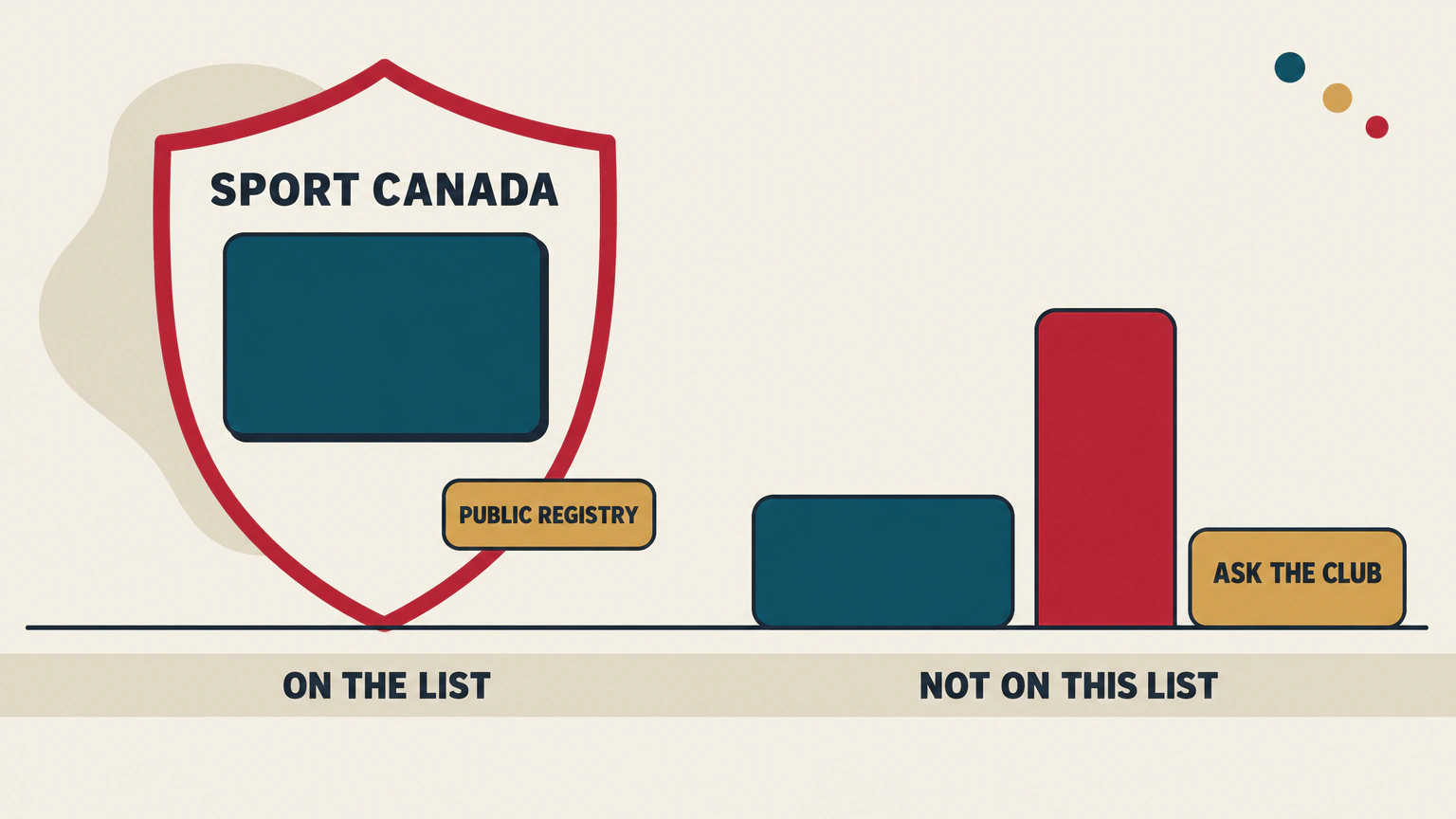
Sport Canada's list of national sport organizations covers 64 sports, and six are combat sports: boxing, fencing, judo, karate, taekwondo and wrestling. We leave fencing out of the comparison because we don't list those classes, and nobody torn between judo and Muay Thai is secretly weighing a sabre. Being on that list gets a beginner real, usable things. The list also has limits, and they're worth knowing first.
What the Sport Canada list is, and what it is not
The federal government's definition is short. National sport organizations "are the national governing bodies for given sport in Canada." Karate Canada is blunter about its own standing, calling itself "the only legitimate national sport governing body for karate recognized, supported and funded by the Canadian government." The same federal page says these bodies govern their sport, pick and manage national teams, sanction national competitions, and run training for coaches and officials.
That makes it a list about who runs each sport at the national level. It isn't a licence to teach. A club doesn't have to belong to Karate Canada to run a karate class on Tuesday nights. Being on the list isn't a promise about any one instructor, and a club with no affiliation isn't automatically a bad club.
For the sports on it, the list gives you a starting point above the club: the funded national organization and, often, its provincial associations, shared rules and contacts.
What affiliation actually buys a beginner
Four things, and you can ask about every one of them before you sign anything.
First, a club list you can search. Judo Canada runs a national club finder. Boxing Canada names every club registered with its provincial association. Wrestling Canada Lutte keeps a directory. Karate Canada sends you to its eleven provincial and territorial associations, which list their own member clubs.
Second, insurance that comes through the system. Karate Canada says most recognized provincial and territorial associations offer "some accident / medical insurance coverage" to people training in their clubs. Judo Canada runs a national accident policy for judokas registered in most provinces and territories.
Third, coaches with a path to proper training. Karate Canada says instructors in its affiliated clubs have access to national coaching courses, known as the NCCP, and are "strongly encouraged" to take them. Taekwondo Canada goes a step further for families. Alongside the Respect in Sport course it recommends for every coach, it points parents of children and youth in the sport to a version of their own.
Fourth, a grade that travels. In judo, clubs award the kyu grades below black belt. Dan grades, starting at black belt, follow Judo Canada's national grading syllabus and go through national and provincial grading committees. Earn a rank abroad and you fill in a Foreign Rank Recognition Form and pay a fee before it counts here. That's the difference between a black belt and a black belt.
The complaint route that does not run through the club
If something feels wrong at a club, the owner is usually the first person you'd tell. In the national system, there's a second door.
Since April 1, 2025, Sport Integrity Canada has run the Canadian Safe Sport Program. It takes reports under the Universal Code of Conduct to Prevent and Address Maltreatment in Sport, known as the UCCMS. For a coach who is subject to the program's rules, that creates an independent reporting route outside the club. You can report online or call 1-866-971-2777 toll free.
Now the boundary, because it's the whole point. The program's rules broadly apply to anyone participating in a national-level, federally funded sport organization, from athletes and coaches to volunteers and board members. Karate Canada, for one, notifies the specific people it designates as covered. A local coach isn't automatically covered. Ask the club or its provincial association whether that coach is subject to the program's rules. The rules can also apply at an event designated by a sport organization.
If you're unsure, report anyway. Sport Integrity Canada says you don't need to work out whether your report is in scope. If you don't report anonymously, it says it will contact you within 14 days.
There's also a public registry of people whose eligibility to take part in sport has been restricted by a sanction or a provisional measure. It's worth a look, with two limits. Cases involving minors generally aren't posted, and Sport Integrity Canada says plainly that the registry "is not exhaustive".
How to check any club in about ten minutes
These checks protect your kid, and a good club expects them. Think of it as the same quick homework you'd do before hiring a new babysitter. Most of it happens on your phone in the parking lot before a trial class, and the rest is three or four direct questions at the front desk.
- Search the discipline's national or provincial body for the club by name. Karate BC, for one, runs a finder for its member clubs that searches by address, city or postal code. Judo Canada and Boxing Canada have national versions, and Taekwondo Canada's site searches for clubs by postal code.
- If the club isn't on that list, ask straight out which body it's affiliated with. Then check that body's own list rather than taking the club's word for it.
- Ask whether every instructor and assistant holds a current police record check, and how often the club repeats it. A check done once, years ago, is a very different answer from one that's kept current.
- Ask whether the club follows the Rule of Two, so no adult is ever alone and unobserved with your child. The Coaching Association of Canada describes it as two responsible adults present, with every interaction in "open, observable, and justifiable settings."
- Ask who insures the class, and whether the cover comes through a provincial association or the club's own policy. A clear answer takes one sentence.
- Look up the head instructor's name in the Canadian Safe Sport Program public registry. Do the same for any assistant who'll coach your child regularly.
- Read the contract before you pay, and check the cooling-off and cancellation rules where you live. In Ontario, prepaid classes fall under the Consumer Protection Act, 2002, which calls them "personal development services". Pay $50 or more in advance and you get 10 days to cancel after you receive a written copy of the contract, with no reason needed. A non-profit club, a club its members own or a city program sits outside those rules, so ask which one you're joining. Here's what Ontario's contract rules give you in full.
Red flags: Three things worth a second look
- A club that won't name the body it answers to, and can't say what it does instead. Ask how it screens instructors and handles complaints, and listen for specifics.
- Gradings that arrive on a fixed calendar with a fee attached, rather than when a student is ready. Ask what a student has to show to pass, and what happens if they aren't ready yet.
- A contract longer than a year, or one that asks you to sign away a cancellation right you already have. In Ontario, a contract for classes like these has to end after one year, and the province's own guidance names martial arts classes as covered.
What these classes cost, from our own cost profiles
The discipline you pick changes the bill, and by more than you might guess. We pulled these figures from our own category pages, and you can read more about who we are and how we work. They carry no time unit, and they shift with where you're browsing from. So read them as the shape of each class type, not a quote for your town.
| Class type on our site | Our own average | Our typical price range | Cost profiles behind it |
|---|---|---|---|
| Martial arts classes | $127 | $107 to $160 | 925 |
| Karate | $107 | $86 to $191 | 720 |
| Boxing | $155 | $93 to $206 | 907 |
| Kickboxing | $185 | $144 to $281 | 658 |
| Self defence courses | $243 | $212 to $327 | 773 |
Karate comes in lowest at a $107 average. Self-defence courses sit highest at $243, which is more than double. The two don't even overlap: the typical range for self-defense courses starts at $212, above the top of karate's $86 to $191. Boxing, kickboxing and general martial arts classes land in between.
We checked nine competing guides to martial arts styles and none printed a class price, so use these figures to start the money questions you ask a club. And if the number that matters is the one you can't cover, there's help paying for a season.
Choosing between two disciplines when both look fine
By now you might have it down to two. Karate or judo. Boxing or Muay Thai. Three tie-breakers decide it, and none of them is which style would win a fight.
The first is the schedule you can keep. A class you make twice a week beats a better one you miss every other Thursday. Look at the class times before anything else, and count the drive home in rush hour.
The second is whether your child wants contact. Some kids love the idea of sparring right up until someone hits back. Others hate the thought of being hit and would happily roll around on a mat for an hour. Watch one class of each with your child, and notice which one they talk about in the car. If you're the adult beginner here, the same test works on you: watch a beginner class before you join one, and see whether the new people are actually being taught or just being tolerated at the back of the room.
The third is whether the nearest good club has an affiliation you can check. If an affiliated club and an unaffiliated one are equally close and equally good, the affiliated one saves you homework because an association has already done part of the checking. If the only good club within reach isn't affiliated with a body you can check, that's fine. Run the checklist a little harder and go.
Pro tip: One thing worth doing first
If your province gives you a cooling-off period, book the trial before it ends, so the class you're judging is one you can still walk away from.
When you're ready, open martial arts classes near you, shortlist two clubs, and go and watch a class at each this week.
Questions parents and adult beginners ask us
What is the best martial art for a child?
The best one is taught by a club you can check, at a contact level your child is comfortable with. Start with contact. Competition judo and wrestling don't use strikes. Then weigh class size, a schedule you can keep, and whether the club is affiliated with a body you can check. Sort by contact type and affiliation, and you'll be down to two options fast.
Is karate or taekwondo better for kids?
Neither, on paper. Both are on Sport Canada's list, and both run through provincial and territorial associations, so the club decides this far more than the discipline does. Two questions usually settle it. Does your child light up at fast, high kicks, or at learning set patterns with both hands and feet? And which of the two clubs near you has a class at a time you'll actually make?
How many martial arts are there?
There's no official count. Lists that give a number are counting styles, and one online index runs past 200 of them. What Canada does publish is Sport Canada's list of national sport organizations, and six combat sports are on it: boxing, fencing, judo, karate, taekwondo and wrestling. Everything else, from Brazilian jiu-jitsu to kung fu, sits outside that list.
What age can a child start martial arts?
It depends on where you sign up. Each club sets its own minimum age, so ask the one you're considering. For the bigger picture, Sport for Life's Long-Term Development framework is a good guide. It focuses on basic movement skills before puberty and saves serious training in a single sport for after age 12. For a young child, a class that feels like play is doing its job.
How can I tell if a martial arts school is any good?
Three checks do most of the work. Find the club on its national or provincial body's list, or ask which body it answers to and look at that list yourself. Ask whether every instructor has a current police record check and whether the club follows the Rule of Two. Then read the contract before you pay. If you have the full ten minutes, add insurance and the safe sport registry.
Does a black belt mean the same thing at every club?
No, and judo shows why. Clubs award the kyu grades below black belt, but dan grades, starting at black belt, follow Judo Canada's national syllabus and go through national and provincial grading committees. A rank earned abroad needs a recognition form and a fee before Judo Canada recognizes it. Outside a shared grading system, a black belt means what the awarding club or association says it means.