

On this page
- The short answer, and why the number you have read is probably wrong
- What each province and territory pays for the 2025 tax year
- The five refundable programs, one at a time
- The non-refundable credits, and when they are worth nothing
- What counts as an eligible program
- How to claim it without losing the money
- What this is actually worth against a season of lessons
- Frequently asked questions
- How we checked this
The short answer, and why the number you have read is probably wrong
The federal children's fitness and arts tax credits no longer exist, so there is no Canada-wide children's fitness tax credit on lesson fees. Seven of the thirteen provinces and territories still offer something on registration or membership fees, from up to $348 a family in Newfoundland and Labrador and $300 a child in Saskatchewan down to $43.95 a child in Nova Scotia. In the other six, including Ontario, Alberta and British Columbia, there is nothing to claim. Every amount here is in Canadian dollars.
Two beliefs cost families real money here. One is that a national credit still runs. The other is that the figure a province advertises is what lands in your bank account.
The federal credit ended, and the page that still describes it
Budget 2016 phased the federal credits out. For the 2016 tax year the maximum eligible fitness fees fell to $500 from $1,000 and the arts figure to $250 from $500. For the 2017 and later tax years both credits were eliminated. The measure received Royal Assent, and the 2025 federal return, Form 5000-R, carries no fitness or arts line.
The Canada Revenue Agency's page for the retired credit is still online, and still written in the present tense: it "allows you to claim eligible fees paid in the year up to a maximum of $500 per child". The only warning is a single line at the top, "Changes to the Children's Fitness Tax Credit were announced in Budget 2016." A parent who lands there has no real reason to think the credit is dead.
Why a $500 credit is not $500
In six of the seven jurisdictions with a live program, the published figure is the maximum expense you may claim, not the money you get. The jurisdiction then applies a percentage to it.
Nova Scotia is the clearest case: up to $500 of eligible expenses per child, multiplied by 8.79% on Form NS479, so the most any family receives is $43.95 per child. The same arithmetic runs in Prince Edward Island ($1,000 of fees at 9.5% is $95), Yukon ($1,000 of fees at 6.4% is $64), Manitoba ($500 at 10.8% is $54) and Quebec ($500 at 20% is $100). Saskatchewan is the exception, because it pays eligible fees up to a flat $300 maximum.
Refundable or not, and why it decides whether you get anything
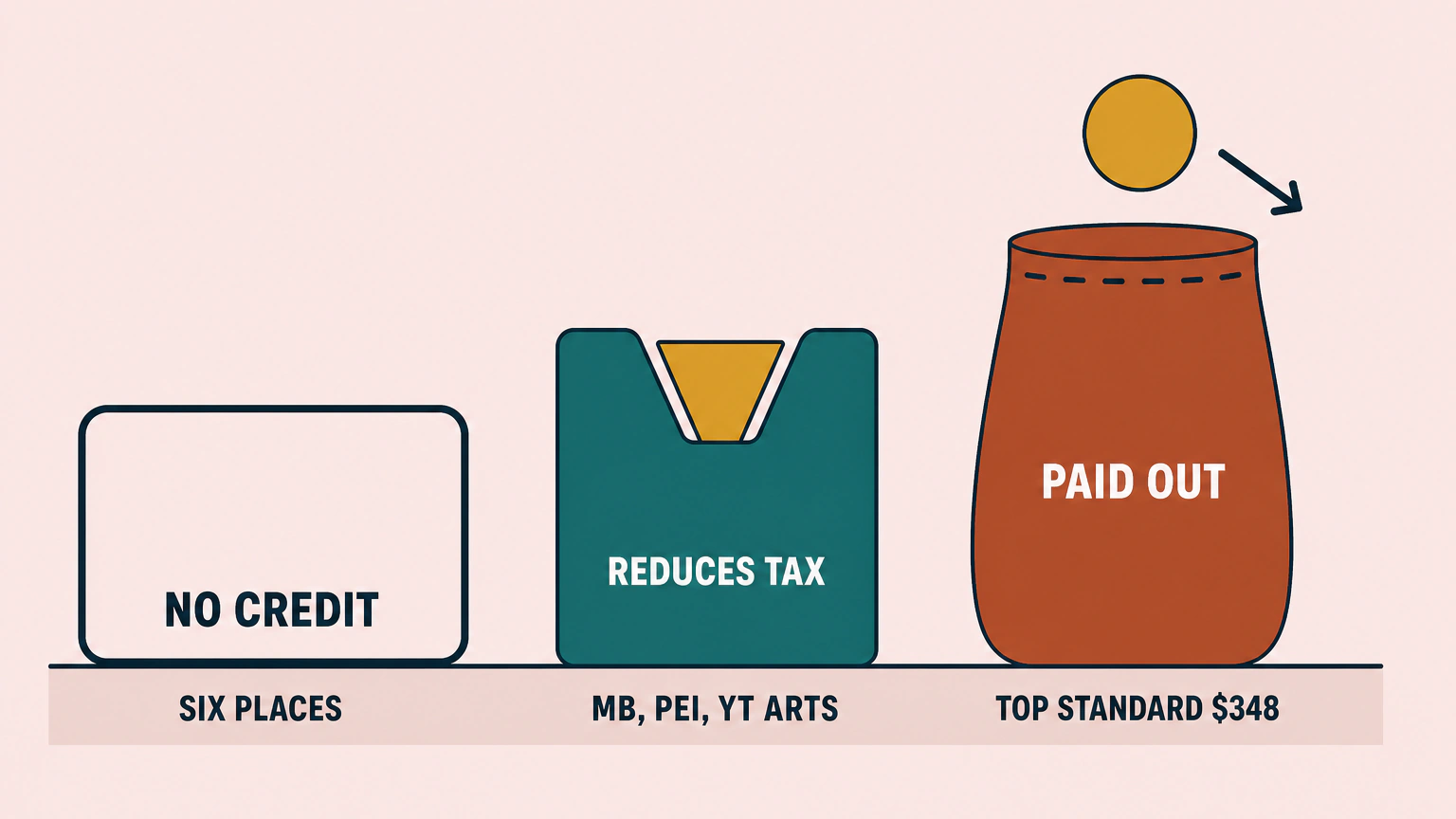
A refundable credit is paid out even when you owe no tax. A non-refundable one only reduces tax you already owe, so a household with nothing payable gets nothing back.
Manitoba's fitness amount, Manitoba's children's arts amount, Prince Edward Island's children's wellness tax credit and Yukon's children's arts amount are non-refundable, and sit on Forms MB428, PE428 and YT428 with the rest of the tax calculation. The other five are refundable, on the 479 credit forms or on the Quebec return.
What each province and territory pays for the 2025 tax year
These figures come from the Canada Revenue Agency's 2025 T1 package and each government's own program page, in Canadian dollars.
| Province or territory | Program | Refundable | Max eligible fees | Rate | Max you receive | Who qualifies | Form and line |
|---|---|---|---|---|---|---|---|
| Newfoundland and Labrador | Physical Activity Tax Credit | Yes | $2,000 per family | 17.4% | $348 per family | you, your spouse or common-law partner, and children under 18 at year end | NL479, line 62000 |
| Saskatchewan | Active Families Benefit | Yes | eligible fees paid, with no separate fee cap | n/a | net eligible fees up to $300 per child, or up to $400 with the federal disability tax credit | child 18 or younger, adjusted family income $120,000 or less, Saskatchewan provider | SK479 worksheet, line 59800 |
| Quebec | Tax credit for children's activities | Yes | $500 per child, $1,000 with a severe and prolonged impairment and fees of $125 or more | 20% | $100 per child, $200 with the impairment | child born after 31 December 2008 and before 1 January 2020, family income $168,470 or less | TP-1, line 462, code 25 |
| Yukon | Children's Fitness Tax Credit | Yes | $1,000 per child, plus $500 with the disability tax credit and $100 or more paid | 6.4% | $64 per child, $96 with the supplement | child under 16, or under 18 with the disability tax credit | YT479, line 63800 |
| Nova Scotia | Children's Sports and Arts Tax Credit | Yes | $500 per child | 8.79% | $43.95 per child | child under 19 on 31 December | NS479, line 62410 |
| Manitoba | Fitness Tax Credit | No | $500 per person, plus $500 with a disability and $100 or more spent | 10.8% | $54, or $108 with the supplement | child under 18, and young adults aged 18 to 24 | MB428, line 58325 |
| Manitoba | Children's Arts and Cultural Activity Tax Credit | No | $500 per child, plus $500 with a disability and $100 or more spent | 10.8% | $54, or $108 with the supplement | child under 16, under 18 with a disability | MB428, line 58326 |
| Yukon | Children's arts amount | No | $500 per child, plus $500 with the disability supplement | 6.4% | $32, or $64 with the supplement | child under 16, or under 18 with the disability tax credit | YT428, line 58326 |
| Prince Edward Island | Children's Wellness Tax Credit | No | $1,000 per child | 9.5% | $95 per child | child under 18 at the start of the year | PE428, line 58365 |
| Ontario, Alberta, British Columbia, New Brunswick, Northwest Territories, Nunavut | none | n/a | n/a | n/a | nothing to claim | n/a | n/a |
How to read this table
Three columns get misread. Maximum eligible fees is a ceiling on spending, not on payment, so spending more brings nothing extra. Maximum you receive is the cash, and it is the only column worth comparing across jurisdictions. And check per child against per family: Newfoundland and Labrador's $2,000 is one household pot, so a second child does not double it, while the child-focused programs elsewhere are per child and Manitoba's fitness amount is per eligible person.
Only Saskatchewan and Quebec apply an income test, and both are cut-offs rather than tapers. A dollar over the line costs you the whole amount. On timing, fees you pay this autumn belong to the 2026 tax year, and Quebec's ceiling is indexed yearly with its 2026 figure already set at $171,925.
The six places with nothing to claim
Ontario, Alberta, British Columbia, New Brunswick, the Northwest Territories and Nunavut have no children's activity credit of any kind. Ontario's Children's Activity Tax Credit was eliminated after the 2016 tax year and British Columbia's ended after 2017.
That is a mechanical finding, not an opinion. In the 2025 T1 package, Forms ON428, ON479, AB428, BC428, BC479, NB428, NT428, NT479, NU428 and NU479 contain no fitness, arts or activity credit, and the Alberta and New Brunswick packages contain no 479 credits form at all.
Pro tip: run this check yourself in two minutes for any year. Open the CRA's provincial forms for your jurisdiction, the 428 for non-refundable credits and the 479 for refundable ones, and search each one for "fitness", "arts" or "activity". If neither form contains any of those words, there's nothing to claim where you live. Quebec residents check point 25 of the line 462 instructions in the TP-1 guide instead.
The five refundable programs, one at a time
These five pay out whether or not you owe tax.
Newfoundland and Labrador, the largest standard payment, and it is not only for children
The rate doubled from 8.7% to 17.4% effective with the 2023 tax year, which is what makes this the largest standard payment in the country without a disability supplement. The word "family" then does real work: the $2,000 pot covers you, your spouse or common-law partner, and children under 18 at year end, so an adult's own gym or sport fees count toward the same claim.
The province's worked examples are blunt. $1,500 of expenses returns $261 and $3,000 returns $348, because the cap bites. Form NL479 asks for the "Amount paid (including all applicable taxes)", so the HST on the fee counts as well.
Saskatchewan, doubled for 2025, with an income test
Both figures doubled for the 2025 tax year, the benefit from $150 and the income ceiling from $60,000, so any page still printing the old numbers is describing 2024.
Saskatchewan is also the strictest about what counts. The provider must be located in Saskatchewan, only registration or membership fees qualify, and equipment and uniforms are excluded outright. Fees covered by fundraising credits don't count, because they aren't money out of your own pocket. Programs run by family members, anything inside the school curriculum or during child care hours, and events where your child watches rather than takes part are all out.
Quebec, twenty percent, an income ceiling and a birth-year window
The birth-year window is Revenu Quebec's way of saying the child was at least 5 and not yet 16 at the start of the year, or not yet 18 where a severe and prolonged impairment applies. The extra $500 of allowable fees for that child applies only once you've paid at least $125.
Quebec files its own return, so this credit goes on line 462 of the TP-1 with code 25 in box 461, not on a CRA form. The income ceiling is the number to watch. It is indexed annually, and it has climbed from $130,000 in 2013 to $168,470 for 2025.
Nova Scotia, where a five hundred dollar credit pays forty four dollars
Nova Scotia and Prince Edward Island both cover sport and arts in one credit, and Nova Scotia uses the highest age cut-off in the country, a child under 19 on 31 December.
Two details make the cap easier to reach than the headline suggests. Eligible fees include administration, instruction, certain uniforms, certain equipment and the rental of required facilities, not just the registration line. And a program qualifies at six consecutive weeks here, shorter than the eight weeks most other jurisdictions demand.
Yukon, where the fitness half is refundable and the arts half is not
The fitness credit is claimed on Form YT479 and paid out. The arts amount sits on Form YT428 and only reduces tax owing. Same territory, same child, two different outcomes.
One ordering rule catches people. If an amount could be claimed as child care expenses, claim it there first, and only the unused part goes to the fitness credit. The same expense can't be counted twice under the arts amount either, so where one organization runs two distinct programs, ask for two receipts.
The non-refundable credits, and when they are worth nothing
Manitoba runs two of these, Prince Edward Island one and Yukon one. All four reduce tax payable and stop there, so a household with no Manitoba, Prince Edward Island or Yukon tax owing gets nothing from them.
Manitoba's two five hundred dollar amounts, one of which covers music and tutoring
The two amounts are separate, so a family whose child does hockey and piano can claim both, for $108 in total. Neither cap has moved since 2024.
Manitoba's arts definition is broad, reaching literary arts, visual arts, performing arts, music, media, languages, customs and heritage, and explicitly including programs that provide "enrichment or tutoring in academic subjects", which brings piano teachers near you and academic tutoring inside the credit. Like Newfoundland and Labrador's broader family credit, Manitoba's fitness amount is not just for children: fees qualify for a child under 18 and for a young adult aged 18 to 24, including your spouse or common-law partner, and you can claim for yourself if you were under 25 at year end.
Yukon's children's arts amount
At 6.4% of up to $500, this one pays $32, or $64 where the disability supplement applies. It's claimed at line 58326 of Form YT428, and an expense already claimed under Yukon's fitness credit can't be claimed here too.
What counts as an eligible program
These rules were inherited from the old federal definitions, so they look alike. The duration test is where they part company.
The eight week and five day tests
In Manitoba, Prince Edward Island, Yukon and Quebec, a program qualifies if it runs eight or more consecutive weeks, or is a camp or intensive of five or more consecutive days where most of the daily activities qualify. That's what makes a term-length dance class or a week-long summer camp eligible, and a one-off workshop not.
Nova Scotia is more generous: six consecutive weeks is enough, or five consecutive days, or eight consecutive weeks for a club membership offering a variety of activities. Newfoundland and Labrador and Saskatchewan set no duration test at all. Newfoundland and Labrador asks only that the activity be genuine physical activity, and Saskatchewan that the program come from a Saskatchewan provider with instruction, supervision and a registration fee.
What is inside the fee
The fee is usually broader than the registration line, and in four jurisdictions it includes the kit.
Usually counts
- Registration fees for a program that meets your jurisdiction's duration test, which is eight consecutive weeks in Manitoba, Prince Edward Island, Yukon and Quebec and six in Nova Scotia
- Membership fees in a club or organization offering qualifying activities
- A camp or intensive of five or more consecutive days where most of the daily activities qualify
- Administration and instruction costs bundled into the fee
- Rental of the facilities the program requires
- Uniforms and equipment supplied through the fee in Nova Scotia, Manitoba, Yukon and Newfoundland and Labrador, but not in Saskatchewan
- The sales tax you paid on the fee in Newfoundland and Labrador, whose form asks for the amount paid including all applicable taxes
Never counts
- Anything that is part of a school's curriculum
- Accommodation, travel, food and beverages
- A program run by your spouse or common-law partner, or by someone under 18
- Fees that were reimbursed, subsidized or covered by fundraising credits
- An amount another person has already claimed
- An amount you claimed as a child care expense deduction
What never qualifies anywhere
School curriculum activities are excluded in every jurisdiction that runs one of these programs. Quebec adds a clarification worth knowing: an extracurricular program offered by a school isn't part of the curriculum, so an after-hours club at your child's own school can still qualify there.
Other common exclusions are programs run by specified family members, amounts someone else has claimed, and amounts you deducted as child care expenses. Reimbursed or subsidized fees come off the top. You can still claim the full amount where the reimbursement was reported as income on a T4 slip and you didn't deduct it elsewhere.
How to claim it without losing the money
- Ask for a tax receipt at the moment you register, not at tax time.
- Check the receipt names the organization, the program, the amount paid, the date and the eligible amount.
- Keep the receipt. You do not send it with your return, but the CRA or Revenu Quebec can ask for it.
- Check your child's age against your jurisdiction's rule before you claim, because the cut-offs differ by up to three years.
- Check the income ceiling if you are in Saskatchewan or Quebec.
- Decide which parent claims, and if you split it, keep the combined total inside the single-claimant maximum.
- If the fee could also be a child care expense, claim it as a child care expense first.
- Enter it on the form and line for your jurisdiction from the table above.
Red flag: three things quietly cost people the claim. A receipt showing only a lump sum, with no eligible amount broken out, leaves you guessing at what you may claim. A program that runs six weeks rather than eight fails the duration test in Manitoba, Prince Edward Island, Yukon and Quebec, although it still passes in Nova Scotia. And a fee paid in December for a program starting in January belongs to the year the money was paid, not the year the activity happens.
Ask for the tax receipt at registration, not in March
Every one of these programs requires a receipt you can produce on request. Where the guidance spells out what the receipt must show, it names the organization, the program and the eligible amount.
Ask at the counter while you're paying. It's worth reading up on your rights when you cancel a prepaid class or membership before you hand over a season's fee, because a season that ends early changes the amount on that receipt.
The form and the line for your jurisdiction
- Newfoundland and Labrador: Form NL479, line 62000
- Nova Scotia: Form NS479, line 62410
- Prince Edward Island: Form PE428, line 58365
- Saskatchewan: Form SK479, worksheet then line 59800
- Yukon fitness: Form YT479, line 63800
- Yukon arts: Form YT428, line 58326
- Manitoba fitness: Form MB428, line 58325
- Manitoba arts: Form MB428, line 58326
- Quebec: TP-1, line 462, with code 25 in box 461
The line number is how you check where the claim appears on your return.
When two parents both paid
Saskatchewan aside, these programs let the claim be split, and they cap the combined total at what one claimant could have taken alone. Two parents splitting a Nova Scotia claim share $43.95. They don't get $43.95 each.
Saskatchewan is the strict one. Only one individual may claim per child, and where the parents live apart it's the parent who primarily fulfils the responsibility for the child's care and upbringing. If they can't agree, a court order or written agreement decides. Where none exists, nobody can claim.
What this is actually worth against a season of lessons
Set the credits against what a season costs and the picture sharpens. Our own quote data comes from users and adapts to where they are, so it isn't a national average of what lessons cost in Canada. On that data, swim lesson providers across Canada quote $136 on average, with a fair price range of $106 to $204 across 803 cost profiles. Dance sits at $418, martial arts at $127 and piano at $387.
Against those figures, Saskatchewan's $300 covers most of a dance season and Newfoundland and Labrador's $348 gets closer but still falls short. Nova Scotia's $43.95 covers roughly a third of a single swim session, and Yukon's arts amount of $32 less than that. Manitoba's fitness amount comes to $54 against a $127 martial arts quote, while its two amounts can reach $108 only if the child is in separate eligible fitness and arts programs and you owe Manitoba tax.
None of that is a reason to skip the claim. It costs one line on a form you're filing anyway. It is a reason to stop treating the credit as a discount when you budget: settle on the fee you can afford first, then work out how Canadian swim lesson levels work for your child, and treat anything the province sends back as a rebate when you file.
Frequently asked questions
Is there still a children's fitness tax credit in Canada?
Not federally. The federal children's fitness and arts credits were phased out in Budget 2016 and eliminated for the 2017 and later tax years, and the 2025 federal return carries no line for them. Seven provinces and territories still run their own: Newfoundland and Labrador, Prince Edward Island, Saskatchewan, Quebec, Nova Scotia, Yukon and Manitoba.
Can I claim my child's swimming lessons on my taxes?
Only in seven jurisdictions. Swimming lessons count as eligible physical activity in Newfoundland and Labrador, Prince Edward Island, Saskatchewan, Quebec, Nova Scotia, Yukon and Manitoba, subject to each one's duration, age and income rules. Everywhere else in Canada, including Ontario, Alberta and British Columbia, there is nothing to claim.
Can I claim my kids' sports on taxes in Ontario?
No. Ontario's Children's Activity Tax Credit was eliminated after the 2016 tax year, and the 2025 Ontario forms, ON428 and ON479, contain no fitness, arts or activity credit. An Ontario parent registering a child for hockey, swimming or dance gets nothing back through the tax system.
Are dance classes tax deductible in Canada?
Not deductible, but creditable in some places. Dance counts on the arts side in Nova Scotia, Prince Edward Island, Manitoba, Yukon and Quebec, and can qualify as physical activity in Newfoundland and Labrador and Saskatchewan. A deduction reduces the income you are taxed on, while these are credits that reduce tax or are paid out.
What is the difference between a refundable and a non-refundable credit?
A refundable credit is paid to you even if you owe no tax, so it arrives as part of your refund. A non-refundable credit only reduces tax you already owe, so a family with no tax payable receives nothing from it. Manitoba's two amounts, Prince Edward Island's wellness credit and Yukon's arts amount are non-refundable; the other five are refundable.
Do I need to send my receipts with my return?
No. These programs tell you to keep your receipts, and the CRA or Revenu Quebec can ask you to produce them later. Keep the receipt somewhere you can find it, showing the organization, the program, the dates and the eligible amount where the program guidance requires those details.
Can both parents claim the same registration fee?
They can split it, but not double it, except in Saskatchewan, where only one person may claim per child. The other programs cap the combined claim at what a single claimant could have taken alone, so splitting changes who receives the money, not how much arrives. Where Saskatchewan parents live apart, the claimant is the child's primary caregiver.
How we checked this
Every figure here was read from a primary source rather than from other guides: the CRA's 2025 T1 package forms (NL479, NS479, SK479, YT479, YT428, MB428 and PE428) and the matching provincial and territorial information guides for 2025, cross-read against the Government of Newfoundland and Labrador's Physical Activity Tax Credit page, the Government of Saskatchewan's Active Families Benefit page, the provinces of Manitoba and Prince Edward Island's personal tax credit pages, and the Quebec Ministere des Finances tax expenditure tables. Quebec's figures were read from Revenu Quebec's line 462 guidance and corroborated against that Quebec government parameter table, which also confirms the annual indexation of the income ceiling. The list of jurisdictions with nothing to claim came from opening every provincial and territorial form in the 2025 package and searching each one, including both the 428 and 479 surfaces where present.
Provincial amounts change with every budget and every new tax package, so check your jurisdiction's figures against the current year's T1 package before you file. We're not your accountant: this is general information about credits governments publish, not tax advice, and anything unusual in your own situation belongs with someone who does returns for a living.