

Here's what each technique asks of you, what Canadian studios really sell, and what a class costs by the hour.
On this page
- Types of acting can mean three different things
- The main acting techniques, by what they ask you to do
- Will you have to dig up your own memories?
- What Canadian studios actually sell
- Stage, screen or voice: picking by where you want to end up
- Which class to book first
- What a class costs, and what to ask before you pay
- Common questions about types of acting
Types of acting can mean three different things
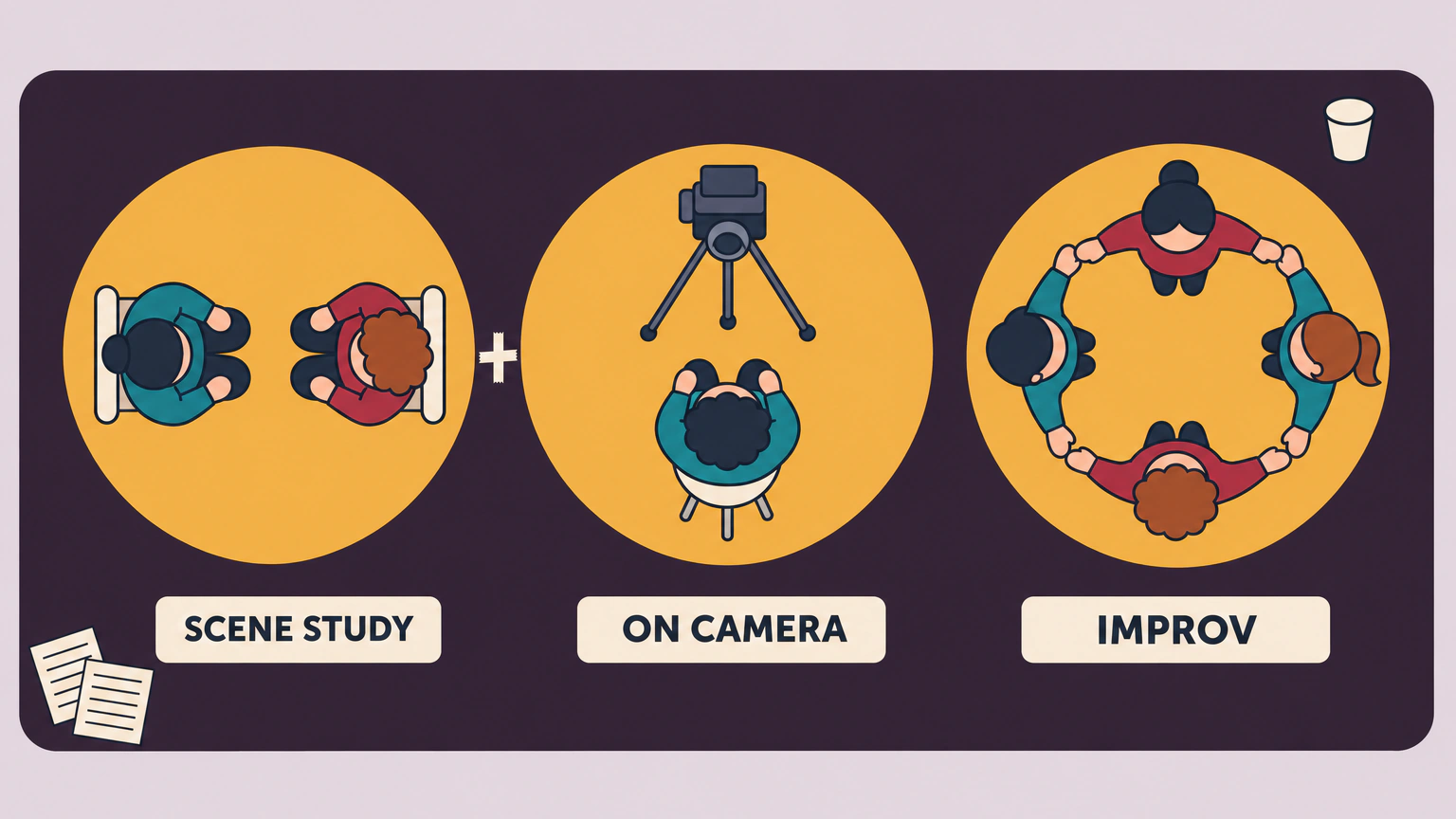
Technique is how you build a performance, the exercises a teacher uses to get you from words on a page to something true. Medium is where you do it: on a stage, in front of a camera or behind a microphone. Class format is what your money buys: a beginner course, scene study, an on-camera class, improv or private coaching.
Most guides to the different types of acting take the first meaning, a list of acting methods, and stop. On your first day in a studio, it's the one that matters least. You'll still meet the technique names on many studio pages, so it helps to know what they ask of you.
The main acting techniques, by what they ask you to do
Nearly all of these acting techniques grew from one Russian teacher. For a beginner, the difference that matters is what you'd be doing on a Tuesday night.
| Technique | What you'd actually do in class | It may suit you if |
|---|---|---|
| Stanislavski | Work out what your character wants, then ask what you'd do "if" you were in their place | You like to understand a scene before you play it |
| Method | Relaxation and sensory exercises and, in Strasberg's version, reliving a big moment from your past | You want depth and you're steady with hard feelings |
| Meisner | Repeat words back and forth with a partner and react to what you hear, with no lines to memorize | You overthink and you'd rather get up than sit and talk |
| Adler | Build the world of the scene from the script and your imagination | You'd rather imagine a life than borrow your own |
| Hagen | Answer plain questions about who you are, where you are and what you want, using real sensory detail | You like practical questions and everyday truth |
| Chekhov | Move, play with imaginary bodies and qualities, and find a character through a physical gesture | You think better on your feet |
| Practical Aesthetics | Break each scene into the literal facts, the want, the essential action and an "as if" | You want a clear step-by-step method |
| Improv games | Play focused games with a group, then build scenes with no script | You're nervous, new or there to have fun |
| Classical | Train voice and movement on language-heavy plays, with Shakespeare at the centre | You love language or you want stage work |
The last column is our own read, not a rule.
Stanislavski, where most of this started
Konstantin Stanislavski was born in Moscow in 1863. Over about forty years he built an approach that brought the psychological and emotional side of acting to the front. The Stella Adler Center describes it as a break from the external style of acting in his day. His "system" gave actors the "Magic If," the habit of imagining yourself inside the character's situation and asking what you'd do. It also gave them tasks, the problems a character tries to solve in each scene (early English translations called them objectives). Later he moved the work onto its feet with a rehearsal process now known as the Method of Physical Action. You'll rarely see his name on a Canadian course title. His work sits underneath nearly everything else.
Method acting, the one that asks for your own memories
Method isn't the same thing as Stanislavski, though the two get mixed up constantly. Lee Strasberg developed the American version with the Group Theatre, which he co-founded in New York in 1931. The Lee Strasberg Theatre & Film Institute is open about what sat at the heart of it: "affective memory," which "called upon actors to recapture and relive a singular 'once in a lifetime' type of event from his or her past."
In Toronto today, Milne Acting Studio's Method workshop opens with The Chair, "a group exercise developed by Lee Strasberg at The Actors Studio," and moves on to the Song and Dance exercise. That's what the training is. Whether you'd want it is a separate question, and a fair one.
Meisner, the one built on listening
Sanford Meisner was one of the Group Theatre's founding members. In 1935 he joined the faculty of the Neighborhood Playhouse in New York, and he developed his technique there. Pro Actors Lab in Toronto sums up the aim as "Living truthfully under imaginary circumstances."
The part everyone remembers is the repetition exercise, and it sounds absurd until you've done it. Two people say a phrase back and forth, over and over, and the point is to react to what the other person just did. You can't plan, because you don't know what's coming. Meisner is also the technique we saw most often as a course title in Canada.
Adler and Hagen, two teachers who went their own way
Stella Adler was another founding member of the Group Theatre. In 1934 she took a break to travel to Russia, stopped in Paris and studied with Stanislavski for five weeks, according to the Stella Adler Center. She came back with a new understanding of his work and broke with Strasberg. As Wikipedia's history of the Method puts it, her version stirs feeling by imagining the scene's "given circumstances" instead of recalling experiences from your own life.
Uta Hagen, at HB Studio in New York, taught through plain, practical questions: "Who am I? Where am I? What do I want? What stands in my way?" HB Studio still calls her books, Respect for Acting and A Challenge for the Actor, central references for actors in training. In our sample, both names turn up only inside blended classes in Toronto and Montreal, never as a course of their own.
Chekhov, who started with the body
Michael Chekhov trained with Stanislavski, and Michael Chekhov Canada says his "refusal to exploit the actor's personal feelings" is what separated him from his teacher. His tools have names like centres, qualities, atmospheres, imaginary bodies and psychological gesture, and you work them out through movement more than talk. A dedicated group teaches the technique in Toronto. It's one of only two techniques besides Meisner that we saw sold under its own name.
Practical Aesthetics, for people who like a plan
David Mamet and William H. Macy conceived this one, and it puts script analysis and physical action ahead of emotional recall. You break each scene into four steps: the literal (what the character is doing), the want, the essential action and an "as if" that ties the action to your own life. None of the 20 Canadian studios we read sells it, so you may never meet it here.
Improv games, and the Calgary connection
Two lines of descent matter here. Viola Spolin built her theatre games working with children in Chicago, including immigrant kids in a Depression-era recreation program. Her son, Paul Sills, carried those games into the Second City. Today, Second City's Toronto classes include an Intro to Acting that "combines improvisational techniques with a variety of scripted media."
The second line runs through Alberta. Keith Johnstone taught drama at the University of Calgary, co-founded Loose Moose Theatre in the city in 1977 and created Theatresports, where teams compete with scenes built from audience suggestions.
That's why so many beginner and kids' classes in Canada start with games. The games aren't filler. They train the same things a scripted scene does: listening, reacting, and letting go of the plan you walked in with. And they're a gentle way in for anyone who'd rather not stand alone with a monologue on night one.
Will you have to dig up your own memories?
Usually not in a beginner class, but ask before you pay. Most first courses we read run on games, voice work and short scenes. When a technique does ask for feeling, each one sends you somewhere different to find it. Method points you to memory, Adler to your imagination, Meisner to your partner and Chekhov to your body.
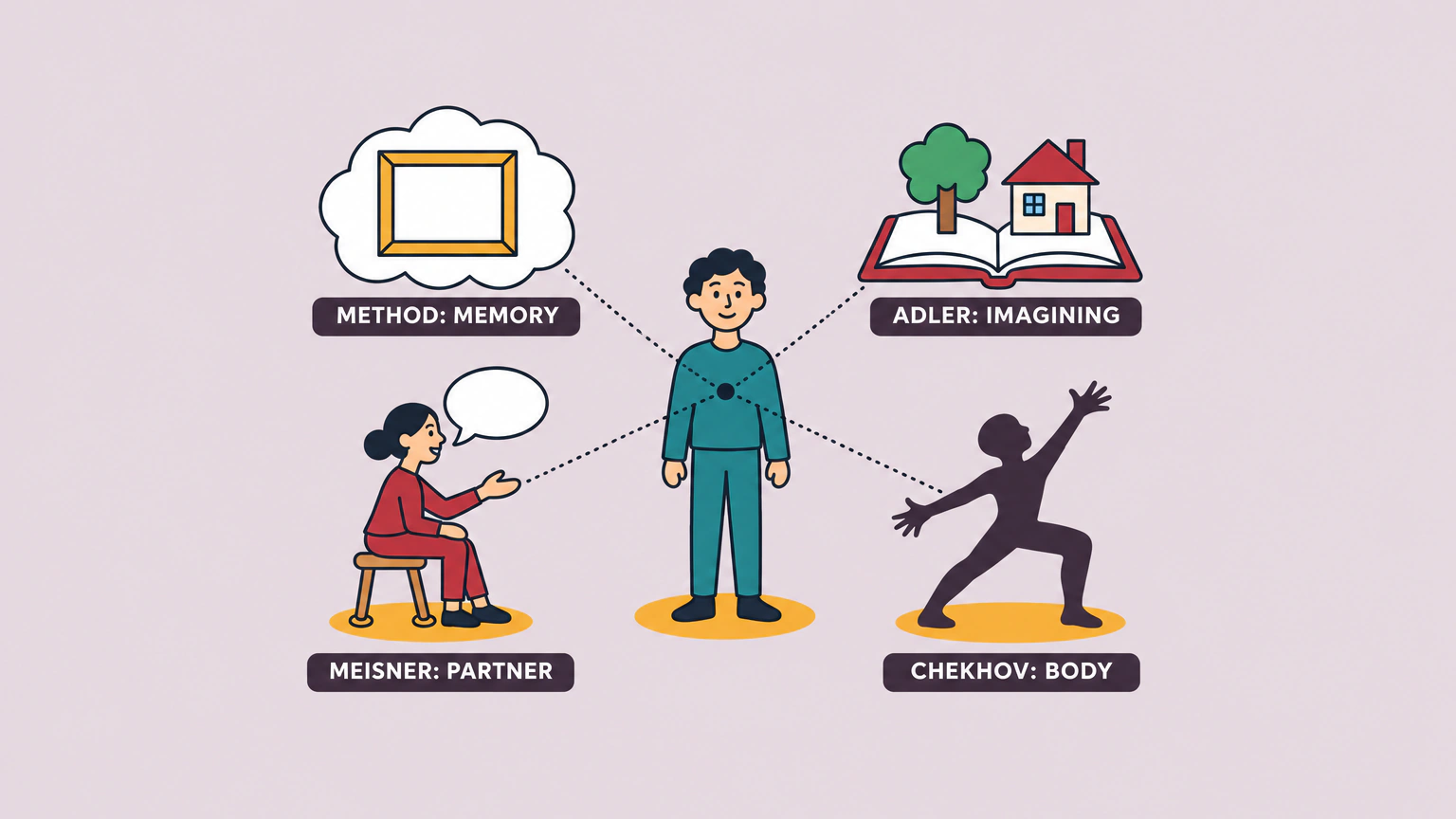
That neat picture leaves something out. Method isn't the only approach that touches your own life. HB Studio says Hagen's actors "draw from their own sensory and emotional experience," and Shoreline's Meisner course in Vancouver works "from the truth of yourself and your own emotional life." So don't screen a class by its label. Screen it by asking.
The research here is thin. An Australian report on actors' wellbeing, published in 2015, describes a 1999 interview study of just five student actors. That study found that for actors working from their own feelings, the line between actor and character could blur, onstage or off, and that emotional distress could follow. Its authors said more research was needed on when that goes well and when it goes badly. They also pointed to acting teachers' lack of experience in recognizing and supporting psychological wellbeing.
We'd take that as a reason to ask how a teacher handles a hard moment, especially with a teen in the room. It isn't a reason to avoid the craft.
If a class stirs up something heavy, that's a job for a counsellor or your doctor, not your acting teacher.
What Canadian studios actually sell
We read the course pages of 20 Canadian studios and theatre schools in six provinces. Technique names turned out to be the exception. Twelve name none of them and sell by format or level. Three blend several. Alza Acting Studio in Toronto works with "some elements of the Meisner technique, Stanislavsky method, and Chekhov." I.O. Acting & Creative Studio in Montreal folds exercises from a list running from Adler to Stanislavski into its beginner course. Karen Ivany in Toronto draws on Hagen, Meisner, Adler and Chekhov. Only five sell one technique by name: Meisner at Pro Actors Lab, Shoreline and ActorVan, Method at Milne, and Chekhov at Michael Chekhov Canada.
What most studios sell is a format: a beginner course (games, voice and short scenes), scene study, on-camera work, improv, or one-on-one coaching. Calgary Actors' Studio defines scene study plainly: "It's an acting class without improvised workshop exercises; it's 100% based on scenes & monologues."
| Course | City | Class hours | Fee as printed | Per class hour |
|---|---|---|---|---|
| Fundamentals, Michael Chekhov Canada | Toronto | 12 | $165 | $13.75 |
| Introduction to Meisner Technique, Pro Actors Lab | Toronto | 36 | $600 + HST | $16.67 |
| Scene Study, Calgary Actors' Studio | Calgary | 25 | $475 + GST | $19.00 |
| Acting Fundamentals, Neptune Theatre School | Halifax | 8 | $160 + HST | $20.00 |
| Adult Intro, Calgary Actors' Studio | Calgary | 20 | $425 + GST | $21.25 |
| The Meisner Technique Level 1, ActorVan Studios | Vancouver | 18 | $395 with GST | $21.94 |
| Tuesday Scene Study, Haven Studio | Vancouver | 20 | $500 with GST, or $450 early | $25.00 or $22.50 |
| Intro to Acting On Camera, Alza Acting Studio | Toronto | 12 | $329 + HST | $27.42 |
| Intro to Acting, I.O. Acting & Creative Studio | Montreal | 12 | $540 + tax | $45.00 |
Per-hour figures divide the printed fee by scheduled class time, before any tax a studio adds on top. Fees are from each studio's own page. Michael Chekhov Canada calls its fee reduced. Haven's Tuesday class asks for previous training.
From $13.75 to $45.00 a class hour, the spread shows how little a fee says until you divide it by the hours. We note one more pattern in our category overview, and our sample points the same way. In Toronto and Vancouver, where much of the country's screen production is based, studios often lean toward on-camera classes, while theatre training leads in many other cities.
Stage, screen or voice: picking by where you want to end up
If you'd like paid work one day, the unions show how the country divides it. ACTRA calls itself "the national union of professional performers working in recorded media in Canada," with over 30,000 members. Canadian Actors' Equity is "the voice of nearly 6,000 professional artists working in theatre, opera and dance." The Union des artistes represents artists working in French, and in other languages too, except on productions made in English for an English-speaking audience.
Voice work has its own short routes in. Calgary Actors' Studio, for one, runs a nine-hour weekend voicing workshop for ages 12 to 18.
Classical training sits at the far end of the stage route. Stratford's Birmingham Conservatory is "a paid two-year intensive" for eight actors who already have foundational training and professional experience, with Shakespeare "at the centre of the exploration." For everyone else, the way in is a public class. The National Theatre School's public classes are open "to all ages and experience levels."
Which class to book first
Match the class to the person, not to the technique name.
| If this sounds like you | Start with | Why |
|---|---|---|
| You're curious and a bit nervous | A beginner course built on games and improv | Calgary Actors' Studio's intro promises you'll "Play your way through the basics" |
| You get stuck in your own head | An introduction to Meisner | It's built on reacting to a partner, so there's nothing to plan |
| You want film or TV work | An on-camera scene study class for beginners | You'll break down real scripts and get used to the lens |
| You want stage work | A class run by a theatre company | Neptune, Persephone and the National Theatre School all run public classes |
| Your child or teen wants to try it | A kids or teen course built on theatre games | Calgary's Teen Intro leans on "theatre games and workshop exercises" |
| You have an audition next week | One private coaching booking or a coached self-tape | You need help with one scene, not a term of classes |
| You want to work in French | A studio that coaches in French | Quebec's French-language work runs through the Union des artistes |
If you still can't choose, we'd book a short beginner course with a teacher you like the sound of and leave the technique for later. Our listings of acting classes in Toronto and acting classes in Vancouver are a good place to compare teachers. And if you're still torn between stage arts, we've laid out the different types of dance the same way.
What a class costs, and what to ask before you pay
| What you're buying | Planning range | Per class hour |
|---|---|---|
| Beginner course, 4 classes of 3 hours | C$295 to C$330 | C$24.58 to C$27.50 |
| Scene study or on-camera course, 6 classes of 3.5 to 4 hours | C$475 to C$500 | C$19.79 to C$23.81 |
| Children's or teen course, 8 classes of 2 to 2.5 hours | C$320 to C$995 | C$16.00 to C$62.19 |
| Private audition or scene coaching, 60 minutes | C$50 to C$125 | C$50 to C$125 |
| Coached self-tape booking, 60 minutes | C$70 to C$120 | C$70 to C$120 |
These are our own planning ranges in Canadian dollars, drawn from selected published offers. They're budgeting guides, not national averages or quotes.
A teen course can work out to anywhere from about C$16 to about C$62 an hour, so ask for the hours before you compare fees. If the top of that range is a stretch, here's where to find help paying for kids' activities. For one audition, compare a single coaching booking with a coached self-tape. Then, before you pay anyone, ask:
- How many hours of teaching do I get, and how much of that will I be up working?
- Is this class open to beginners, or do I need training first?
- Who's teaching, and how would they describe their approach in plain words?
- Will any exercise ask me to use a personal memory, and can I pass on it?
- What happens if an exercise gets hard for me or for my teen?
- Can I watch or try a class first, and what's refundable if I stop?
- Does the fee include tax, and are footage or showcase charges extra?
In Ontario, the Consumer Protection Act, 2002 counts "modelling and talent" among its "personal development services," and instruction in them is covered too. So a for-profit studio's course that you must prepay, costing more than $50, should come with a 10-day cooling-off period. The $50 line is set by the regulation under the Act. The 10 days run from the later of two dates: the day you get your written copy of the contract, and the day all the services are available. Programs run on a non-profit or co-operative basis, or funded or run by a charity or a municipality, fall outside those rules. That can include a theatre company's school. Here's what Ontario's rules give you in full. Other provinces differ.
If a class comes bundled with an introduction to an agent, read ACTRA's advice on our acting classes page before you sign.
When you're ready, open acting classes near you, pick two course pages, and ask how many class hours you get.
Common questions about types of acting
What are the main types of acting?
It depends on what you're sorting by. By technique, the big names are Stanislavski, Method, Meisner, Adler, Hagen, Chekhov and Practical Aesthetics, plus improv games and classical training. By medium, it's stage, screen and voice. By class, you're usually choosing between a beginner course, scene study, on-camera work, improv and private coaching.
Which acting technique is best for beginners?
We don't think there is one, and 15 of the 20 Canadian studios we read don't make you pick a single technique anyway. If you're nervous, start with games and improv. If you overthink everything, try an introduction to Meisner. Either way, a good teacher and a small class will matter more than the name on the course.
Is method acting dangerous?
Not by default, but it deserves care. The Strasberg Institute says the heart of Strasberg's training was "affective memory," which asked actors to "recapture and relive" a major event from their past. Research on what that does to people is thin. Before you try it, ask whether you can pass on an exercise and what the teacher does if one goes badly.
Is method acting the same as Stanislavski?
No. Stanislavski built his system in Moscow over about forty years. Method is the American version Lee Strasberg developed with the Group Theatre, which he co-founded in New York in 1931. Stella Adler and Sanford Meisner were in the Group too, and both later rejected parts of Strasberg's approach.
What do you learn in an acting class?
Less theory than you'd expect. A beginner class usually mixes games, voice and short scenes. Scene study is narrower: Calgary Actors' Studio says its version is "100% based on scenes & monologues." On-camera classes add breaking down scripts and getting used to the lens. A good class gets you up working every week instead of sitting through lectures.
Are acting classes worth it?
They can be, if you know what you're buying. Training doesn't guarantee auditions or an agent. What it reliably gives you is practice at speaking up, listening, working with a group and being watched without shrinking. We think that's worth the fee for plenty of adults and teens, and a short beginner course is an easy way to find out.