

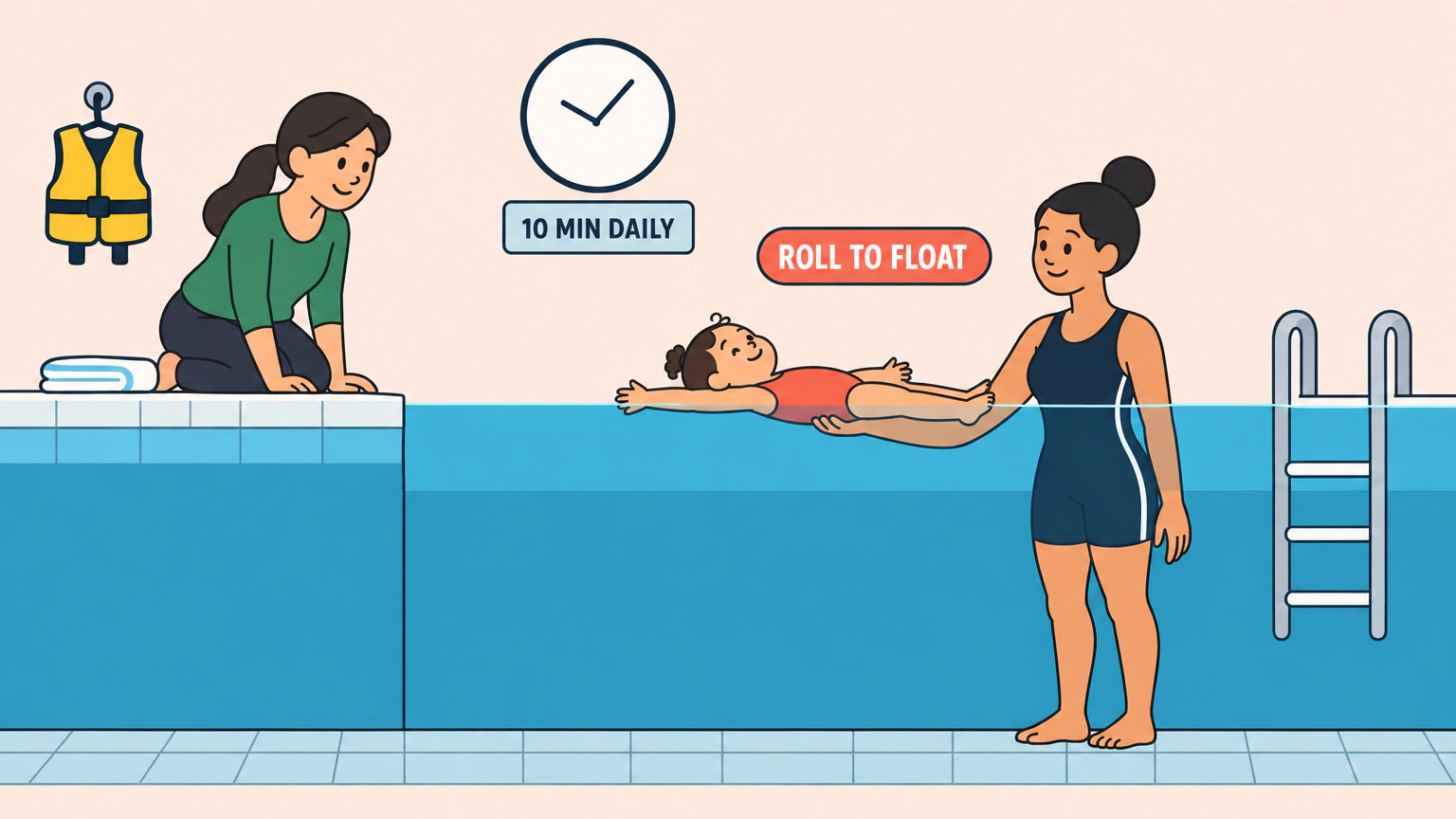
ISR (Infant Swimming Resource) is a private program of one-on-one lessons, 10 minutes a day on weekdays for about six weeks. It teaches babies from 6 months old to roll onto their backs and float, and it teaches walking toddlers to swim, float and swim again until they reach the wall. In Canada it's scarce. We searched ISR's own instructor locator from 42 Canadian cities. The only Canadian listings it returned were in Calgary, Airdrie and Lethbridge, all in southern Alberta. A Calgary course costs $720 including GST, plus a US$50 registration fee. And the Canadian Paediatric Society and the Lifesaving Society in Alberta both say no lesson before age 4 should be counted on to prevent drowning.
On this page
- What an ISR lesson actually looks like
- Where you can take ISR in Canada
- What ISR costs, next to a city swim class
- What Canadian safety experts say about lessons before age 4
- What the research shows, and what it can't
- How to decide whether ISR is right for your child
- The protection that matters more than any lesson
- Frequently asked questions
What an ISR lesson actually looks like
An ISR lesson is one child and one instructor in the water, and nobody else. You watch from the deck. Infant Swim Canada, the Calgary ISR instructor's business, puts it simply in its FAQ: "Parents are not required to get in the water."
What your child learns depends on whether they walk yet. Babies up to about 18 months learn to roll onto their backs and float, then hold that float until help arrives. Children who walk learn a swim-float-swim sequence. They swim a short way face down, roll over to rest and breathe, then swim again until they reach the steps or the wall.
Lessons run 10 minutes a day, five days a week, for about six weeks on average. The Calgary instructor gives three reasons for this schedule: repetition, short attention spans, and body heat, since the pool is cooler than your child. Ten minutes is shorter than most parents expect. Some of you will spend longer finding parking.
ISR's head office reviews your child's medical history at registration. Before each lesson, the instructor asks about sleep, diet and toileting. Near the end of the course, children show their skills in clothes, and the Calgary instructor adds winter gear. Refreshers follow about every six months. ISR has been teaching this way since 1966.
Where you can take ISR in Canada
Almost nowhere. From 42 Canadian cities, ISR's own locator returned Canadian listings only in Calgary and Airdrie, both served by one instructor, and in Lethbridge, served by a second. Even in Calgary, both of the instructor's fall 2026 sessions are listed as full, so compare lesson providers across Alberta in our directory as well.
Everywhere else, the locator looks across the border, pointing Vancouver families to Washington state, Toronto and Niagara families to western New York, and Windsor families to Michigan. From 28 of the 42 cities, including Edmonton, Winnipeg, Ottawa, Montreal and Halifax, it found nothing within about 160 km. ISR says it certifies new instructors every week and keeps a waiting list, so check the locator yourself with your full address.
Names can mislead. A program that calls itself "survival" or "self-rescue" swimming may not be ISR at all, and the locator is how you check that an instructor is certified. A daily six-week commute across the border isn't realistic for most families. So the safety advice and the questions worth asking apply just as much to any infant survival-style program. If you live in the GTA, swim lessons in Toronto are a lot closer than Buffalo.
What ISR costs, next to a city swim class
The one Canadian price we could find is the Calgary instructor's. Her typical six-week course costs $720 including GST, which works out to $120 a week or $24 a lesson. Add a US$50 registration fee, paid to ISR's head office for the medical review. ISR's American instructor pages list US$105, so confirm the amount when you book.
What a Calgary family pays, side by side
| ISR with a Calgary instructor | City of Calgary Parent and Tot | City of Calgary private lessons | |
|---|---|---|---|
| Ages | 6 months to 6 years | 4 months to 2 or 3 years, with an adult | 3 years and older |
| Who is in the water | Your child and the ISR instructor | You and your child, up to 10 swimmers a class | Your child and the instructor, or two children from the same household |
| How it runs | 10 minutes a day, weekdays, for about six weeks | Usually five to eight classes a course | Booked one class at a time |
| Price | $720 including GST for six weeks | $5.75 to $10 a class | $47.50 a class |
| What that works out to | $120 a week, or $24 a lesson | $28.75 to $80 for a course | $47.50 each time |
| Extra fees | US$50 registration fee to ISR's head office for the medical review | None for lessons | None for lessons |
| Help with the cost | KidSport Calgary provider; 10% off the oldest child's fee when siblings sign up together | 90% off programs under $100 for children 17 and under, through Fair Entry | Ask whether Recreation Fee Assistance applies |
Read the terms before you pay. A $360 deposit, non-refundable, holds your time slot and pays for the first half of the lessons. Only lessons the instructor cancels, for bad weather or her own illness, are credited. So a week your child spends sick at home is a week you've already paid for.
The instructor is a KidSport Calgary provider. When siblings sign up for the same session, the oldest child gets 10% off. Our guide to help paying for a child's lessons explains how KidSport works.
As we see it, ISR buys about 50 minutes a week of one-on-one time that a city class can't offer a baby. No study has tied it to fewer drownings.
What Canadian safety experts say about lessons before age 4
If everything you've read so far was American, here's the Canadian view, in the experts' own words. The Canadian Paediatric Society's 2003 position statement was blunt: "Swimming programs for infants and toddlers less than four years of age should not be promoted as being an effective drowning prevention strategy." It added: "No young child, particularly those who are preschool aged, can ever be considered 'water safe'."
Its current advice for parents dates from 2023. Most children can't swim on their own until at least 4, it says, even when lessons start earlier. They won't be competent swimmers until 6 or 7. For children under 4, the society recommends programs that build water confidence and teach parents about water safety.
The Lifesaving Society's Alberta and Northwest Territories branch addresses the very skill ISR teaches. Children under 4, it says, "do not have the developmental ability to use aquatic survival skills to 'self-rescue' in an emergency situation." And Alberta is the province where ISR's Canadian instructors work.
The American Academy of Pediatrics sees it a little differently. It recommends lessons "as a layer of protection against drowning that can begin for many children starting at age 1." For babies under 1, its answer is no, "because there is currently no evidence that infant swim programs for babies under 1 year old lower their drowning risk."
Who says what, by your child's age
| Child's age | Canadian Paediatric Society | Lifesaving Society, Alberta and NWT branch | American Academy of Pediatrics | ISR |
|---|---|---|---|---|
| Under 1 | Hold babies who can't sit unaided and are too young for a PFD whenever they're in or near water | No swim lesson under 4 should be sold as drowning prevention | Doesn't recommend infant swim classes; no evidence they lower drowning risk | Roll onto the back and float, from 6 months |
| 1 to 3 | Pick programs that build water confidence and teach parents water safety | Lessons never replace supervision within arm's reach | Lessons can start for many children at 1, as one layer of protection | Swim, float, swim once walking |
| 4 and up | Most children can't swim on their own before 4; competent by about 6 or 7 | Learning to swim is one of five layers of protection | Most children are ready for lessons by 4; front crawl by 5 or 6 | Aimed at children up to 6 |
Set the differences aside and paediatricians in both countries agree on two things. Under 1, there's no evidence that lessons protect a baby. At every age, no lesson replaces an adult within arm's reach, and ISR itself calls supervision "the most effective defense against drowning."
What the research shows, and what it can't
Two studies do most of the work in this debate, and each one is narrower than it sounds.
The first is a 2009 US case-control study, the source of the 88% figure you may have seen. Among children aged 1 to 4, those who drowned were less likely to have had formal swim lessons: 2 of 61, against 35 of 134 children matched to them. But it looked at formal lessons of any kind, not ISR in particular, and the authors called their own estimate imprecise. The real reduction in risk could sit anywhere from 3% to 99%.
The second is a 2025 trial of toddler self-rescue training. Fifty children aged 12 to 23 months had 20 ten-minute sessions on weekdays over four weeks. Afterwards, 40 of the 48 who stayed in the study passed every test, including three minutes afloat in clothes after being released face down. On a second try, 47 of the 48 did. A minority of parents felt their toddler went through "a little trauma or distress", especially early on. The trial had no comparison group, and it counted pool skills, not drownings.
Lessons at this age carry their own hazards, and the CPS names three: water intoxication, when a child swallows so much water that blood sodium drops and seizures can follow; hypothermia; and infections such as swimmer's ear. The precautions ISR says it takes are short lessons, temperature and fatigue checks, medical screening and a daily check-in with you.
So toddlers can learn this skill. Nobody has yet shown that learning it prevents drownings.
How to decide whether ISR is right for your child
We think ISR swimming lessons can make sense when four things line up. Your child is past their first birthday, your family is around water often (a home pool, a lakefront cottage), an ISR instructor is close enough for thirty weekday trips, and your child's doctor has no concerns. The 2025 trial's own authors write that "at-risk toddlers might benefit from self-rescue training." A toddler who lives beside a pool is the plainest example we can think of.
The rest of the time, a Parent and Tot class is the better call. Choose it for a baby under 1, where the AAP and the CPS agree. Choose it when the goal is comfort in the water and your own water-safety skills, which is exactly what the CPS recommends for children under 4. And choose it when money is tight or no ISR instructor is near you. If you're leaning that way, here's what Parent and Tot and Preschool levels mean, and you can compare swim schools near you.
We're parents writing for parents, not doctors. If your baby has a medical condition, talk to your doctor before any infant swim program, ISR or otherwise.
Seven questions to ask before you pay a deposit
Ask these before any infant survival instructor, ISR or not, takes your money.
- Are you certified by ISR right now, and will you show me your listing on ISR's instructor locator?
- What medical information do you need before the first lesson, and who looks at it?
- How warm is the pool? The AAP suggests water of about 31 to 34°C for children 3 and younger.
- If my child is sick for a week, do I get those lessons back or lose them?
- What will my child be able to do on the last day, and will they show it in clothes?
- Can I watch every lesson, and what should I practise or avoid at home in between?
- How often do you recommend refreshers, and what do they cost?
The protection that matters more than any lesson
From 2018 to 2023, drowning killed 103 Canadian children aged 1 to 4. That's more than a third of the unintentional injury deaths in that age group, and more than any other cause, according to the CPS's June 2026 statement.
The layers that protect a toddler start with an adult within arm's reach of every baby and toddler in or near water. The Lifesaving Society's ratio is at least one adult for every baby and one for every two young children. Fence a home pool on all four sides, at least 1.2 m high, with a self-closing, self-latching gate, and remember that the house doesn't count as a side. Lifejackets and PFDs start at 9 kg (20 lb), because none is approved in Canada for smaller babies. Water wings and neck rings are toys, not safety devices. Empty wading pools and buckets when you're done. And learn CPR.
ISR lists door alarms among its layers of defence. The CPS's 2003 statement addresses a different device: "pool alarms are not effective and may give parents a false sense of security." Neither one replaces a fence.
No lesson makes a toddler water safe. Every Canadian body we checked, and ISR itself, says the same thing: lessons are one layer, never the whole plan. Keep an adult within arm's reach of every baby and toddler near water. Fence a home pool on all four sides with a self-closing, self-latching gate. Put toddlers of 9 kg or more in a lifejacket or PFD, and skip water wings. Empty the wading pool when you're done.
Your next step is small. Book the Parent and Tot class, or join ISR's waiting list, and sign up for a CPR course either way.
Frequently asked questions
Is ISR available in Canada?
Barely. We searched ISR's instructor locator from 42 Canadian cities, and its only Canadian listings were in Calgary, Airdrie and Lethbridge, all in southern Alberta. From Vancouver the nearest listings are in Washington state, from Toronto they're in western New York, and from Windsor they're in Michigan. ISR says it certifies new instructors every week, so search the locator with your full address and join its waiting list.
How much do ISR swim lessons cost in Canada?
One Calgary instructor charges $720 including GST for about six weeks. Add a US$50 registration fee paid to ISR's head office. Her $360 deposit holds your slot and isn't refundable, and lessons your child misses through illness aren't credited. Each ISR instructor sets their own price.
Is ISR swimming safe for babies?
ISR takes real precautions: a medical history reviewed before the first lesson, daily health questions and lessons capped at 10 minutes. Lessons at this age still carry hazards the Canadian Paediatric Society names, including water intoxication, hypothermia and infections. The American Academy of Pediatrics doesn't recommend infant swim classes before age 1. Talk to your child's doctor before you book any infant swim program.
Does ISR swimming actually work?
It teaches a real skill. In a 2025 trial of toddler self-rescue training, most toddlers learned to float in clothes for three minutes after four weeks of short weekday sessions. But no study has shown that ISR prevents drownings. Both the Canadian Paediatric Society and the Lifesaving Society say no lesson before age 4 should be relied on to prevent drowning.
How long do ISR swim lessons take?
Lessons last 10 minutes a day, five days a week, and the full program takes about six weeks. The Calgary instructor stresses that six weeks is only an average: some children finish faster and some need more practice. After that, refreshers follow about every six months, so your child's skills keep up with their growing body.
Will my child cry during ISR lessons?
Probably, at least at first. The Calgary instructor's own FAQ says "Children often fuss during the first few lessons." The fussing fades, it adds, as they gain confidence. In the 2025 trial, parents generally rated the program positively. A minority felt their toddler went through "a little trauma or distress", especially in the early sessions.
What age should a baby start swim lessons in Canada?
A Parent and Tot class can start at 4 months in Calgary, with you in the water. For children under 4, the Canadian Paediatric Society recommends programs that build water confidence and teach parents about water safety. Most children can't swim on their own until at least 4, it says, even if they start lessons younger.