

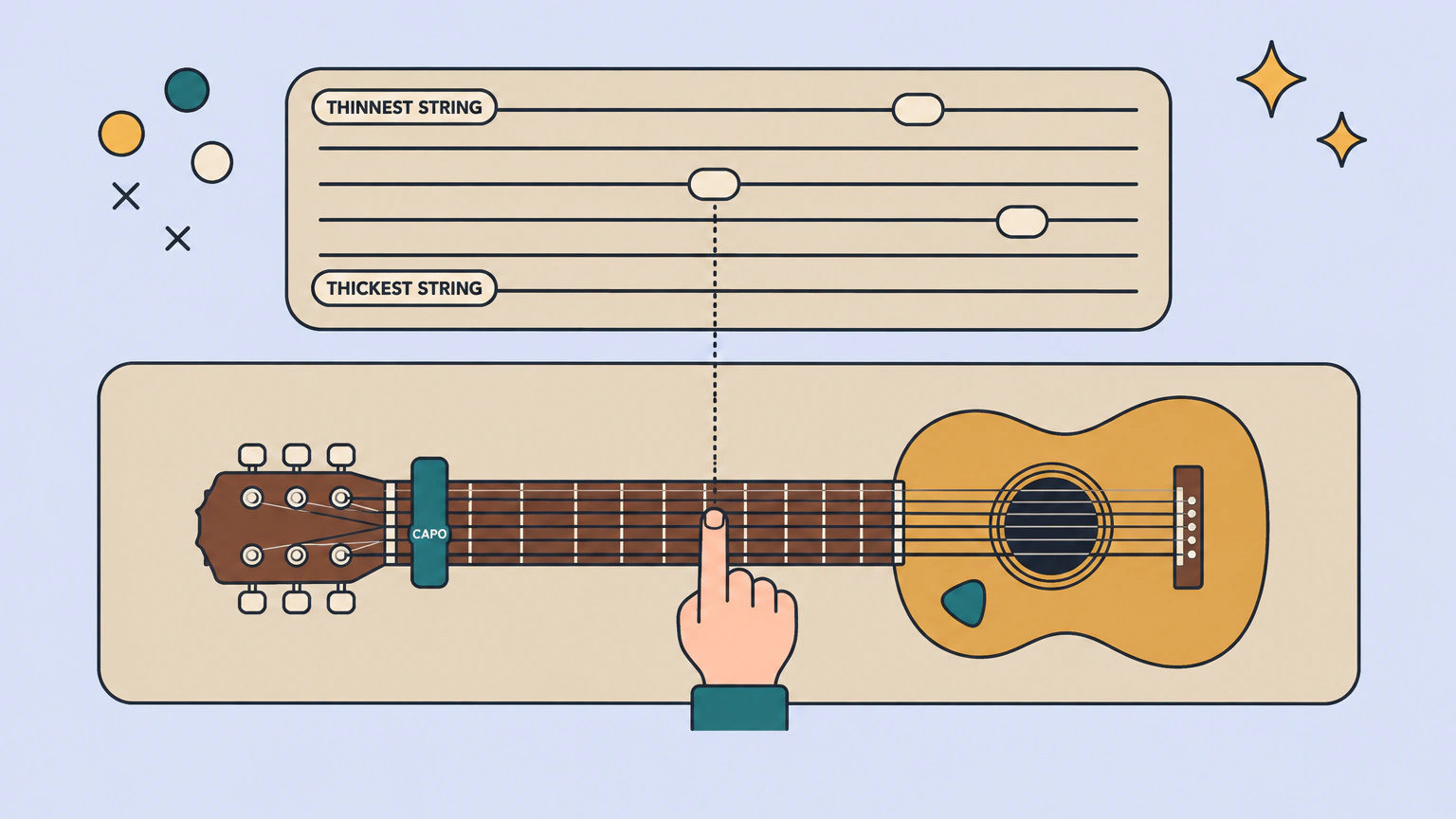
Guitar tab is a map of your guitar neck: the six lines are the six strings, usually with the thinnest string on top, and each number tells you which fret to press on that string, with 0 meaning play it open. Read it left to right, play stacked numbers together, and check the tuning and capo lines at the top before your first note, because they decide where those numbers land and how they sound.
On this page
- Start with the six lines and the numbers
- Read the top of the tab before you play a note
- What the letters and symbols in a tab mean
- What tab won't tell you: rhythm and fingers
- How to tell whether a tab is any good
- Tab or sheet music: what Canadian guitar exams expect
- When a guitar teacher is worth booking
- Guitar tab questions people ask
Start with the six lines and the numbers
Tab exists because one written note can sit in several places on a guitar neck. The high E of the open 1st string, for example, is also fret 5 on the 2nd string and fret 9 on the 3rd. Tab tells you which spot the writer meant.
Check which string is on top
Six lines, six strings. In the common layout, the top line is the 1st string, the thinnest (high E in standard tuning), and the bottom line is the 6th string, the thickest (low E). Fender and Songsterr both teach it this way.
It feels upside down at first, because the thick string is the one nearest your chin. That's exactly the point. Songsterr's advice is to "visualize a guitar neck as if you are playing the guitar and looking down on the neck." Look down at the guitar in your lap and the string nearest you sits at the bottom of the view.
Wikipedia notes that the line order isn't standardized, and some tab is written the other way up. That's why many tabs print the string letters at the start of each line (e, B, G, D, A, E from top to bottom), with a lowercase e for the thin string. Some write T, A, B down the left edge instead, which doubles as a memory aid: T for the treble strings at the top, B for the bass strings at the bottom.
A number is a fret, and 0 means open
A number on a line tells you which fret to press on that string. A 0 needs no finger. As Fender puts it, "a 0 means that you play the open string." A string with no number isn't played at all. So a lone 3 on the bottom line means the 3rd fret of the thickest string, picked on its own.
What the number never tells you is which finger to use. That comes from a bit of logic, from a teacher, or from a fingering note that some writers add under the tab.
Read left to right, and play stacked numbers together
Read tab left to right, like a sentence. Numbers that follow one another are single notes, played in that order. Numbers stacked in one vertical column are played at the same time, and that's how tab writes a chord. Fender calls them "stacked numbers," and Songsterr builds its C chord the same way.
Take a G chord. Reading from the bottom line up, its column says 3, 2, 0, 0, 0, 3: fret 3 on the thickest string, fret 2 on the next, three open strings, then fret 3 on the thinnest. Strum all six together.
The gaps between numbers can hint at timing. Fender says notes "will sometimes be spaced apart" to show whether they're played close together or farther apart. Sometimes, though, the spacing tells you nothing at all, and that's a bigger problem than it sounds.
Read the top of the tab before you play a note
Most guides stop at lines and numbers, which is where a real tab starts. Many tabs online open with a few lines of text before the first number: a tuning, a capo position, sometimes a key, and some notes from whoever wrote it. One header on Ultimate Guitar reads "Tuning: E A D G B E Key: C# Capo: 1st fret". Those lines aren't decoration. Skip them and you can play every number right and still sound nothing like the song.
The tuning line: retune first, then read as normal
Standard tuning, from the thickest string to the thinnest, is E A D G B E. If the tab names a different tuning, retune before you start. Then read every number exactly as written, because a number is a fret, not a note.
Two tunings turn up often, and Wikipedia's tuning articles describe both. Drop D lowers only the 6th string, by a whole step (two frets' worth), from E to D. To get there, play the open 4th string, which is already a D, and bring the 6th string down until it sounds the same D an octave lower. Go a little below the note and tune up to it, because a string tuned down to its note tends to drift. A half step down, also called E flat tuning, lowers every string by one fret's worth.
In a drop D tab, a 3 on the bottom line still means fret 3. Your fingers go where the numbers say, exactly as they would in standard tuning. The retuning is what makes those frets sound like the record.
The capo line moves zero up the neck
A capo clamps across the strings and acts as a new nut, the little ridge at the headstock end where the strings start. Wikipedia describes it as a way "to create a new nut at a higher note," so you can play in a different key with the same shapes. That's how a guitarist moves a song into a key that suits a voice, which matters if you sing while you play or you're taking singing lessons and want to accompany yourself.
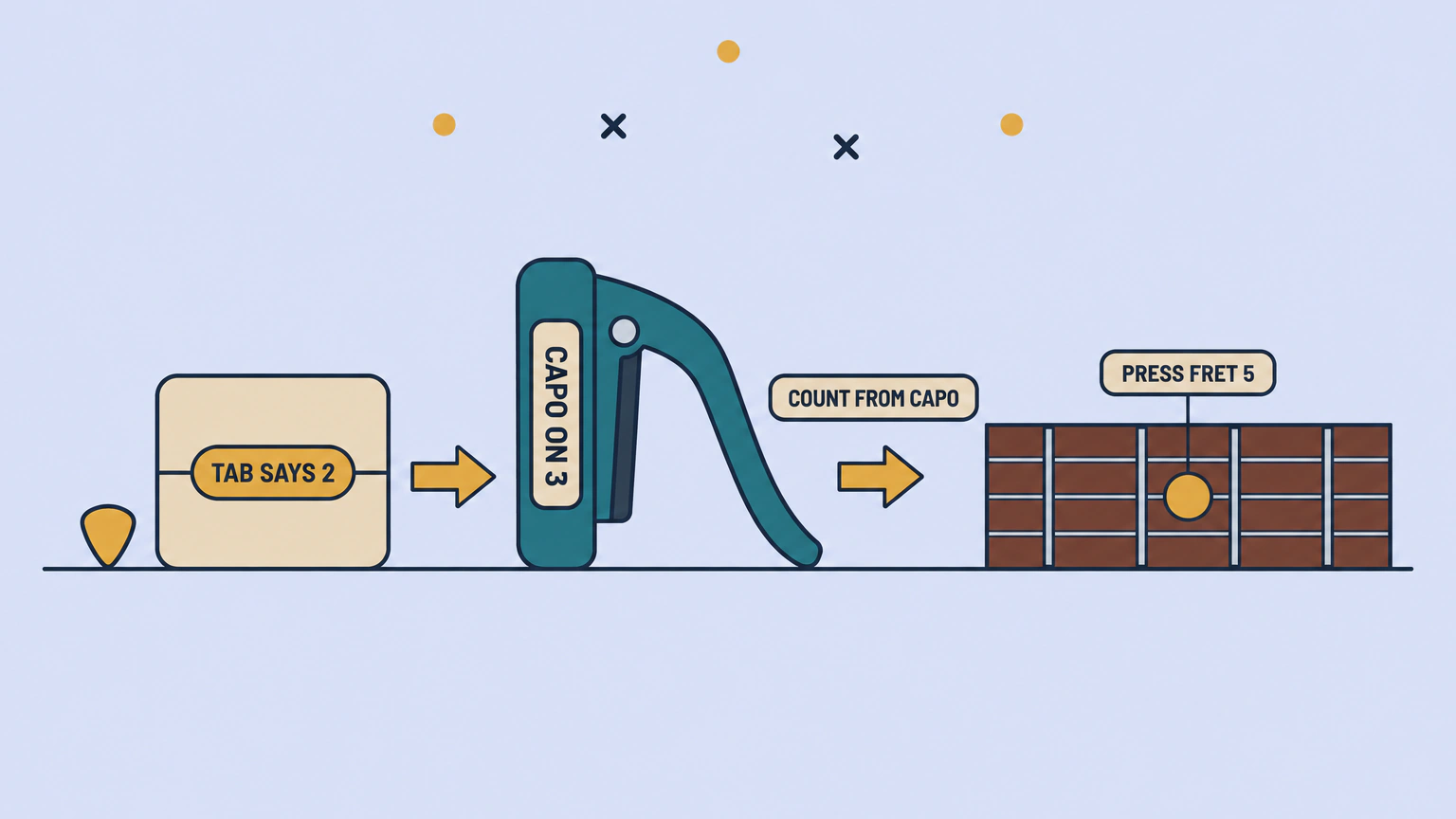
One rule decides how to read guitar tabs with a capo: the numbers normally count from the capo, not from the end of the neck. Wikipedia's tablature article puts it flatly: with a capo, "the numbers always indicate the number of frets from the capo, and not from the nut." Say the capo sits on fret 3 and the tab shows a 2. You press the 2nd fret above the capo, which is fret 5 counted from the nut. A 0 means the string rings open above the capo. You don't need a finger there, because the capo is holding fret 3 for you.
Real tabs aren't always that tidy. On Ultimate Guitar, one writer notes "numbers relative to capo," while another warns, "It is not relative to the capo, so these are the actual frets played with capo 3." Same site, opposite habits. A third tab shows "no capo" in the site's summary box while the writer's own notes put the capo on the first fret. So read the writer's notes, not just the summary line.
The writer's notes and legend
Many tabs carry a short legend near the top or bottom, listing the symbols the writer uses and what they mean. Read it before you reach for any general chart, ours included, because the writer's own key wins. The same bracket can mean a ghost note to one writer and an optional or tied note to another. The notes also tend to say which part of the song you're looking at, whether the numbers count from the capo, the tempo, and where to let notes ring.
Before you play the first note
Five things to check at the top of any tab before you play a note:
- The tuning line. If it isn't standard (E A D G B E, thickest string to thinnest), retune first, then read every number as written.
- The capo line. If there is one, clamp the capo on that fret before you read anything else.
- How the numbers count. Look for a note saying the numbers are "relative to the capo" or are real fret numbers. Most tabs count from the capo.
- The legend. Check what this writer's brackets, letters and slashes mean, because they aren't the same everywhere.
- The recording. Put the song on, because the tab shows you where to play and the recording shows you when.
If a number still doesn't make sense, put it in here with your tab's tuning and capo lines, and you'll see where to press and what note you'll hear.
Where does this number go?
Pick the line, type the number, and copy the tuning and capo lines from the top of your tab.
Count the lines from the top. Many tabs also print the string letters at the left end of each line.
Type exactly what the tab shows. A 0 means the string is played open.
Tunings are written from the thickest string to the thinnest. If your tab names a different tuning, retune to it first. The numbers still mean frets.
This assumes the capo covers all six strings.
Press fret 2 above the capo.
That's fret 5 counted from the nut, on the 5th string.
It sounds as D.
What the letters and symbols in a tab mean
Past the numbers, tabs use letters and marks for the moves that make a riff sound like itself: hammer-ons, bends, slides and mutes. Plain-text tabs online write these guitar tab symbols as letters and slashes, while printed books use curved lines and arrows for the same moves. Each move gets both forms side by side, plus what your hands do.
Tab symbols in text and in print
| In a text tab | In a printed tab or book | What you do |
|---|---|---|
| h, as in 5h7 | A curved line from a lower note up to a higher one, often marked H | Pick the first note, then hammer a finger onto the second fret without picking again |
| p, as in 7p5 | A curved line from a higher note down to a lower one, often marked P | Pick the higher note, then pull that finger off so the lower fretted note sounds |
| b, as in 7b9 | An arrow curving upward, marked full or 1/2 | Push the string sideways until the note rises: full is two frets' worth, 1/2 is one |
| r | An arrow curving back down after a bend | Let the bent string ease back to the note you started on |
| / and \ | A diagonal line between two numbers | Keep the finger pressed and slide up (/) or down (\) to the next number |
| ~ or v | A wavy line over the note | Wobble the string slightly up and down while the note rings (vibrato) |
| x | An x in place of a fret number | Rest a finger lightly on the string without pressing, then pick it for a muted click |
| PM or P.M. | P.M. over the tab, with a dotted line | Rest the side of your picking hand on the strings by the bridge until the dotted line ends |
| (5) | A fret number in round brackets | Depends on the writer: a ghost note, an optional note or a tied note, so check the legend |
| * with a fret number | A diamond shape before the fret number | Touch the string lightly right over the fret wire without pressing, then pick: a natural harmonic |
| let ring | let ring, with a dashed line | Keep holding and let the notes sound until the dashed line ends |
Why a number in brackets needs a second look
Brackets are the one symbol nobody agrees on. Songsterr uses round brackets for a ghost note, one that's "felt but not heard." Guitar Tricks says brackets "usually mean that the note is optional, should be played very lightly, or represents a ghost note." One real tab on Ultimate Guitar lists "( ) - Ghost Note/Tied Note/Implied Note" in its legend, which is three meanings in one line. And Wikipedia's symbol list uses a number in brackets after a fret number for something else again, a tapped harmonic.
So check the legend first. Then listen to the recording at that spot. If the note is barely there, play it lightly or leave it out. Barely there is the whole idea of a ghost note.
What tab won't tell you: rhythm and fingers
Plain tab tells you where to play, not when. Songsterr says it bluntly: tabs "do not have information on the rhythm or lengths of the notes," only on where to play them. Fender is gentler, saying tabs "don't provide a ton of direction on rhythm." Either way, the timing has to come from somewhere else, and there are three good places to get it.
- Put the recording on and read along. Your ears supply the timing, and they also catch the wrong number someone typed before you've practised it for a week.
- Use a tab format that shows rhythm. Some add rhythm stems under the numbers, and some books set the tab under standard notation. A few writers also add counts such as "1 e and a" over a tricky bar.
- Learn to read rhythm on its own. It's a much smaller job than learning full notation, and it carries over to every tab you'll ever open.
Fingering is the other gap. Tab never says which finger goes where, so a teacher, or a fingering note under the tab, has to fill it in.
One habit pays off over the long run: learn the note names on the neck alongside tab. Then "9th fret on the 3rd string" stops being a coordinate and becomes a note you know. It's an E, by the way.
How to tell whether a tab is any good
Fender warns that free tabs "aren't always reliable," and the reason is who writes them. Ultimate Guitar is open about it: "All non-official tabs are submitted by users from all over the world," and each one is "reviewed by the tab's moderators before it becomes publicly available." It calls them "generally accurate, with the most popular versions often being the best."
That gives you a method. Open the highest-rated or most-used version first. Play along with the recording, and trust your ears when a number clashes with what you hear. If a passage sounds wrong, compare it with a second version of the same song. And treat a tab with no tuning or capo line, on a song you know uses one, as a warning sign. Paid, professionally made versions exist too, if you'd rather not do the checking yourself.
Tab or sheet music: what Canadian guitar exams expect
Lots of guitarists never sit an exam, and tab serves them fine. For a learner or a child heading toward graded exams or a high school credit, the picture changes.
The Royal Conservatory's Classical Guitar Syllabus, the 2018 edition and still the current one, builds sight reading in from the very first level, Preparatory. Candidates tap a short rhythm, then play "a two-measure, single-line melody that moves by step" in C major or A minor. The syllabus never mentions tab.
Conservatory Canada's Contemporary Idioms Guitar track is the rock, pop and jazz option, and it's no different on this point. At every level from 1 to 8, candidates must perform at sight "A rhythmic exercise," "A melodic passage" and "A chord chart." Its level documents don't mention tab either. Conservatory Canada says these exams carry "the same accreditation for high school credits with various provincial ministries of education as our Classical exams."
Knowing how to read guitar tabs gets you playing, and notation is what the examiner puts in front of you. If a credit is part of the plan, our guide to which RCM levels earn a high school credit covers the levels that count and what the exams cost.
When a guitar teacher is worth booking
Tab and a recording will teach you a lot of songs. We mean that. A teacher earns the fee on everything tab leaves out: rhythm, fingering, hand position, reading notation for an exam, and catching the mistake you've practised for three weeks without hearing it.
Parents, if your child is aiming at RCM or Conservatory Canada exams, the lessons have to cover reading, so ask about it before you book. You can compare guitar teachers near you, or start with our pages on guitar lessons in Toronto and Vancouver. And if money's tight, our guide to programs that help pay for a child's lessons shows which funds cover music and which don't.
Then pick one tab you actually want to play. Read its header, set your tuning and capo, put the recording on, and start.
Guitar tab questions people ask
Are guitar tabs upside down?
The common layout only feels upside down: it puts the thinnest string on the top line and the thickest on the bottom. Some tabs reverse that order, so check the string letters at the left edge. A lowercase e at the top means the thin string is on top.
Do guitar tabs show the rhythm or the strumming pattern?
Plain-text tabs don't. They show where to play, not when or for how long, a gap Songsterr and Fender both point out. Some formats add rhythm stems under the numbers, and some books put the tab under standard notation. Otherwise the recording is your rhythm guide, so play along with it until the timing sits right.
What does an x mean in a guitar tab?
An x is a muted or dead note. Rest a finger lightly on the string without pressing it down to the fret, then pick it. You'll get a short percussive click instead of a pitch. A column of x's across several strings means a muted strum, which Guitar Tricks notes you'll see a lot in funk.
What does a number in brackets mean in a guitar tab?
It depends on who wrote it. Usually it's a ghost note, played so softly it's more felt than heard. Some writers use brackets for an optional note or a tied note instead. Check the tab's legend first, then listen to that spot in the recording. If the note's barely there, play it lightly.
How do you read a tab that says capo 3?
Clamp the capo on fret 3, then count every number from the capo. A 0 is the string played open above the capo, and a 2 is the 2nd fret above it, which is fret 5 counted from the nut. The exception is a tab whose notes say it uses real fret numbers. Then a 5 simply means fret 5.
Should I learn tabs or sheet music first?
If you want to play songs soon, start with tab. If you're aiming at RCM or Conservatory Canada exams, a school band or classical guitar, you'll need standard notation too. RCM tests sight reading from Preparatory through Level 10, and Conservatory Canada does it at Levels 1 to 8. Many players learn both, tab first.
Is learning guitar from tabs cheating?
No. Tab is a perfectly normal way to write guitar music. Fender teaches it, and printed transcriptions sometimes give it alongside standard notation. Its real limits are rhythm and fingering, so pair it with the recording, and with a teacher if you're stuck. Nobody's checking how you learned the song, only how it sounds.