

On this page
- Can you learn to draw if you think you can't?
- What to practise first, in order
- How much should you practise?
- Teaching yourself or taking a class
- What a beginner drawing course costs, from Vancouver to Montreal
- How to pick a drawing class
- If it's your child who wants to draw
- Questions people ask about learning to draw
Can you learn to draw if you think you can't?
Yes. The evidence is better than a pep talk.
In 1997 two researchers, Cohen and Bennett, ran four studies on where adults' drawing errors come from. Their results pointed at the eye and away from the hand: misperceiving the object was "the major source of drawing errors", and motor coordination was "a very minimal source". Put plainly, you can learn to draw without talent. In a small, non-randomized study published in the journal NeuroImage in 2015, students taking introductory drawing or painting improved at drawing from observation. As the authors put it, the art students "improved in their ability to sketch human figures from observation".
Plenty of Canadian schools plan for the beginner who feels hopeless. The Toronto District School Board's adult program, TDSB Learn4Life, calls one course "Drawing For People Who Can't Draw". Calgary runs "Drawing for the intimidated". Montreal's Visual Arts Centre offers Elementary Steps in Drawing to help "even the most timid beginner", and the listing at the Vernon Community Arts Centre opens with "Think you can't draw? Think again!"
Learning to draw as an adult isn't a late start either. The courses we priced set a minimum age (15 in Regina, 18 at TDSB, 19 at Vancouver's Trout Lake Community Centre) and no maximum. TDSB even has a lower rate from 65.
What to practise first, in order
Most advice on how to learn to draw hands you a pile of exercises. An order helps more. Betty Edwards wrote Drawing on the Right Side of the Brain, and her workshops break drawing what you see into five skills: edges, spaces, relationships (perspective and proportion), lights and shadows, and the whole. The fifth, her workshop site says, "emerges spontaneously from the first four". We've kept her order and added gesture at the end, because it keeps a beginner's drawing loose.
Start with edges: draw real things, slowly
Pick something real: a shoe, a houseplant, the mug you're drinking from. (Finish the tea first.) Draw its edges slowly, with your eyes on the object more than on the page. This is contour drawing, and it feels odd at first, because your pencil crawls while your eye does the work.
Two exercises push it further. Ethan Hein, in a short post on learning to draw, says to "try drawing without looking at the page." Edwards' version is the upside-down drawing. Turn a picture upside down and copy it. You can't easily name the parts any more, so you draw the lines you actually see.
We'd draw from life at this stage and leave photos for later, because a real object shows you its edges from where you sit. Keep the paper cheap, too. Hein's advice is a big newsprint pad, so you can draw a lot "without being worried about wasting expensive paper".
Then measure: check proportions with your pencil
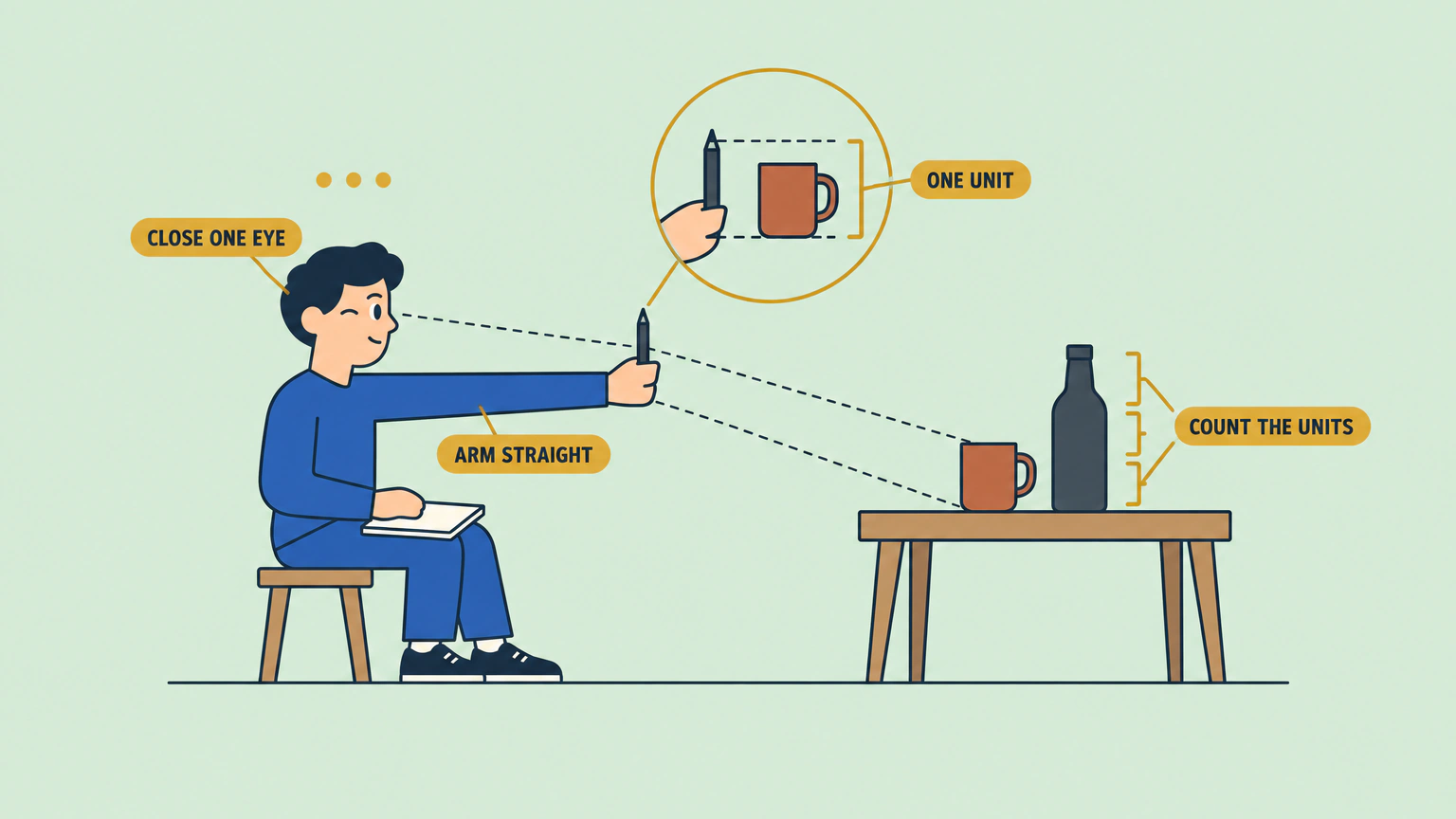
When one thing is too big or too small beside another, the whole drawing looks wrong. The fix is called sighting, and Proko's measuring lesson and The Virtual Instructor teach it the same way.
- Hold your arm straight out and lock the elbow. Bend it and the measurement changes.
- Close one eye.
- Line the pencil tip up with the top of one object, then slide your thumb down to its bottom. That length is your unit.
- Move the unit along and count how many fit into something else. Proko's example is to "count how many head lengths fit in the height of the pose". At your table, count how many mugs tall the bottle is.
Then check the gaps. Edwards' second skill is drawing "negative spaces", the shapes between and around objects. The hole inside a mug's handle is a shape too. Draw that hole and a wrong handle is easier to spot. Langara College's Drawing Fundamentals course in Vancouver also teaches "correct measurement techniques".
Light and shade come next
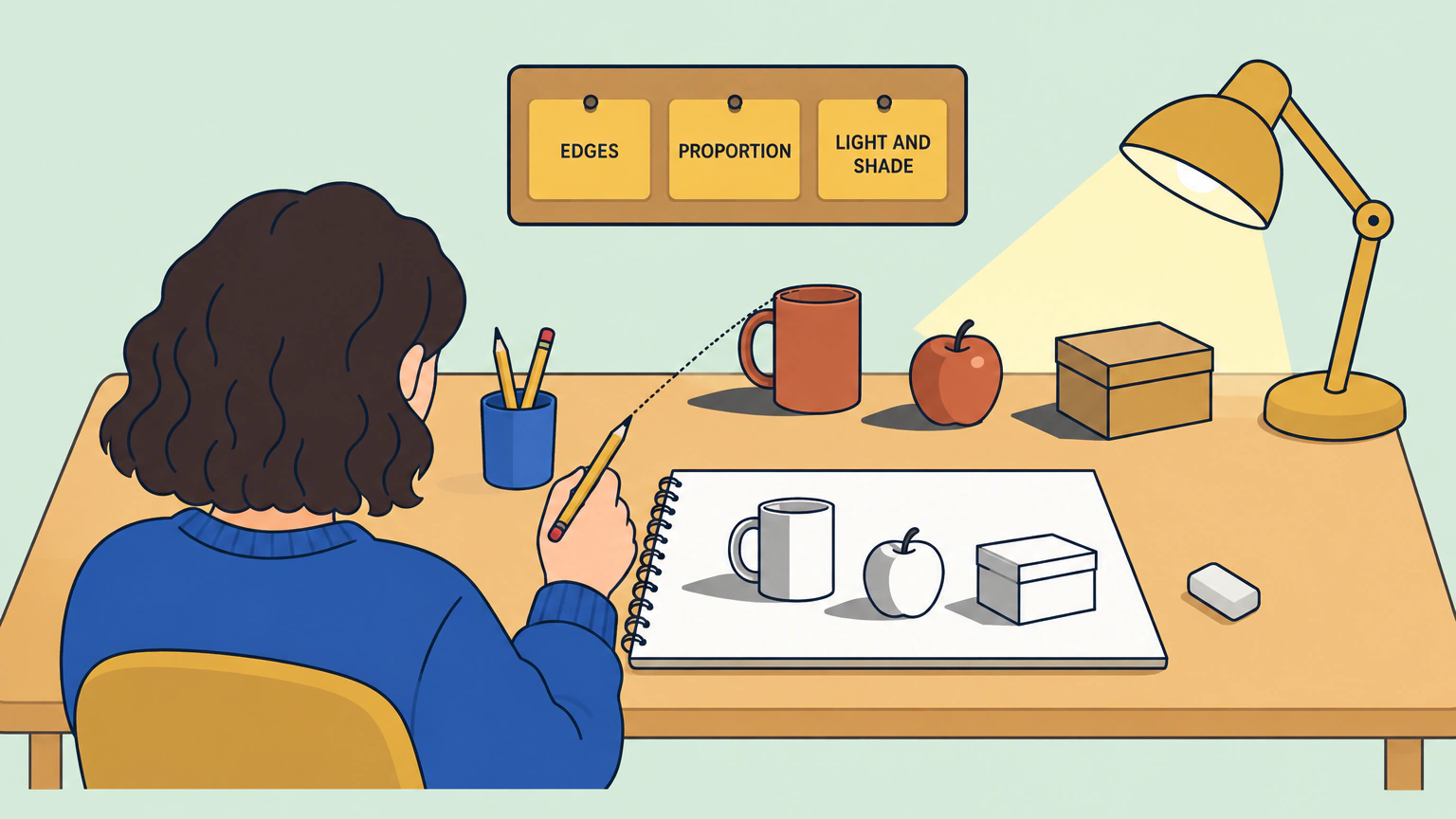
Set one object near a lamp so the light hits it from one side. Then squint. Hein again: "Squint your eyes at the scene until all you can see are big blobs of light and dark. Draw those."
What you're drawing now is value, which means how light or dark an area is, whatever its colour. Squinting hides the detail and leaves the big shapes. Put the dark ones in the right places, and a flat outline starts to read as a solid mug with a lit side and a shadow side.
Of the ten entry-level course descriptions we read, eight mention light and shade, tone or value, more than any other skill. It's also the skill a well-known free drawing course leaves out, and that matters if you plan to teach yourself.
Loosen up with gesture and quick poses
Slow, careful drawing can make you stiff. Gesture drawing is the counterweight: fast sketches that go after the overall movement of a pose or a scene and ignore the details. Hein's rule is blunt: "Give yourself thirty seconds to do an entire scene." With no time to fuss, you look for the whole thing at once.
Course listings rarely mention it. Only one of the ten we read names gesture. That's the Toronto School of Art's Introduction to Drawing, where students learn to "capture gestures using line".
A drop-in is the cheap way to add it. The same school's Open Life Drawing has short-pose sessions with a model and no teacher, at $20 a visit.
How much should you practise?
Little and often. We couldn't find a study that sets a daily amount, and one beginner guide we read says to "aim for an hour a day" without giving a source.
The firmest rule we found comes from Drawabox, a free online course, and it's about balance: "All of the time you spend on drawing is to be divided into two equal portions. At most, half of your time spent drawing can be used for studying." Studying includes the course's own homework. The other half is drawing for its own sake, with whatever tools you like.
Our advice is plainer. A little drawing on most days beats one long session a week. Date every page, too. In month three, put a new drawing beside one from month one, and you'll see a change your memory would have hidden.
A class supplies the routine for you. The courses we priced meet once or twice a week, for between an hour and a half and three hours each time.
Teaching yourself or taking a class
You can go a long way without paying anyone. Drawabox's lessons are free, and so is feedback from other students. What it sells is official critique, paid for with credits you get by subscribing through Patreon. The course builds three "core fundamentals": "MARK MAKING", "OBSERVATION" and "SPATIAL REASONING". It's just as plain about what it leaves out: "we do not touch upon any lighting, rendering, or shading in this course."
Set that beside what Canadian classrooms say they cover.
What ten Canadian entry-level drawing courses say they teach
| What the course says it teaches | How many of the 10 descriptions name it | Try it at home |
|---|---|---|
| Light and shade (tone, value or shading) | 8 | Light a mug from one side, squint until only the big dark shapes show, and draw those |
| Line and contour | 6 | Draw the edges of a shoe or a houseplant slowly, eyes on the object more than the page |
| Perspective | 6 | Draw a box, a chair or the corner of the room from where you sit |
| Seeing, or drawing from observation | 5 | Draw what's on the table in front of you, not from memory |
| Composition | 5 | Decide where the object sits on the page before the first line |
| Proportion and measuring | 3 | Measure with your pencil at arm's length |
| Gesture | 1 | Short poses at a drop-in life drawing session |
Light and shade tops the classroom list and is missing from the free course, so it's the skill a self-taught beginner has to add. The lamp-and-squint exercise is the place to start.
Whether drawing classes are worth it goes back to those 1997 studies. If your errors come from misjudging what you see, you're the person least able to catch them. A teacher walking past your easel can.
Our verdict: take one beginner course early, then keep going with a free course and a drop-in.
What a beginner drawing course costs, from Vancouver to Montreal
If you've wondered how much art classes for adults cost, here's the spread for beginner drawing. Per hour of teaching, we found about $7 at Regina's city arts centre, $11 to $16 at Montreal's Visual Arts Centre, Trout Lake Community Centre, TDSB Learn4Life and the Vernon Community Arts Centre, and about $20 at the Toronto School of Art. Whole courses run from $90 to $413. These are fall 2026 listings we priced in four provinces, a snapshot and not a national average.
Beginner drawing courses we priced, fall 2026
| Course | Who runs it, and where | Schedule, fall 2026 | Price | Per hour of teaching | Materials |
|---|---|---|---|---|---|
| Sketching the Basics (15 and up) | City of Regina, Neil Balkwill Civic Arts Centre | 8 Fridays, 1 to 3:30 p.m., Sept. 18 to Nov. 6 | $135 | $6.75 | Supply list on your receipt, unless the fee includes them |
| Drawing I (no prerequisite) | Visual Arts Centre, Westmount, Montreal | 12 Mondays, 10 a.m. to 1 p.m., Sept. 14 to Dec. 7 | $400 | $11.11 | Not listed; ask |
| The Joy of Drawing & Sketching (19 and up) | Trout Lake Community Centre, Vancouver | 5 Tuesdays, 6:30 to 8 p.m., Sept. 15 to Oct. 13 | $90 | $12.00 | The listing says supplies are provided at the first class |
| Drawing For People Who Can't Draw (18 and up) | TDSB Learn4Life, Leaside High School, Toronto | 11 Mondays, 6:30 to 9 p.m., from Sept. 14 | $413, or $330 at 65 and up, HST included | $15.02 | Not listed; ask |
| Drawing for the Adult Beginner | Vernon Community Arts Centre, Vernon, B.C. | 8 classes on Wednesdays and Thursdays, 1:30 to 4 p.m., Sept. 30 to Oct. 22 | $325, or $292.50 for members | $16.25 | Tools and all materials included |
| Introduction to Drawing | Toronto School of Art, Toronto | 6 Saturdays, 2 to 5 p.m., Oct. 31 to Dec. 5 | $367 | $20.39 | Your instructor's materials list |
| Open Life Drawing, a drop-in with a model and no teacher | Toronto School of Art, Toronto | Sundays 10 a.m. to 1 p.m. and 1:30 p.m., Mondays 6 to 9 p.m. | $20 a session, or 5 sessions for $100 | $6.67 | Bring paper and materials; easels and stools provided |
Per hour of teaching is the price divided by the total class time in each published schedule. The Regina listing gives only a date range, so we counted every Friday in it. The last row has no teacher. Its per-hour figure is for the three-hour sessions.
The fee is only part of the bill. Vernon's price covers materials, Regina sends a supply list with your receipt, and two of the listings don't say either way. Regina's list for Sketching the Basics is short: four drawing pencils, two erasers, fine black pens and a sketchbook at least 11 by 14 inches. A live model can mean an extra fee. TDSB's prices include HST. The others don't mention tax, so ask.
Discounts pull the other way. TDSB takes 20% off at 65 and up, and eligible learners pay a subsidized rate that's 80% lower. Vancouver's Leisure Access Program gives residents who qualify 50% off many community centre programs, and Vernon has a members' rate.
One option is free. Regina's Painting and Drawing Drop In runs on Friday mornings with no fee and no registration, and you bring your own materials.
Seven listings can't cover every city. For more, our own pages list teachers and studios, starting with drawing classes in Toronto, Vancouver and Montreal.
How to pick a drawing class
The listing tells you most of what you need, if you know where to look. Read the refund rules as closely as the price. Where they allow it, your first class works as a partial trial: you go once, watch how the teacher works the room, and get some of your money back if the fit is wrong. At TDSB that refund is pro-rated, less a $15 fee.
Eight things to know before you pay for a beginner drawing course:
- The listing says beginner or "no prerequisite". Calgary's adult class spells it out: "Prerequisite: None".
- You'll draw real things in class, a still life or a model, not only copy the teacher's step-by-step demo.
- You know what materials will cost. Some fees include them (Vernon's does), some send a list with your receipt (Regina), and some expect you to bring your own.
- Any model fee is already in the price you were quoted. TDSB's beginner figure drawing course builds in $60 for the model.
- You've worked out the price per hour of teaching: the fee divided by the number of classes times the hours in each.
- You know when the refund window closes. After the first class, TDSB Learn4Life still gives a pro-rated refund until the second class starts, and Trout Lake a partial one until 24 hours after the second class. The Visual Arts Centre promises a full refund only before the session begins.
- You've asked about discounts: 20% off at 65 and up and an 80% subsidized rate for eligible learners at TDSB Learn4Life, a members' price at Vernon, and, for Vancouver residents who qualify, 50% off many community centre programs through the Leisure Access Program.
- You've asked how many people are in the class and whether the teacher comes round to each easel.
When winter registration opens
Winter terms are booked in early December, going by the two sets of dates we found. In Toronto, you can browse the city's recreation programs from November 17, registration is expected between December 1 and 9, and classes start the week of January 4, 2027. In Vancouver, Trout Lake Community Centre opens winter registration on Thursday, December 3 at 7 p.m., in person and online.
Popular sections fill. At the Toronto School of Art this fall, the Thursday section of Introduction to Drawing and the Saturday Drawing 1 & 2 course were both full, and Regina's Sketching the Basics had a wait list.
So shortlist two or three courses in November, and register the day booking opens. You can start with drawing and painting classes near you.
If it's your child who wants to draw
City programs take children from about six. Calgary's kids' drawing and cartooning classes are for ages 6 to 12, and the city's page says "All supplies are provided". Calgary also runs a drawing and painting class that a parent and child take together. In Regina, Drawing Everything in the World! is for ages 6 to 9 and costs $82 for the fall session, with a sketchbook required. Trout Lake's Comics & Cartooning is for ages 7 to 12, at $90 for six sessions, and kids bring a pencil and an eraser.
The same order of practice works for children, in shorter doses: edges, measuring, light and shade, then fast sketches.
Two things can lower the bill. Find out whether your province pays back part of a child's arts fees, and look for help paying for a child's classes.
Questions people ask about learning to draw
Short answers to what people ask when they look up how to learn to draw as a beginner.
How long does it take to learn to draw?
There's no set number of months, and anyone who gives you one is guessing. What you can measure is a first course. The beginner courses we priced give you between 7.5 and 36 hours of teaching, and a small study in the journal NeuroImage found that students taking drawing and painting classes got better at sketching figures from observation. Date your pages, then compare week one with the last week of your course.
How much should I practise drawing each day?
There's no proven daily number, so choose an amount you'll keep up. The free online course Drawabox sets a rule about the split, not the minutes: at most half your drawing time goes to exercises, and the rest is drawing for its own sake. Our view is that a little on most days beats one long Sunday session, because the habit is the hard part.
Should I learn to draw on paper or on a tablet?
Start on paper. It's cheap, and the beginner courses we read teach in pencil, charcoal, ink and Conté crayon. Drawabox keeps its exercises to traditional tools as well, though it encourages students to draw digitally in the half of their time that isn't exercises. Move to a tablet when learning the software is part of what you want.
Can you learn to draw by tracing or copying?
Copying by eye, yes. Langara College's Drawing Fundamentals course includes "the age old practice and discipline of copying drawings from the old masters". Tracing is another matter. It skips the skill itself, judging sizes and angles by eye, and that's where most drawing errors start. Trace to study a line, and don't count it as practice.
Are drawing classes worth the money?
For one term early on, usually yes. A teacher catches what you misjudge, and that's the thing you can't see for yourself. The beginner courses we priced cost $90 to $413. If that's too much, a free drop-in like Regina's Friday mornings or a $20 life drawing session gives you a room and a routine, though no teaching.
What should I draw first as a beginner?
Two or three plain objects on a table, lit from one side: a mug, an apple, a box. That's where beginner courses start. Montreal's Visual Arts Centre lists still life for Drawing I, Langara teaches measuring by drawing "still life and the figure", and Regina's Creative Sketchbook Drawing includes still life too. Faces and hands can wait. Tonight, set a mug by a lamp. Then look up the winter drawing courses near you.