
What do I need to charge per lesson?
Two prices in CAD from your own numbers - break-even and target. Free, no sign-up, no market averages, nothing leaves your browser.
Your prices
Your week holds 4 whole 45-minute slots on each of the 5 days set here, so 20 sellable slots a week. With 13 of them booked and 38 teaching weeks, the year holds 494 lessons.
Break-even price: your yearly business costs divided by the lessons you get paid for, plus what one lesson costs you to deliver, then solved for any percentage that comes off the price itself.
Target price: the same sum with your take-home target added on top before the division.
Hourly equivalent: the lesson price times 60, divided by the lesson minutes.
Effective hourly rate: a year of teaching income divided by every hour you commit - taught, prep, travel, messaging and stranded slots.
Turn JavaScript on and all four are worked out from your own numbers as you type, with no market average anywhere.
Nothing you type is sent anywhere. The shareable link puts your numbers in the address bar of your own browser, and the email opens in your own mail app.
Copy the link and the whole model comes back exactly as you left it.
Where a year of your hours goes
Your effective hourly rate divides a year of teaching income by all of these, before costs.
Package comparison
Teaching you have been paid for and still owe
That is arithmetic, not a policy. What you owe back depends on what you agreed and on your province.
What if the year goes worse than that
Same cost inputs, same target, a thinner year. This is what your price would have to be.
GST/HST
You are not charging GST/HST, so what you set is what a client pays.
Whether a lesson is taxable depends on the supply, including what you teach and who supplies it. The Excise Tax Act exempts tutoring in "a course that is approved for credit by, or that follows a curriculum designated by, a school authority" and certain recreational programs supplied by public sector bodies.
A package sold before you register and taught after it is genuinely awkward, and this page does not model it. Ask your accountant.
https://distinguishedteaching.ca/tools/lesson-rate-calculator/
How your two prices are worked out
Both prices come out of one division, and the interesting part is what goes underneath the line.
Start with the week. You told us which days you teach and how long you teach on them. A lesson plus its changeover is one slot, and a day only counts the whole slots that fit inside it. A leftover twenty minutes on Monday isn't half a slot, and it doesn't join up with a leftover twenty on Tuesday. Add the days together and that's your sellable slots per week. Say how many are booked and your fill rate falls out of it. You never had to guess a percentage.
Then the year. Your teaching weeks, plus a reduced-load summer if you run one. Multiply by your booked slots and you have the lessons the year holds. Take off the share you book but never get to teach, and what's left is what you actually get paid for.
Now the costs. Your yearly business costs sit on top of the year. The costs that belong to one lesson sit on top of each lesson: a room, materials, the card fee. A percentage cut, like a platform commission, comes off the price itself, so it has to be solved for rather than subtracted.
Break-even is the price where a year of lessons covers those costs and nothing else. Your target price is the same sum with your take-home added on top. Both are rounded up to the next cent, because a price rounded down misses the target it was solved for.
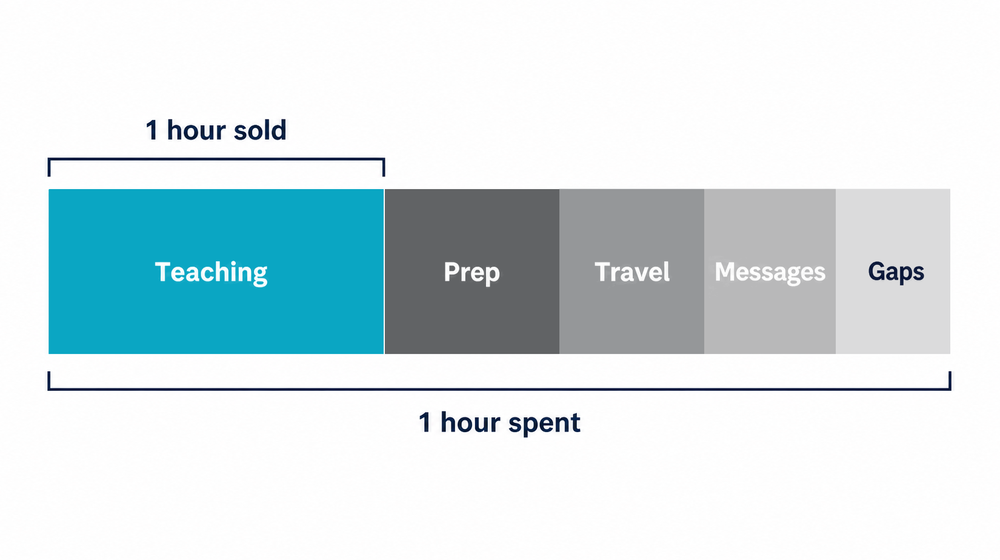
The last number is the uncomfortable one. Your effective hourly rate divides a year of teaching income by every hour you committed to it: the taught hours, the prep, the driving, the messages, and the stranded slots between two bookings that you can't sell and can't spend anywhere else. It's gross, before costs. It's usually a lot lower than the number on your price list, and the size of that gap is worth knowing before you set your next price.
No market average went into any of it. The calculator has no rate table behind it, and we won't be adding one. Every figure it gives you is arithmetic on numbers you typed.
Questions instructors ask about lesson rates
How much should I charge for a lesson?
Enough to cover your costs and leave you the income you're aiming for, across the lessons you can realistically sell. That's what the calculator above works out. The honest answer is that it depends far more on how many slots you fill and how many weeks you teach than on your instrument or your subject. Two teachers with the same price can take home very different amounts.
Why doesn't this show me the average rate in my area?
Because we'd have to make it up. A believable local average needs a real sample, a date and a method, and nobody publishing one for Canadian lesson rates shows you all three. A stale invented number would anchor you to something you can't defend to a parent. Your own costs and your own week are both things you can defend.
Do I charge GST or HST on lessons in Canada?
It depends on the supply, including what you teach and who supplies it. The Excise Tax Act exempts qualifying curriculum-based tutoring and certain recreational programs supplied by public sector bodies. Private hobby lessons are not exempt under Part VI section 12 merely because they involve music or recreation. If you must register and the lesson is a taxable supply, you generally charge GST/HST. Ask an accountant about your facts and the applicable place-of-supply rule.
When do I have to register for GST/HST?
For most businesses making taxable supplies in Canada, registration becomes mandatory once worldwide taxable supplies from all businesses and associates exceed $30,000 before expenses. Zero-rated supplies count; exempt supplies do not. Financial services, sales of capital property and goodwill on the sale of a business are excluded. CRA tests the amount over the previous four (or fewer) consecutive calendar quarters and inside any single quarter. Cross it in one quarter and you charge tax on the supply that took you over. Cross it under the previous-quarter test and you stop being a small supplier at the end of the following month. Registration follows within 29 days of your effective registration date. Different small-supplier tests apply to public service bodies, charities and public institutions.
Is it better to charge per lesson or sell a package?
A package is worth it when it fills slots that were empty. It costs you when it discounts lessons you'd have sold anyway. That's a straight price cut with nothing bought in return. The calculator asks you which one it is, because the answer flips the whole verdict. Open the package block and give it your real discount.
What does 10% off ten lessons actually cost me?
More than 10%, whenever the lesson carries a fixed cost of its own. Your room rental, your materials and a fixed card fee don't shrink when the price does, so they eat a bigger share of what's left. A swim instructor paying $18 a lesson for pool time turns a 15% discount into a 23% cut in what the lesson leaves behind. If you entered no fixed per-lesson cost, the two cuts are the same.
How do I raise my rates for students I already teach?
Set the new price first, then work out what the old one is still costing you. If you've sold prepaid packages and remain obliged to deliver them, each undelivered lesson is teaching owed at the package's old price - the calculator puts hours and dollars on that. Put the new rate and its effective date in writing. We don't write the letter here.
Should online lessons cost less than in-person?
Only if they cost you less to deliver. Online drops your driving and may reduce stranded gaps too. Set your travel minutes and trips to zero, keep everything else, and see what happens to your effective hourly rate. That difference is the honest size of the discount you can afford.
Setting a lesson rate in Canada without copying anyone else's
The tempting place to start is what everybody else charges, and it's the wrong one. You can't verify that number or control it, and it arrives with a stranger's costs and a stranger's fill rate baked in.
The denominator is the better place to start. The hours you can sell are the times clients actually book, and they may be much fewer than all the hours you are free. Your price divides into that sellable window, not into your working week.
The year comes next. Take out your actual breaks, holidays and summer closure. Divide an annual target by the weeks you genuinely teach, not by a default 52. Plug in 52 and the price you need comes out too low.
After that come the hours nobody pays for: prep and marking, the messages, the rescheduling, the invoices, and the drive between two students' houses, which eats the prime window itself. And there's the stranded slot, the 5 p.m. between a booked 4 and a booked 6, which you can neither sell nor spend. Add them all up, and the hour you advertise and the hour you actually give turn out to be two different things.
Then the tax question, which in Canada isn't one question. Exemption depends on statutory conditions including the course, curriculum, supplier and program. For most businesses, registration depends on whether worldwide taxable supplies before expenses from all businesses and associates exceed the $30,000 small-supplier threshold in a single quarter or over the previous four (or fewer) consecutive calendar quarters. Zero-rated supplies count; exempt supplies do not. Different small-supplier tests apply to public service bodies, charities and public institutions. The rate follows place-of-supply rules. The calculator starts with CRA's current table: 13% in Ontario, 15% in New Brunswick, Newfoundland and Labrador and Prince Edward Island, 14% in Nova Scotia, and 5% GST elsewhere, with QST, RST or PST shown separately.
Last, the package. It's granted in one line of a text message and it applies to the scarcest thing you own, so check it against capacity before you say yes. Work out how many extra lessons a week it would take to end the year where you started, then look at how many free slots you actually have. If the first number is bigger than the second, the discount comes out of your income, because your capacity can't cover it.
Terms used on this page
- Lesson length
- the taught minutes a client pays for.
- Changeover
- the minutes between two lessons that you cannot sell.
- Slot
- a lesson plus its changeover. The unit your capacity is measured in.
- Prime window
- the hours your clients actually book.
- Sellable slots a week
- how many whole slots your teaching days hold.
- Booked slots
- the ones sold this week.
- Fill rate
- booked slots divided by sellable slots. Derived, never guessed.
- Free slots
- what is left. The only place extra lessons can come from.
- Teaching weeks
- weeks you actually teach, after breaks and the summer.
- Unpaid load
- prep, travel, messaging and stranded slots.
- Committed hours
- taught hours plus the unpaid load. The honest denominator.
- Gross teaching revenue
- money in from lessons, before tax and before costs.
- Direct per-lesson cost
- room, materials, card fee, commission. What one lesson costs you to deliver.
- Contribution per lesson
- the price less its direct costs. What the lesson leaves behind.
- Break-even lesson price
- the price where a year covers costs and nothing else.
- Target lesson price
- the price that also delivers your take-home target.
- Effective hourly rate
- gross teaching revenue divided by committed hours.
- Discount recovery
- the extra lessons a week that would hold your year steady after a discount.
- Outstanding teaching liability
- prepaid lessons you still owe, in hours and dollars.
- Unwind amount
- what a client paid, less the lessons they took at your single-lesson price.
More for instructors on Distinguished Teaching
-
Your own listing
The fastest way to earn more here is a fuller prime window, not a bigger discount. We list Canadian instructors free, send the leads free, take no referral fee, and the client pays you directly.
-
Your category, and our consumer-side cost estimates
Our piano category page currently shows a national average estimate of $338 and a range of $274 to $384, based on 853 cost profiles. That's a consumer-side estimate, not what an instructor nets. It's context, not your rate.
Piano instructors on Distinguished Teaching, Math tutors, Swim instructors, Personal trainers, or All 26 categories.
Not pricing anything tonight, just reading? We also publish Canadian learning guides.
The calculator works out your numbers, not your tax position, and we're not accountants: whether your lessons are taxable has a real answer, and it depends on conditions written into the tax law. Take these figures to your own accountant before you register for anything.